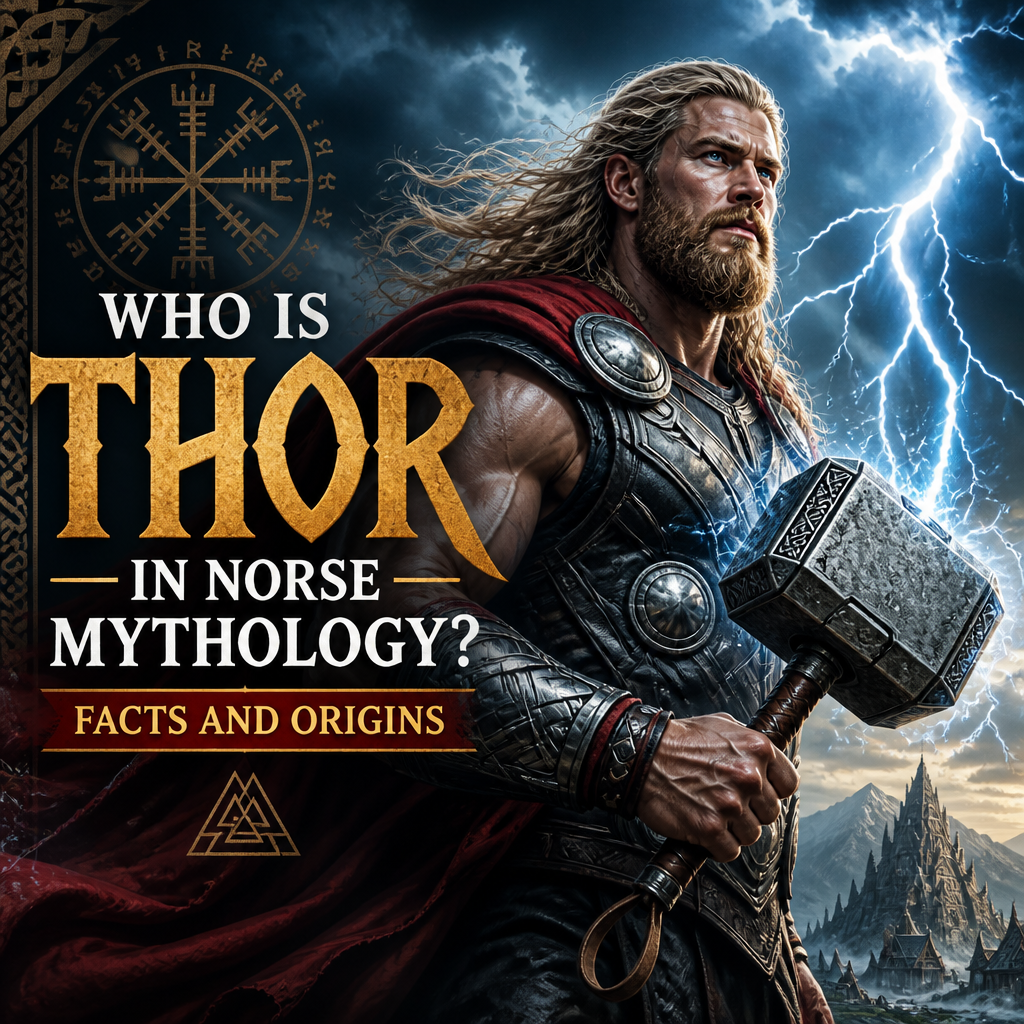
Who Is Thor in Norse Mythology?
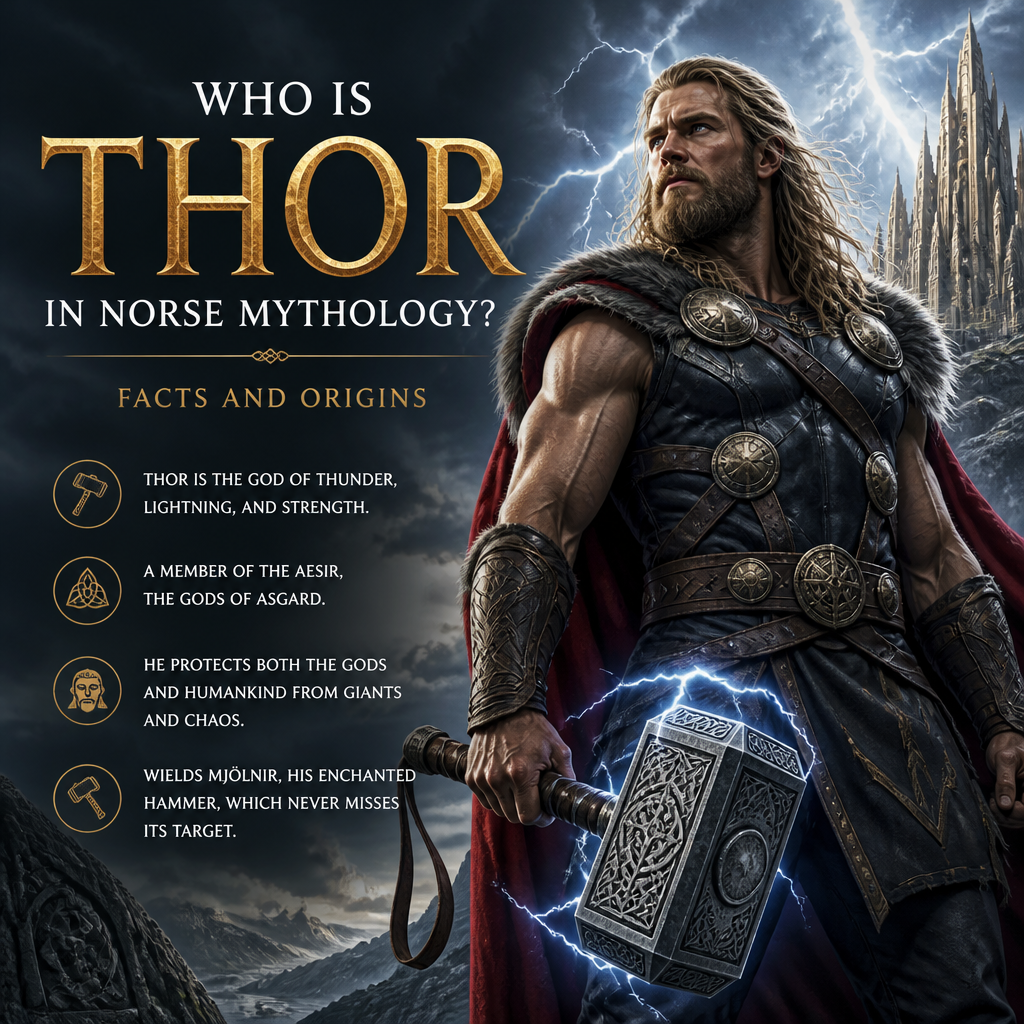
Thor is one of the most famous gods in Norse mythology, known for his immense strength, fiery temper, and legendary hammer, Mjölnir. He is the god of thunder, storms, protection, strength, and fertility. While modern audiences often recognize Thor from comics and films, his roots go back more than a thousand years to the myths, poems, and sagas of the Viking Age.
In Norse belief, Thor was not a distant or mysterious deity. He was a powerful protector of gods and humans alike, a defender against giants, chaos, and destructive forces. To the people of ancient Scandinavia, Thor represented reliability, courage, and the raw power of nature.
Thor’s Place Among the Norse Gods
Thor belongs to the Æsir, one of the main families of Norse gods. The Æsir include major figures such as Odin, Frigg, Tyr, Baldr, and Heimdall. Thor is the son of Odin, the chief of the gods, and Jörð, a personification of the Earth.
Unlike Odin, who is associated with wisdom, magic, poetry, and war, Thor is more direct and physical. He solves problems with strength, boldness, and action. This contrast makes him one of the most approachable and human-like gods in the Norse pantheon.
Thor lives in a great hall called Bilskirnir, located in the realm of Þrúðheimr, meaning “home of strength.” He is married to the golden-haired goddess Sif, who is associated with fertility and the harvest. Thor also has children, including Þrúðr, Magni, and Móði.
Thor as the God of Thunder
Thor’s connection to thunder is central to his identity. In Norse mythology, the rumbling of thunder was often imagined as the sound of Thor riding across the sky in his chariot. This chariot is pulled by two magical goats named Tanngrisnir and Tanngnjóstr.
Lightning and storms were signs of Thor’s presence. As a weather god, he was deeply important to farming communities. Rain could bring fertility to the land, while storms showed nature’s dangerous power. Thor stood at the center of both ideas: he was fierce and frightening, but also protective and life-giving.
Mjölnir: Thor’s Mighty Hammer
No symbol is more closely linked to Thor than Mjölnir, his enchanted hammer. This weapon was forged by dwarves and is one of the most powerful objects in Norse mythology. Mjölnir could crush mountains, defeat giants, and return to Thor’s hand after being thrown.
The hammer was not only a weapon. It was also a sacred symbol used for blessing and protection. In myths, Mjölnir is used to bless marriages, births, and funerals. Archaeological finds show that many Viking Age people wore small hammer pendants, likely as protective charms and signs of devotion to Thor.
Mjölnir represents several important ideas:
- Protection against danger
- Strength in battle
- Fertility and blessing
- Order against chaos
- Thor’s role as defender of the world
Thor and the Giants
Many of Thor’s most famous myths involve his battles with giants, known in Old Norse as jötnar. These beings are not always simply “evil,” but they often represent wild, chaotic, and destructive forces outside the ordered world of gods and humans.
Thor frequently journeys into Jötunheimr, the land of the giants, where he tests his strength and courage. His constant struggle against the giants shows his role as a guardian. He protects Asgard, the realm of the gods, and Midgard, the world of humans.
One famous story tells of Thor’s visit to the giant king Útgarða-Loki, where he is tricked into competing in impossible challenges. In another myth, the giant Þrymr steals Mjölnir and demands the goddess Freyja as his bride in exchange for its return. Thor disguises himself as Freyja, attends the wedding feast, retrieves his hammer, and defeats the giants.
These stories often mix humor, danger, and heroic action, showing Thor as both mighty and entertaining.
Thor’s Personality
Thor is brave, loyal, and strong, but he is not usually described as subtle. He can be quick to anger and impatient with trickery. While Odin often seeks knowledge through sacrifice and cleverness, Thor relies on action and force.
Still, Thor is not portrayed as foolish. He understands duty and takes his role seriously. His great strength is matched by his commitment to protecting others. This made him especially beloved among ordinary people, including farmers, warriors, and seafarers.
Thor’s personality can be summed up through a few key traits:
- Courageous in the face of danger
- Protective of gods and humans
- Fiercely opposed to chaos
- Honest and straightforward
- Sometimes hot-tempered
- Deeply connected to the natural world
Thor and the World Serpent
One of Thor’s greatest enemies is Jörmungandr, the World Serpent. According to Norse mythology, Jörmungandr is so enormous that it encircles the entire world beneath the sea, biting its own tail.
Thor encounters the serpent in several myths. In one famous tale, he goes fishing with the giant Hymir and manages to hook Jörmungandr using an ox head as bait. Thor nearly kills the serpent, but Hymir cuts the fishing line in fear.
Their final battle is foretold to happen during Ragnarök, the great doom of the gods. Thor will kill Jörmungandr, but after taking nine steps, he will fall dead from the serpent’s venom. This tragic ending shows that even the strongest god cannot escape fate.
Thor’s Role in Viking Age Belief
Thor was one of the most widely worshipped gods in the Viking Age. Place names across Scandinavia preserve his memory, and hammer amulets have been found in many archaeological sites. His popularity may have come from his practical importance: he protected homes, fields, families, and communities.
For people living in a harsh northern environment, a god of storms, strength, and protection had deep meaning. Thor was a divine defender who stood between human society and the dangers beyond it.
Why Thor Still Matters Today
Thor remains a powerful figure because he combines mythic grandeur with relatable qualities. He is a god of thunder and cosmic battles, but he is also emotional, direct, and loyal. His stories include adventure, humor, bravery, and sacrifice.
So, who is Thor in Norse mythology? He is the thunder god, the wielder of Mjölnir, the protector of Midgard, and one of the strongest champions of the Norse gods. More than that, he is a symbol of courage, resilience, and the enduring fight to protect order from chaos.

Orin Vale has spent the better part of two decades tracing the threads that connect the world’s oldest stories — from the halls of Asgard to the banks of the Nile, from Olympus to the jungles of the Maya. What began as a childhood fascination with flood myths and trickster gods grew into years of independent study across comparative mythology and ancient religion, always chasing the same question: what did these stories mean to the people who first told them? Orin writes for readers who want more than trivia — the ones looking for the beliefs, fears, and truths that myths were built to carry.