Norse symbols are among the most recognizable visual language to survive from the pre-Christian religion of Scandinavia. Carved into runestones, stamped onto pendants, and woven through the sagas and Eddic poems, these Norse symbols carried meaning far beyond decoration: they marked protection, power, death, fate, and devotion to specific gods. This guide brings together the most searched Norse symbols — from Thor’s hammer to Odin’s spear, from runic alphabets to the disputed Web of Wyrd — and explains what each one meant, where it comes from, and, just as importantly, whether it belongs to the Viking Age or to a much later tradition dressed up as ancient. Understanding Norse symbols requires separating verified Viking Age archaeology from post-medieval Icelandic magic and from modern reinvention, and this guide draws that line clearly for every entry.
Symbols of Power and Protection in Norse Mythology
Some Norse symbols existed to shield the wearer — from enemies in battle, from hostile spirits in the wilderness, or from misfortune in daily life. These protective Norse symbols are among the most commonly worn today, and each carries a distinct origin story.
What Does Mjolnir Symbolize in Norse Mythology?
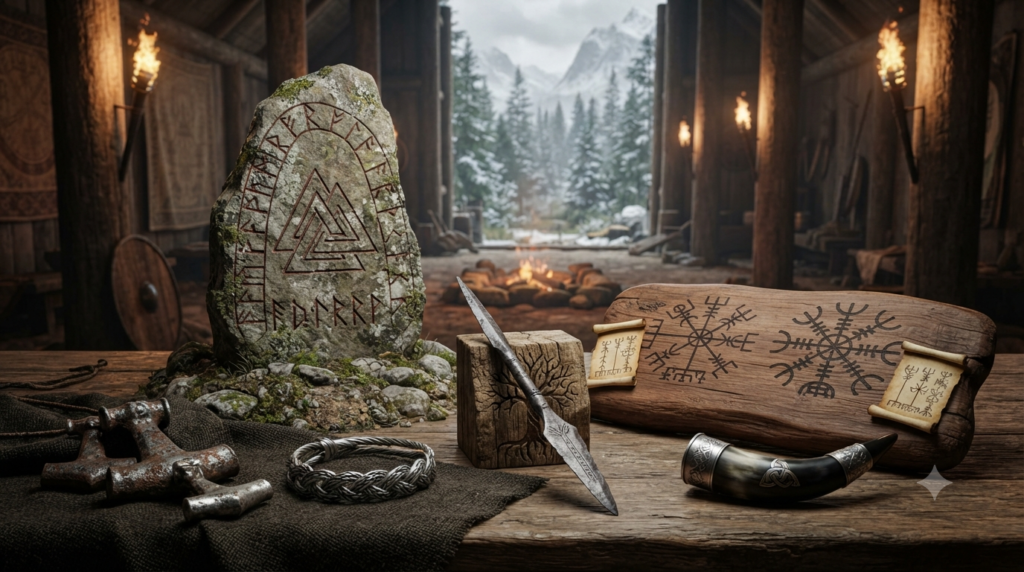
Mjolnir is the hammer of Thor, forged by the dwarven brothers Sindri and Brokkr in a wager against Loki that nearly cost the trickster his head. Of all Norse symbols, Mjolnir is the most directly tied to divine protection: Thor used the hammer to defend Asgard from giants, and by extension it became a symbol of strength, consecration, and the warding-off of chaos. Mjolnir pendants were worn as jewelry throughout the Viking Age, with confirmed archaeological finds across Scandinavia, the British Isles, and Iceland dating from the 8th to the 11th century, some inscribed with runic dedications. Historians have also noted that Mjolnir pendants grew especially common during the conversion period, worn as a deliberate counter-symbol to the Christian cross. Beyond protection, the hammer was ritually used to bless weddings, births, and funerals, linking it to consecration as much as to combat. Among Norse symbols, Mjolnir remains the single most widely recognized and most archaeologically confirmed.
What Is the Aegishjalmur, or Helm of Awe, in Norse Mythology?
The Aegishjalmur, or Helm of Awe, is an eight-armed Norse symbol resembling a spiked wheel, each arm ending in a trident-like point radiating outward from a central axis. It appears in the Poetic Edda poem Fáfnismál, where the dragon Fafnir claims to have worn it “between his eyes” to strike terror into all who approached and to dominate lesser creatures. Unlike Mjolnir, the Helm of Awe is not confirmed in Viking Age archaeology in its familiar graphic form; its visual design comes from later Icelandic magical manuscripts known as galdrabækur (grimoires), especially the 17th-century Galdrabók, which drew on older oral and mythological material. In practice, the Aegishjalmur was invoked for protection, for instilling fearlessness before conflict, and for warding off harm — a purpose consistent with its saga origins even though its exact stave-form is a later Icelandic magical tradition rather than a Viking-era artifact.
What Is the Troll Cross in Norse Mythology?
The Troll Cross, or trollkors, is a small iron ring pendant, often shaped with a knot or loop, traditionally worn to ward off trolls and the malevolent spirits believed to lurk in the forests of Scandinavia. Unlike Mjolnir or the Valknut, the Troll Cross belongs less to the formal mythology of the Aesir and Vanir gods and more to Scandinavian folk belief — a layer of tradition that predates, coexists with, and outlasted Old Norse religion proper. Rural communities, particularly in Sweden, associated the symbol with safeguarding livestock and travelers from trolls said to roam the wilderness. Its modern popularity owes much to 20th-century Swedish folklore-revival jewelry, which brought a symbol rooted in agrarian superstition into the same visual family as more explicitly religious Norse symbols.
Symbols of Death, Fate, and the Unseen
Death and fate sit at the center of Norse cosmology, governed not by a single god but by forces — the Norns, the battlefield, the hall of Valhalla — that even Odin cannot fully control. The Norse symbols in this group reflect that preoccupation.
What Is the Valknut in Norse Mythology?
The Valknut, meaning “knot of the slain,” consists of three interlocking triangles and appears on genuine Viking Age memorial stones, most notably the Stora Hammars I image stone on Gotland, alongside depictions of Odin’s ravens and his eight-legged horse Sleipnir. Its consistent placement near warriors, funeral imagery, and figures associated with Odin has led scholars to connect the Valknut with the god’s role as ruler of the slain in Valhalla. The exact meaning remains debated: some interpret it as representing Odin’s power to bind and unbind — paralyzing enemies in battle or releasing warriors into death — while others read it as a symbol of the passage between the world of the living and the realm of the dead. Among Norse symbols directly tied to death and the afterlife, the Valknut has the strongest archaeological grounding.
What Is the Web of Wyrd Symbol in Norse Mythology?
The Web of Wyrd is usually shown as a grid of nine intersecting lines and is popularly described as representing the threads of fate spun by the Norns — Urd, Verdandi, and Skuld — who tend the well beneath Yggdrasil. The underlying concept is authentically Norse: the Old Norse word urðr, related to the Old English wyrd, describes a fate that has already become fixed, and the Norns are well attested in the Poetic Edda and the Prose Edda. However, the specific grid-shaped Web of Wyrd symbol itself has no confirmed presence in Viking Age archaeology or medieval Icelandic manuscripts. Its geometric form is a modern visual invention, loosely inspired by rune-stave aesthetics and by genuine Norse ideas about fate, rather than a design that Vikings themselves ever carved or wore. It is worth treating this distinction carefully: the mythology behind the Web of Wyrd is real, but the symbol commonly sold under that name today is not ancient.
What Is the Svefnthorn in Norse Mythology?
The Svefnthorn, or “sleep thorn,” is mentioned in several Icelandic sagas — including Sögubrot af Fornkonungum and Gongu-Hrolfs saga — as a magical charm capable of plunging its target into an unnaturally deep, prolonged sleep. In the sagas, the Svefnthorn functions more as an act or an object of magic than as a fixed graphic symbol; no single canonical visual design survives from the medieval sources themselves. The stave-like images now sold and tattooed as “the Svefnthorn” are later interpretations, part of the same Icelandic galdrastafir (magical stave) tradition that produced the Helm of Awe, dating from the 17th century onward rather than from the Viking Age.
Odin’s Sacred Treasures and Divine Symbols
Several Norse symbols are tied not to a general concept but to a specific object owned by a specific god — most often Odin, whose treasures encode his roles as war-leader, ruler, and seeker of wisdom.
What Is Gungnir, Odin’s Spear, in Norse Mythology?
Gungnir is Odin’s spear, forged by the dwarven sons of Ivaldi and said to never miss whatever it is thrown at. Beyond its role as a weapon, Gungnir carries deep ritual significance: Norse sources describe a practice of casting a spear over an opposing army before battle as a symbolic dedication of that fight to Odin, consecrating the fallen to him regardless of outcome. This custom is echoed in the Eddic poem Völuspá, where Odin casts a spear to spark the war between the Aesir and the Vanir. As a Norse symbol, Gungnir represents unerring authority, the sacrifice inherent in warfare, and Odin’s sovereignty over both victory and death on the battlefield.
What Is Draupnir, Odin’s Ring, in Norse Mythology?
Draupnir, meaning “the dripper,” is a golden arm-ring forged by the same dwarven brothers who made Mjolnir, gifted to Odin with the property of producing eight new rings of equal weight and value every ninth night. As a Norse symbol, Draupnir represents abundance, wealth, and self-renewing prosperity — but its story carries a somber turn. Draupnir was placed on the funeral pyre of Odin’s son Baldr and later carried back from the realm of Hel by the messenger god Hermod, tying this symbol of multiplying gold to themes of grief, loss, and the thin boundary between the living and the dead. Few Norse symbols combine wealth and mourning as directly as Draupnir does.
What Is the Triple Horn of Odin in Norse Mythology?
The Triple Horn of Odin depicts three interlocking drinking horns and references the myth of the mead of poetry — held in three vessels named Óðrœrir, Boðn, and Són — which Odin stole from the giant Suttungr after seducing the giant’s daughter Gunnlod and spending three nights with her underground. Having swallowed the mead and escaped in the form of an eagle, Odin granted the gift of poetic and creative inspiration to the gods and to worthy humans. As a Norse symbol, the Triple Horn represents artistic inspiration, hospitality, and the pursuit of wisdom through cunning rather than force — themes distinct from the martial symbolism of Mjolnir or Gungnir. It remains especially popular today among practitioners of modern heathenry and Ásatrú as an emblem of the ritual sharing of mead.
Cosmic Symbols: Runes, the World Tree, and Wayfinding
The final group of Norse symbols reaches beyond individual gods or objects toward the structure of the cosmos itself — writing, the tree that holds the Nine Worlds together, and the search for direction in a hostile world.
What Is the Elder Futhark in Norse Mythology?
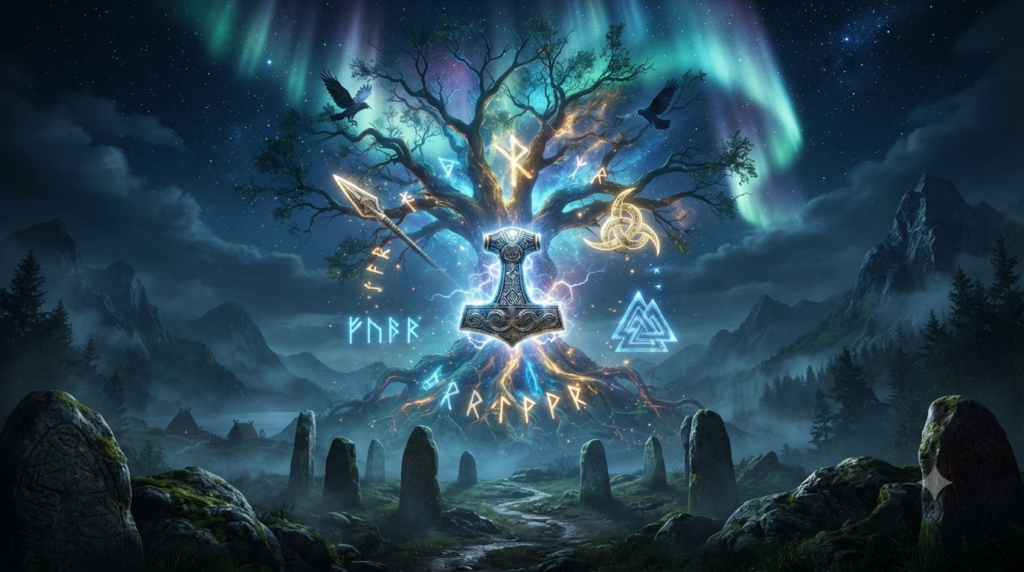
The Elder Futhark is the oldest runic alphabet used by Germanic peoples, consisting of 24 characters in use from roughly the 2nd to the 8th century CE, predating the Younger Futhark that Vikings themselves used during the Viking Age proper. Mythologically, the runes are tied to one of the most striking episodes in Norse literature: Odin’s self-sacrifice, described in the Hávamál, in which he hangs from Yggdrasil for nine nights, pierced by his own spear and given to himself, in order to gain the wisdom of the runes. Runes functioned as more than an alphabet — each carried symbolic and magical associations, used for divination, for inscriptions on weapons and memorial stones, and for protective charms. Of all Norse symbols, runes are the most directly linked to knowledge obtained through sacrifice.
What Does Yggdrasil Symbolize in Norse Mythology?
Yggdrasil, the immense world tree — most often described as an ash, though some sources suggest a yew — symbolizes the axis that connects and sustains the Nine Worlds of Norse cosmology, including Asgard, Midgard, and Hel. Its roots reach down to three wells, one of them tended by the Norns who shape fate. Yggdrasil is also home to a cast of creatures locked in perpetual tension: an eagle perched at its crown, the serpent Nidhogg gnawing at its roots below, and the squirrel Ratatoskr running the length of the trunk to carry insults between them. As a Norse symbol, Yggdrasil represents the interconnectedness of fate across all beings and worlds, along with the cycle of destruction and renewal that culminates in Ragnarok.
What Is the Vegvisir Symbol in Norse Mythology?
The Vegvisir, meaning “wayfinder” or “sign post,” is an eight-spoked Norse symbol said to help the bearer find their way through storms, fog, and unfamiliar terrain. Like the Helm of Awe and the Svefnthorn, the Vegvisir is not attested in Viking Age sources; it is first recorded in the 19th-century Icelandic manuscript Huld, compiled in 1860, placing it firmly within the same post-medieval galdrastafir grimoire tradition rather than among genuine Viking-era artifacts. That later origin does not diminish its cultural resonance — the Vegvisir has become a widely worn symbol of guidance and protection during travel, especially popular within modern heathen practice and tattoo culture, precisely because its meaning of “not losing one’s way” translates so directly across centuries.
Viking Age Symbols vs. Modern Norse Symbols
Not every Norse symbol in circulation today comes from the same historical layer, and the difference matters for anyone using these symbols with an interest in accuracy rather than aesthetics alone. Three distinct layers make up what people now call “Norse symbols.”
The first layer is genuinely Viking Age: symbols confirmed through runestones, grave goods, pendants, and contemporary Eddic material composed or transmitted during the 8th to 11th centuries. Mjolnir, the Valknut, Gungnir, Draupnir, the Triple Horn of Odin, the Elder Futhark, and Yggdrasil all belong here, each supported by either physical archaeology or mythological sources close to the Viking Age itself.
The second layer comes from post-medieval Icelandic magic. The Aegishjalmur, the Svefnthorn, and the Vegvisir trace back to 17th- to 19th-century Icelandic galdrabækur — magical manuscripts compiled centuries after the conversion to Christianity, drawing on older folklore and saga references but expressed through symbol-forms that did not exist during the Viking Age itself.
The third layer is folk tradition adjacent to formal mythology, represented here by the Troll Cross, rooted in Scandinavian rural belief about trolls and forest spirits rather than in the Aesir-Vanir pantheon directly.
A fourth category deserves honest mention: modern invention with no historical basis at all, most clearly represented by the Web of Wyrd, whose grid design has no confirmed source earlier than contemporary neopagan and commercial jewelry design, despite drawing on authentically Norse ideas about fate. None of these later layers make a Norse symbol meaningless — Icelandic galdrastafir, Scandinavian folk charms, and even modern reinterpretations are their own real traditions — but presenting a 19th-century Icelandic grimoire stave or a 21st-century invention as something a Viking Age warrior carved onto a rune-stone is simply inaccurate.
Frequently Asked Questions About Norse Symbols
Which Is the Most Important Norse Symbol?
Mjolnir holds that position by most measures: it has the strongest archaeological record of any Norse symbol, appearing in confirmed Viking Age pendants across Scandinavia and beyond, and it carries the broadest range of meaning, from protection and strength to consecration in weddings, births, and funerals.
Are Norse Symbols Real, or Are Some of Them Modern Inventions?
Both are true, depending on the specific symbol. Norse symbols such as Mjolnir, the Valknut, Gungnir, Draupnir, and the runes of the Elder Futhark are confirmed through Viking Age archaeology or contemporary literary sources. Others, including the Vegvisir, the Aegishjalmur, and the Svefnthorn, come from Icelandic magical manuscripts written centuries after the Viking Age. A smaller number, like the Web of Wyrd, are modern designs with no confirmed historical precedent at all.
Can Anyone Wear Norse Symbols Today?
There is no restriction rooted in the mythology itself; Norse symbols were historically worn broadly for protection, identity, and devotion rather than reserved for a closed group. In contemporary contexts, some Norse symbols have been misappropriated by extremist movements, which is why many practitioners of modern heathenry emphasize context and intent when displaying them.
What Is the Difference Between a Rune and a Norse Symbol?
Runes are letters of a specific writing system, the Elder or Younger Futhark, each with a name, a sound value, and an associated symbolic meaning. A Norse symbol, by contrast, is typically a standalone image — such as Mjolnir or the Valknut — that is not part of an alphabet. Runes can appear within Norse symbols, such as inscriptions carved onto Mjolnir pendants, but the two categories are distinct.
Do Norse Symbols Have Real Protective Powers?
Within Norse mythology and belief, protective Norse symbols such as Mjolnir, the Aegishjalmur, and the Troll Cross were understood to offer genuine spiritual protection to those who wore or invoked them. This guide presents that belief as it was historically held, without asserting a factual claim about supernatural power.
Which Norse Symbols Are Directly Associated with Odin?
Gungnir, Draupnir, and the Triple Horn of Odin are the clearest examples, each tied to a specific myth involving the god. The Valknut is also strongly associated with Odin through its consistent appearance near imagery of his ravens and his horse Sleipnir on Viking Age memorial stones, and the Elder Futhark connects to Odin through his self-sacrifice on Yggdrasil to obtain the runes.
Were Norse Symbols Actually Used by Real Vikings, or Are They a Hollywood Invention?
Several Norse symbols were genuinely used by real Vikings, evidenced by archaeological finds of pendants, carvings, and inscriptions from the 8th to 11th centuries — Mjolnir and the Valknut are the strongest examples. Others popularly labeled “Viking symbols” in film and television, such as the Vegvisir and the Aegishjalmur, come from Icelandic manuscripts written centuries after the Viking Age ended, meaning they represent later Norse-derived magical tradition rather than something a Viking Age warrior would have recognized.
How Were Norse Symbols Traditionally Made?
Viking Age Norse symbols such as Mjolnir pendants were typically cast in metal — silver, bronze, or iron — worn as jewelry, or carved into wood, bone, and stone, including runestones and memorial markers. The later galdrastafir symbols, including the Vegvisir and the Aegishjalmur, were originally recorded as ink drawings in Icelandic manuscripts before becoming the metal pendants and tattoos common today.

Orin Vale has spent the better part of two decades tracing the threads that connect the world’s oldest stories — from the halls of Asgard to the banks of the Nile, from Olympus to the jungles of the Maya. What began as a childhood fascination with flood myths and trickster gods grew into years of independent study across comparative mythology and ancient religion, always chasing the same question: what did these stories mean to the people who first told them? Orin writes for readers who want more than trivia — the ones looking for the beliefs, fears, and truths that myths were built to carry.