Who Is Mafdet in Egyptian Mythology?
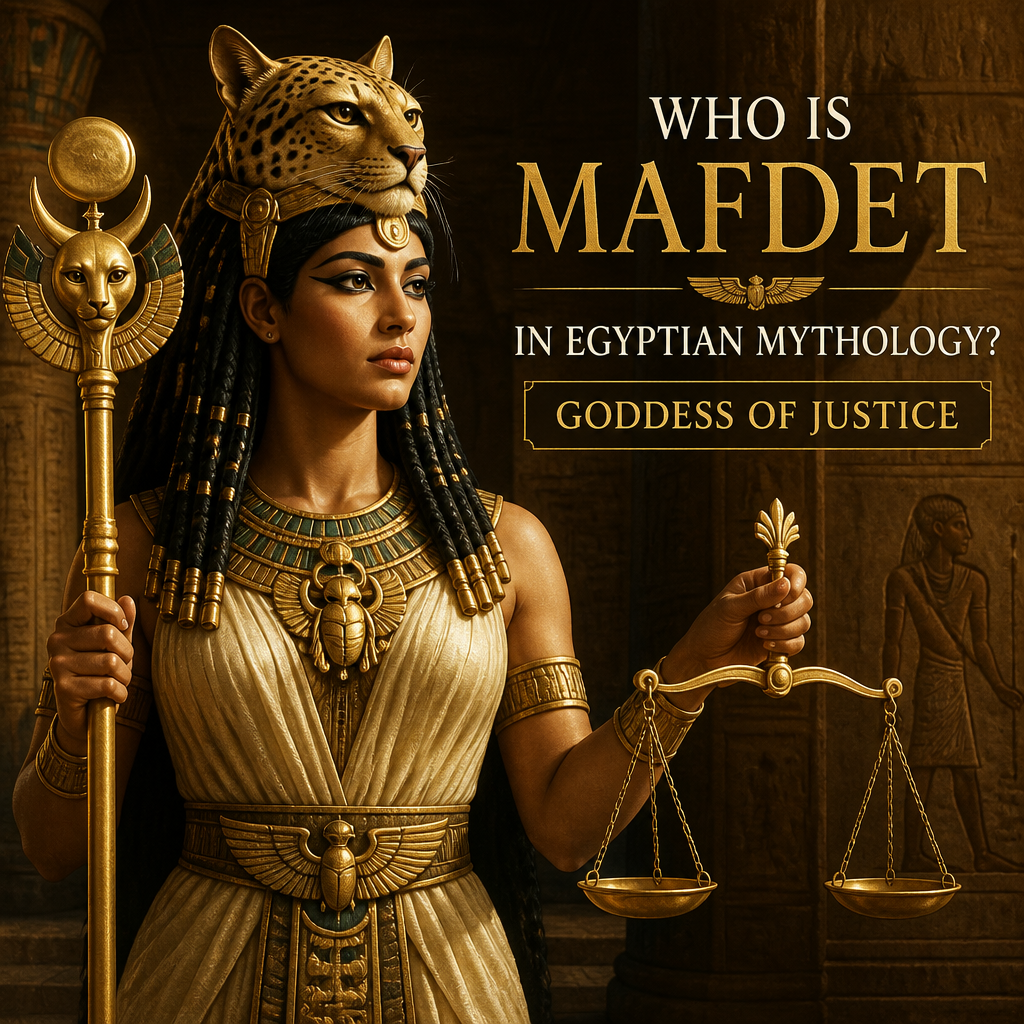
Mafdet is one of the oldest known protective goddesses in ancient Egyptian religion. Often associated with justice, execution, and protection from dangerous creatures, she appears in early Egyptian texts as a fierce divine guardian who defended the sun god Ra and the pharaoh from threats. While she is not as famous today as Isis, Bastet, or Sekhmet, Mafdet held an important place in Egyptian mythology, especially during the earliest periods of Egyptian history.
Her image is usually connected with fast, predatory animals such as wild cats, mongooses, or civets. Because these animals were known for killing snakes and scorpions, Mafdet became a natural symbol of protection against venomous creatures and hidden dangers.
Mafdet’s Origins in Ancient Egypt
Mafdet is attested as early as the First Dynasty and appears in the Pyramid Texts, some of the oldest religious writings in the world. These texts were carved into the walls of royal tombs during the Old Kingdom and describe spells, prayers, and divine beings connected with the king’s afterlife.
In these early sources, Mafdet is portrayed as a powerful and active goddess. She is not merely a passive protector; she hunts, strikes, and punishes enemies. Her role was especially important in a world where snakes and scorpions posed real dangers. For ancient Egyptians, divine protection from such threats was both practical and spiritual.
Mafdet’s early prominence suggests that she was once a major protective deity before later goddesses, such as Bastet and Sekhmet, became more widely worshipped.
What Was Mafdet the Goddess Of?
Mafdet was primarily a goddess of:
- Protection
- Justice
- Execution
- Venomous animals
- Royal authority
- Swift punishment
Her protective nature was closely tied to her ability to destroy dangerous beings. In Egyptian mythology, snakes, scorpions, and other venomous creatures often symbolized chaos and evil. Mafdet’s role was to eliminate these threats before they could harm the gods, the king, or the dead.
She was also linked to legal punishment. Mafdet represented swift justice against wrongdoers, especially those who opposed divine order, known as ma’at. In this sense, she was not only a guardian but also an enforcer of cosmic balance.
Mafdet’s Appearance and Symbols
Mafdet’s exact animal form is debated by scholars. Ancient Egyptian art and texts describe her as a feline or mongoose-like creature, but her identity is not always clear. She may have been based on one of several animals known for killing snakes.
Common Depictions of Mafdet
Mafdet could be shown as:
- A wild cat or feline predator
- A mongoose or civet-like animal
- A woman with the head of a predatory animal
- An animal running up the side of an executioner’s staff
- A creature associated with blades or claws
One of her most important symbols was the executioner’s instrument, sometimes interpreted as a pole or staff with a curved blade. This symbol reflects her role as a goddess of punishment and divine justice.
Her claws were also significant. In some texts, Mafdet is described as tearing out the hearts of enemies, emphasizing her terrifying power against evil forces.
Mafdet and Protection from Snakes
One of Mafdet’s most important roles was protecting against snakes, especially those seen as enemies of the sun god. In Egyptian belief, the sun’s daily journey across the sky and through the underworld was threatened by chaotic forces, often represented by serpents.
Mafdet defended Ra from these dangers. Her speed and predatory skill made her an ideal divine protector. Just as a mongoose or wild cat might kill a snake in real life, Mafdet destroyed serpent enemies in the mythological realm.
This connection made her especially meaningful in both royal and funerary contexts. The pharaoh needed protection in life, and the deceased king needed protection in the afterlife. Mafdet served both purposes.
Mafdet in the Pyramid Texts
The Pyramid Texts are among the most important sources for understanding Mafdet. In these inscriptions, she appears as a fierce defender of the deceased king. She is invoked to strike down hostile beings and protect the king on his journey into the afterlife.
These texts describe Mafdet as a goddess who acts quickly and violently against enemies. Her presence shows that the ancient Egyptians imagined the afterlife as a place where protection was necessary. Even a divine king needed powerful guardians to overcome chaos and danger.
Mafdet’s role in the Pyramid Texts also reveals her deep connection to kingship. She was not only a household protector or local deity; she was part of the sacred system that supported royal power.
Mafdet, Bastet, and Sekhmet
Mafdet is sometimes compared with Bastet and Sekhmet because all three goddesses have feline associations and protective qualities. However, each had a distinct character.
Mafdet
Mafdet is older and more directly connected with execution, punishment, and protection from venomous creatures. Her nature is swift and judicial.
Bastet
Bastet later became one of Egypt’s most beloved cat goddesses. She was associated with the home, fertility, music, joy, and protection. Although she could be fierce, she was often gentler than Mafdet or Sekhmet.
Sekhmet
Sekhmet was a lioness goddess of war, plague, and healing. She represented overwhelming destructive power and the fiery force of the sun.
Compared with Bastet and Sekhmet, Mafdet’s role is more focused on precise, immediate protection and the punishment of enemies.
Why Mafdet Became Less Prominent
Although Mafdet was important in early Egyptian religion, her worship seems to have declined over time. As Egyptian mythology developed, other goddesses took on many of her protective functions.
Bastet became increasingly popular as a cat goddess, while Sekhmet became a major figure in royal and solar mythology. Isis also grew into one of the most powerful protective deities in Egypt. Over the centuries, Mafdet’s role became less visible, though her presence in early texts remained significant.
This does not mean she disappeared entirely. Instead, her functions were partly absorbed into the broader network of Egyptian protective goddesses.
Mafdet’s Importance in Egyptian Mythology
Mafdet matters because she shows how ancient Egyptian religion responded to both everyday dangers and cosmic fears. Snakes, scorpions, injustice, and enemies of the king were all threats to order. Mafdet embodied the power to confront and destroy those threats.
She also reflects the Egyptian belief that protection and justice were connected. To protect the innocent and preserve ma’at, evil had to be punished. Mafdet’s fierce nature was not random violence; it was divine force used to defend order.
Conclusion
So, who is Mafdet in Egyptian mythology? Mafdet is an ancient Egyptian goddess of protection, justice, and swift punishment. Associated with predatory animals that killed snakes and scorpions, she guarded the pharaoh, the gods, and the dead from dangerous forces. Her role in the Pyramid Texts shows her importance in early Egyptian religion and royal afterlife beliefs.
Though she later became overshadowed by better-known goddesses like Bastet, Sekhmet, and Isis, Mafdet remains a fascinating figure. She represents one of ancient Egypt’s earliest visions of divine protection: fast, fearless, and fiercely devoted to destroying chaos.

Orin Vale has spent the better part of two decades tracing the threads that connect the world’s oldest stories — from the halls of Asgard to the banks of the Nile, from Olympus to the jungles of the Maya. What began as a childhood fascination with flood myths and trickster gods grew into years of independent study across comparative mythology and ancient religion, always chasing the same question: what did these stories mean to the people who first told them? Orin writes for readers who want more than trivia — the ones looking for the beliefs, fears, and truths that myths were built to carry.