Balor
Introduction
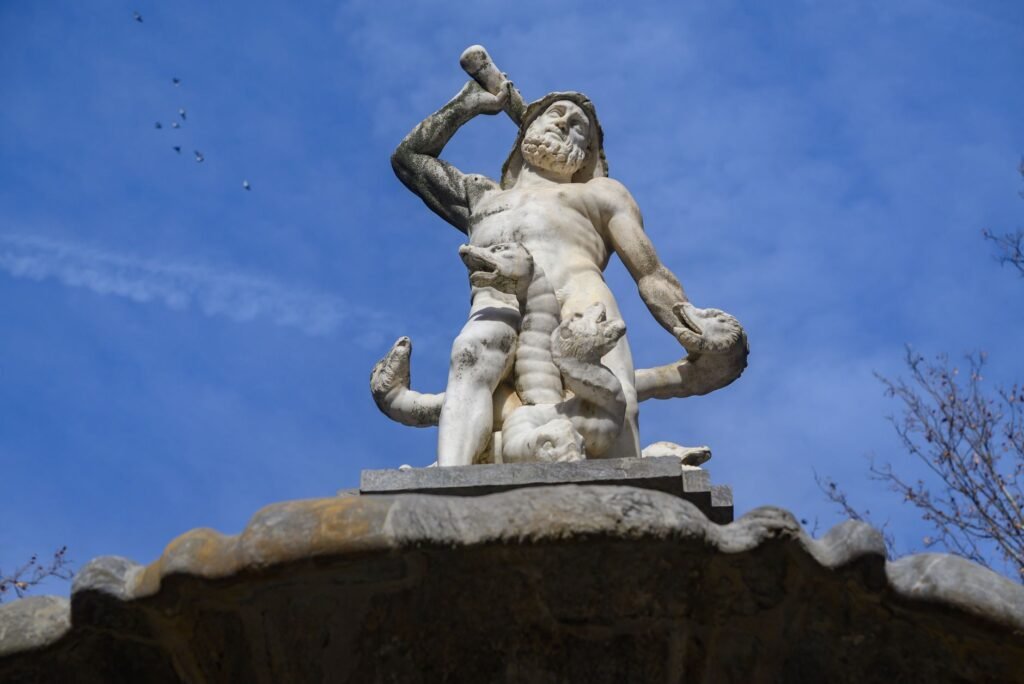
Balor is one of the most formidable figures in Irish mythology, known primarily as a giant, destructive being associated with the Fomorians, a supernatural race often depicted as hostile or chaotic opponents of the gods and heroes of Ireland. He appears most famously in the Cath Maige Tuired (The Battle of Mag Tuired), where he serves as a key adversary of the Tuatha Dé Danann and is ultimately slain by his grandson Lugh.
Balor matters because he represents several important themes in medieval Irish tradition: the danger of destructive power, the struggle between order and chaos, and the idea that even overwhelming force can be defeated through cleverness, prophecy, and destined kinship. Although his story survives mainly in medieval Irish literary sources rather than in a single unified pre-Christian myth, Balor remains one of the best-known figures in Celtic mythology.
Origin and Meaning
The name Balor appears in Irish tradition as Balar or Balor, and scholars have long discussed its etymology. The exact origin of the name is not certain. Like many names preserved in early Irish literature, it may reflect an older mythological or linguistic layer that predates the surviving manuscripts, but no consensus explanation is universally accepted.
Several points are clear:
- The name belongs to the Fomorian mythic cycle.
- Balor is consistently treated as a figure of devastation, hostility, and lethal power.
- Later tradition associates him with a destructive eye, especially the famous evil eye or venomous eye.
Because the surviving texts are medieval and were written in Christian Ireland, the form of the name and its interpretation may reflect both older oral tradition and later literary shaping. As a result, the historical “origin” of Balor should be understood as mythological rather than historical in the ordinary sense.
Historical Context
Balor belongs to the mythological world of early Irish literature, especially the mythological cycle preserved in manuscripts from the Middle Ages. These texts were written by Christian scribes, but they preserve older stories about supernatural peoples, divine kings, and heroic battles.
The Fomorians and the Tuatha Dé Danann
In the tradition where Balor appears most prominently, the Fomorians are a race often described as hostile, chaotic, or monstrous. They are not always uniformly evil in every source, but they typically stand in opposition to the Tuatha Dé Danann, the other great supernatural people of Irish myth.
Balor functions as one of the strongest Fomorian leaders. His role is especially important in the second Battle of Mag Tuired, a mythic conflict that symbolizes the struggle for sovereignty in Ireland.
Medieval Irish literary setting
The surviving accounts come from a culture that valued genealogy, kingship, and learned commentary. Mythological figures were often integrated into a framework that linked them to:
- ancestry and descent,
- kingship and legitimacy,
- prophecy and fate,
- cosmic or seasonal conflict.
Balor’s story was therefore not merely entertainment. It also served as a mythic explanation of power, succession, and the defeat of hostile forces by a divinely favored champion.
Main Characteristics
Balor is usually described with a mixture of giant-like, monstrous, and tyrannical traits. The most famous feature associated with him is his destructive eye.
Defining traits
| Characteristic | Description |
|---|---|
| Status | Fomorian king or leader in several traditions |
| Nature | Giant, monstrous, destructive, hostile figure |
| Signature feature | A deadly eye, often opened only in battle |
| Function in myth | Antagonist defeated by Lugh |
| Symbolic role | Embodiment of destructive or oppressive power |
The evil eye
Balor’s eye is one of the most distinctive elements in Irish myth. In some accounts, it is so destructive that when opened it can lay waste to armies or devastate anything it looks upon. Because of this, Balor is sometimes compared to figures of the “evil eye” in other mythologies, though the Irish tradition has its own distinct context and meaning.
The eye is often explained through narrative logic:
- it is dangerous even to its allies,
- it must be controlled or hidden,
- it becomes lethal when used in combat.
This feature makes Balor memorable and dramatically useful as a mythic enemy: he is not only strong, but uniquely catastrophic.
Family and Genealogy
Balor’s family relationships vary somewhat across sources, which is common in medieval mythological tradition. However, certain links are central and widely repeated.
Children and descendants
Balor is best known as the father of Ethniu (also spelled Ethlinn in some traditions), who becomes the mother of Lugh. This makes Balor the maternal grandfather of the hero who kills him.
This relationship is one of the most famous generational patterns in Irish myth:
- Balor represents destructive force.
- Ethniu connects the hostile Fomorian line to the heroic line.
- Lugh combines talent, legitimacy, and divine favor, and ultimately overcomes Balor.
Family pattern in myth
This structure is significant because it creates a dramatic prophecy motif. Balor is warned that he will die at the hands of his grandson, and efforts to prevent this prophecy fail. Similar “fated descent” patterns are common in world mythology, but the Irish version is especially striking because the grandson is not a random hero but a central divine figure.
Spouse and kin
Different genealogical traditions name different spouses or relatives for Balor, and these details are not always consistent across the sources. What is consistent is his connection to the Fomorian line and to the larger mythic genealogy that links rival groups of supernatural beings.
Symbols
Balor is associated primarily with symbols of destruction, vision, and lethal power rather than with a rich cult of iconography.
Major symbolic elements
- The eye: Balor’s most famous symbol, representing destructive sight and overwhelming force.
- Giant stature: In many traditions, his immense size reflects his role as a primordial or superhuman threat.
- Darkness and devastation: He is often linked with ruin, blight, and catastrophic power.
- The closed eye: In some versions, the eye is covered or kept shut, suggesting controlled violence or latent danger.
Symbolic meaning
Balor’s eye can be interpreted in several ways:
- as a mythic explanation for the harmful force of a lethal gaze,
- as a symbol of destructive kingship or tyrannical force,
- as a narrative device that sets up the heroism of Lugh.
Unlike deities with long-established ritual symbols, Balor’s symbolism is mostly literary and mythic. His image is less about worship and more about storytelling and archetype.
Sacred Animals
No universally attested sacred animal belongs to Balor in the way that some gods are closely linked to specific beasts. However, Irish myth often associates supernatural figures with animals symbolically rather than through formal cult.
Possible symbolic associations
Because Balor is a giant and destructive figure, later interpretation may connect him loosely with:
- cattle, through the wider mythic economy of wealth and conflict in Irish tradition,
- ravens or carrion birds, by symbolic association with battle and death,
- the bull, as a general image of power and aggression.
These are interpretive associations rather than firmly established cultic animal affiliations. The sources do not support a fixed sacred-animal system for Balor.
Sacred Plants
There are no well-attested sacred plants specifically tied to Balor in the surviving primary sources. Unlike some deities or heroes with strong plant symbolism, Balor’s tradition centers on battle, vision, and destruction.
Indirect plant associations
If plants are mentioned in broader mythic contexts around Balor, they tend to reflect the landscape of war rather than devotion. For example:
- battlefield vegetation,
- blighting or withering imagery,
- the contrast between fertility and destruction.
However, these are literary motifs, not established sacred plant traditions.
Sacred Places
Balor is connected to several places in Irish myth, though the most important are narrative settings rather than pilgrimage sites.
Mag Tuired
The most important location in Balor’s story is Mag Tuired or Magh Tuireadh (“the Plain of Towers” or “Plain of Pillars,” depending on interpretation). This is the site of the great battle where he is defeated. The second Battle of Mag Tuired is one of the foundational mythic events of Irish tradition.
Tory Island
Later Irish folklore and local tradition often associate Balor with Tory Island off the coast of County Donegal. In some traditions, Balor is imagined as a giant whose presence is linked to this island, and local place-lore may preserve stories of his dwellings, strongholds, or maritime connections.
Northern and western landscapes
Balor is often associated with the northwest of Ireland in broad mythic geography, especially in traditions that situate the Fomorians on remote islands or beyond ordinary human territory. This reinforces his status as an outsider force.
| Place | Significance |
|---|---|
| Mag Tuired | Battle site where Balor is slain |
| Tory Island | Major location in later legend and folk tradition |
| Northwestern seascape | Mythic zone associated with the Fomorians |
Powers and Attributes
Balor’s powers are formidable but centered on a few key functions in myth.
Main powers
- Destructive gaze: His eye can kill or devastate.
- Superhuman strength: He is often treated as a giant or giant-like being.
- Leadership: He acts as a Fomorian ruler or war leader.
- Prophetic significance: His destiny is tied to a prophecy about his grandson.
Mythic role of power
Balor’s power is not presented as balanced or benevolent. It is excessive, dangerous, and ultimately doomed. In mythological terms, he is a figure of overreach: a being whose force is real but unstable, and whose defeat restores a more favorable order.
This makes him a classic “cosmic antagonist” figure. He is not simply a villain in a modern moral sense; he embodies a threat that the hero must overcome for the world to remain viable.
Main Myths
Balor appears in several traditions, but the central myths are concentrated around his role as enemy of the Tuatha Dé Danann and grandfather of Lugh.
The prophecy of Balor’s death
One of the best-known stories says that Balor learns a prophecy predicting that he will be killed by his own grandson. In response, he tries to prevent the prophecy from coming true. Different versions describe different efforts, but the basic pattern is the same: fear of fate leads to actions that help bring fate about.
The birth of Lugh
Balor’s daughter Ethniu becomes pregnant with Lugh under circumstances that vary by source. In some traditions, the conception is linked to Balor’s attempt to imprison or protect his daughter from the prophecy. Regardless of the details, the myth establishes a powerful generational link between Balor and Lugh.
The Battle of Mag Tuired
Balor’s most famous mythic appearance is in the Cath Maige Tuired. In this battle, he fights as a major champion of the Fomorians against the Tuatha Dé Danann. During the conflict, his eye is used with catastrophic effect, but Lugh eventually kills him—most famously by casting a stone or spear-like missile through the eye and turning the destructive power back on Balor himself.
The precise version varies:
- some accounts emphasize a sling or stone,
- others stress a specially aimed weapon,
- all agree that Lugh defeats him by exploiting the eye’s vulnerability.
The death by his grandson
The death of Balor at the hands of Lugh is one of the clearest examples in Irish mythology of prophecy fulfilled through heroic action. The story combines:
- family conflict,
- fate and inevitability,
- the triumph of skill over brute force,
- the replacement of an older, destructive order by a younger, more effective one.
Relationship with Other Mythological Figures
Balor’s relationships are central to his mythic identity.
Lugh
Balor’s most important relationship is with Lugh, his grandson and killer. Their opposition is one of the great generational conflicts in Irish myth. Lugh is frequently interpreted as a figure of skill, sovereignty, and versatile excellence, while Balor represents destructive old power.
Ethniu
Ethniu, Balor’s daughter, is the crucial link between Balor and Lugh. Her role makes the myth especially layered: she belongs to Balor’s family line but becomes the mother of the hero who destroys him.
The Fomorians
Balor is commonly treated as a leader among the Fomorians, though the exact structure of Fomorian kingship differs across texts. He is one of their most dangerous champions and may be represented as a ruler or war leader.
The Tuatha Dé Danann
Balor stands in direct conflict with the Tuatha Dé Danann, especially in the battle narrative. His defeat helps establish their superiority in the mythic history of Ireland.
Other figures
Balor also exists in a wider web of mythic personalities connected with prophecy, kingship, and divine descent. However, the surviving texts focus much more on his opposition to Lugh than on a broad network of interpersonal relationships.
Worship and Cult
There is no strong evidence that Balor was worshipped as a god in the sense of a stable historical cult with temples, priesthood, or regular ritual observance. Unlike major deities in other ancient religions, Balor survives primarily as a mythological and literary figure.
What the sources suggest
- He is not clearly attested as an object of formal worship.
- There are no widely known Balor temples or ritual calendars.
- His presence in the tradition is narrative, not devotional.
Later folk memory
Balor did, however, remain important in Irish folklore and local tradition. In such traditions, mythic giants and legendary beings often acquire place-based stories, moral lessons, and memorial associations. These are not the same as ancient cult, but they show the durability of his image.
Ancient Sources
Balor is known mainly through medieval Irish texts. As with many figures from Celtic mythology, the surviving evidence comes through manuscript transmission rather than direct pre-Christian records.
Key sources
| Source | Relevance |
|---|---|
| Cath Maige Tuired | Main source for Balor’s role in the battle against the Tuatha Dé Danann |
| Lebor Gabála Érenn (The Book of the Taking of Ireland) | Places Balor within a mythic-historical framework |
| Dindshenchas traditions | Preserve place-lore and legendary associations |
| Other medieval Irish tales and genealogical materials | Contribute to variant accounts of Balor’s family and role |
Classical authors
Balor is not a figure from Greek or Roman classical literature, so authors like Homer, Hesiod, Ovid, or Pausanias do not discuss him. The relevant primary sources are instead early Irish.
Caution on interpretation
Because these texts were recorded in Christian Ireland, they may preserve older myth while also reshaping it. Scholars therefore treat details such as genealogy, chronology, and cosmology with caution.
Roman Equivalent
Balor does not have a single exact Roman equivalent.
Possible analogies
Some readers compare him loosely with figures such as:
- Saturn or Cronus, because of the generational conflict with a younger successor;
- Polyphemus or other monstrous giants, because of his size and destructive eye;
- warlike or underworld-associated adversaries in Roman myth.
These are only approximate comparisons. No Roman deity or monster corresponds precisely to Balor’s role in Irish tradition.
Influence on Modern Culture
Balor continues to appear in modern culture, especially in works influenced by Celtic myth, fantasy literature, and role-playing games.
Literature and fantasy
Modern authors sometimes adapt Balor as:
- a giant antagonist,
- a lord of the Fomorians,
- a symbolic source of dark or ancient power.
His eye and prophetic death make him especially attractive in fantasy storytelling.
Games and popular media
Balor appears or is alluded to in:
- tabletop role-playing materials,
- video games inspired by Celtic legend,
- fantasy settings using names and motifs from Irish mythology.
The name is often used for powerful monsters, bosses, or demonic figures because it has a strong sound and a ready-made mythic identity.
Art and cultural memory
Artists and illustrators interested in Celtic myth often depict Balor with:
- a huge, warlike body,
- a single terrible eye,
- an expression of archaic menace.
His image has become part of the broader visual vocabulary of Celtic-inspired fantasy, even when the details depart from the medieval sources.
Curiosities
- Balor is one of the clearest examples in Irish myth of a prophecy that becomes self-fulfilling.
- His greatest weakness is also his greatest weapon: the destructive eye becomes the point of his defeat.
- The story of Balor and Lugh is often read as a mythic pattern of old power replaced by young power.
- Unlike many famous mythic beings, Balor is better known for a single dramatic episode than for a long sequence of independent adventures.
- Local traditions, especially around Tory Island, helped keep his legend alive beyond the manuscript tradition.
- Balor is frequently cited in discussions of giants in Celtic mythology, though his role is more complex than that of a simple monster.
Frequently Asked Questions
Who is Balor in Irish mythology?
Balor is a major Fomorian figure in Irish mythology, best known as the grandfather of Lugh and the opponent slain by Lugh in the Battle of Mag Tuired.
What is Balor famous for?
He is most famous for his deadly eye, which could devastate enemies, and for his death at the hands of his grandson Lugh.
Is Balor a god?
Balor is generally not treated as a worshipped god. He is better understood as a mythological giant or supernatural antagonist in medieval Irish tradition.
Who killed Balor?
According to the main tradition, Balor was killed by Lugh, his grandson, during the Battle of Mag Tuired.
What is the meaning of Balor’s eye?
The eye symbolizes destructive power, dangerous sight, and catastrophic force. It is one of the most memorable images in Irish myth.
Which sources mention Balor?
The main sources include Cath Maige Tuired and Lebor Gabála Érenn, along with related medieval Irish genealogical and place-lore texts.
Does Balor have a Roman equivalent?
No exact Roman equivalent exists. He is sometimes compared loosely to giants or to figures involved in generational conflict, but these are only partial analogies.
Where was Balor associated with?
He is especially associated with Mag Tuired and, in later tradition, with Tory Island and the northwestern mythic landscape of Ireland.
Conclusion
Balor is one of the most powerful and enduring figures in Irish mythology. As a Fomorian leader, a giant with a destructive eye, and the doomed grandfather of Lugh, he embodies the dramatic tension between catastrophe and order, prophecy and fate, old force and heroic renewal.
Although the surviving evidence comes from medieval Irish sources rather than from direct ancient cult, Balor has remained a major mythic character because his story is vivid, symbolic, and structurally important. He stands at the intersection of genealogy, battle myth, and legendary kingship, and his defeat by Lugh remains one of the most memorable episodes in the Irish mythological tradition.

Orin Vale has spent the better part of two decades tracing the threads that connect the world’s oldest stories — from the halls of Asgard to the banks of the Nile, from Olympus to the jungles of the Maya. What began as a childhood fascination with flood myths and trickster gods grew into years of independent study across comparative mythology and ancient religion, always chasing the same question: what did these stories mean to the people who first told them? Orin writes for readers who want more than trivia — the ones looking for the beliefs, fears, and truths that myths were built to carry.