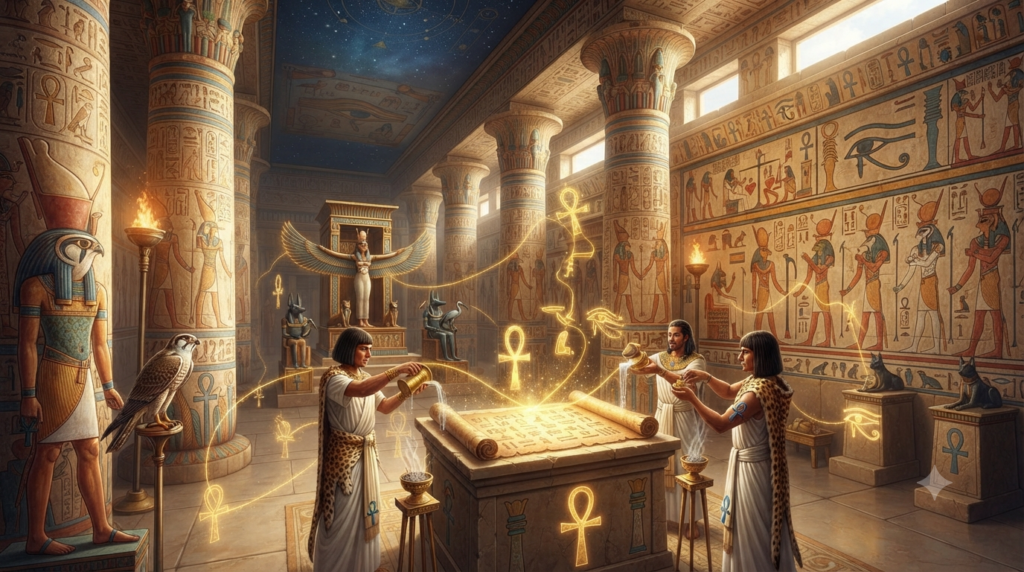
Few civilizations left behind a belief system as vast, as visually distinctive, or as long-lasting as ancient Egypt. Egyptian mythology developed over more than three thousand years along the banks of the Nile, shaping everything from royal succession to burial practice to the smallest household amulet. Unlike mythologies that survive mainly through a handful of literary epics, Egyptian mythology survives written directly onto the walls of temples and tombs, carved into stone, and preserved on papyrus buried alongside the dead, giving it one of the richest physical records of any ancient religion.
This guide serves as the central starting point for exploring Egyptian mythology on LoreCircle, bringing together its gods and goddesses, its sacred symbols, its creatures and monsters, and its great myths and legends in one place. Each section below introduces one major area of Egyptian mythology and leads to a full, dedicated guide covering that area in depth.
The World of Egyptian Mythology
Egyptian mythology took shape within one of the longest-lived civilizations in human history, stretching from the unification of Upper and Lower Egypt around 3100 BCE through the Old, Middle, and New Kingdoms, and continuing in various forms until the spread of Christianity closed Egypt’s last active pagan temple in the sixth century CE. Across this enormous span of time, Egyptian mythology never functioned as a private, personal belief system separate from government. The pharaoh ruled as a living god, temples operated as full economic institutions controlling land and labor, and priests carried out daily rituals believed to be genuinely necessary to keep the sun rising and the Nile flooding on schedule.
Because ancient Egypt was a civilization of distinct regional centers rather than one uniform culture, Egyptian mythology absorbed and combined ideas rather than replacing them outright. A local god from a rising city was folded into the wider pantheon instead of erasing the gods that came before, and creation stories from rival priesthoods were generally allowed to coexist rather than compete to the exclusion of one another. This habit of combination, rather than substitution, is the single most important pattern to understand before exploring any individual corner of Egyptian mythology.
Explore Egyptian Mythology by Category
Egyptian Gods and Goddesses
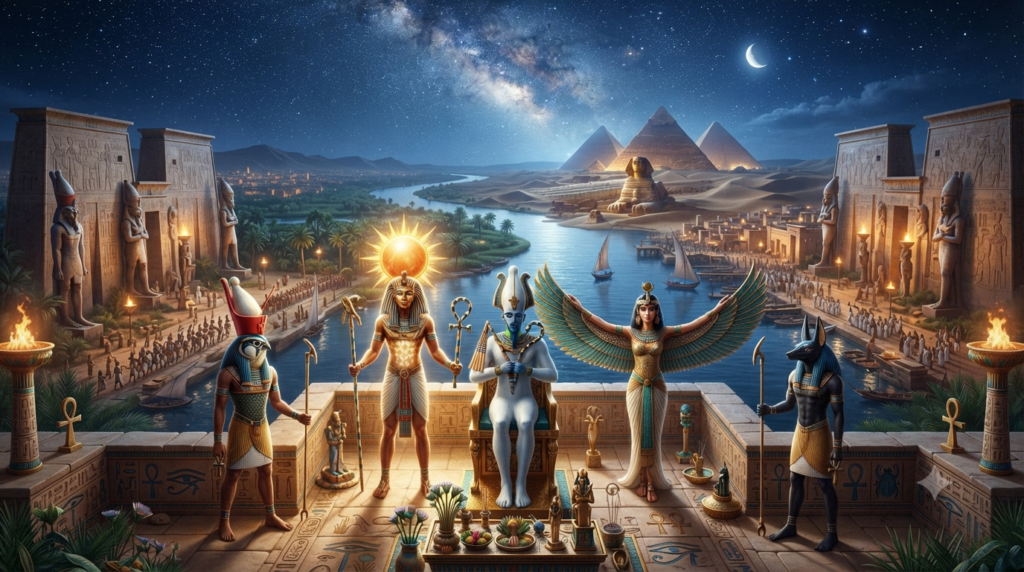
Egyptian mythology centers on a pantheon that Egyptologists estimate once included between 1,500 and 2,000 named deities, though only a few dozen appear consistently as major national gods. This part of Egyptian mythology traces the primeval creators who shaped the universe, the Osiris myth family at the heart of Egyptian kingship, and the gods of wisdom, war, love, the Nile, and the moon who governed nearly every part of Egyptian life. The complete guide to Egyptian gods and goddesses profiles each of these deities individually, from major national figures like Ra, Osiris, and Isis to more specialized gods tied to a single city or craft.
Egyptian Symbols
Long before most Egyptians could read hieroglyphic writing, Egyptian mythology communicated its deepest beliefs through instantly recognizable images: the ankh representing life, the Eye of Horus representing healing, and the crowns and scepters that marked out royal authority. This part of Egyptian mythology covers the sacred signs painted on tomb walls, carved into temple doorways, and worn as protective amulets by ordinary Egyptians. The complete guide to Egyptian symbols explains the meaning behind each of these signs and the specific religious or royal role each one played.
Egyptian Creatures and Monsters
Beyond its gods, Egyptian mythology populated the space between the divine and the human world with a distinct set of creatures: guardians who judged and devoured the unworthy dead, composite beasts born from chaos, and living sacred animals believed to house a god’s spirit inside a real, physical body. This part of Egyptian mythology introduces figures like Ammit, the sphinx, and the sacred Apis bull, each playing a specific functional role rather than receiving the kind of independent worship given to a true god. The complete guide to Egyptian creatures and monsters covers each of these beings in full.
Egyptian Myths and Legends
Where a god’s profile explains who a deity was, the myths and legends of Egyptian mythology explain what that deity actually did, tracing complete stories from beginning to consequence. This part of Egyptian mythology covers events such as the death and resurrection of Osiris, the long contest between Horus and Set for the throne of Egypt, and the sun god Ra’s nightly journey through the underworld. The complete guide to Egyptian myths and legends tells each of these stories in full, along with the sacred and literary texts, like the Book of the Dead, that preserved them.
How Egyptian Gods, Symbols, Creatures, and Myths Connect
None of these four areas of Egyptian mythology exist in true isolation, and following a single thread across all of them reveals how tightly the system was woven together. The god Osiris anchors the mythology’s most important myth, his death and resurrection at the hands of his brother Set. That same myth produced one of Egyptian mythology’s most important symbols, the Djed pillar representing Osiris’s own backbone and stability. The underworld judgment tied to Osiris’s court introduced one of Egyptian mythology’s most feared creatures, Ammit, who devours any heart found unworthy. And the ceremony at the center of that judgment, the weighing of the heart, stands as one of Egyptian mythology’s most complete surviving myths, recorded in detail in the Book of the Dead. A single mythological idea, in other words, routinely touches a god, a symbol, a creature, and a myth all at once, which is exactly why exploring Egyptian mythology by category works best alongside following the connections between categories.
Frequently Asked Questions About Egyptian Mythology
What is Egyptian mythology?
Egyptian mythology is the body of religious beliefs, stories, gods, and symbols developed by the ancient civilization of Egypt over more than three thousand years, covering everything from the creation of the universe to the fate of the individual soul after death.
How old is Egyptian mythology?
The earliest elements of Egyptian mythology date back to before the unification of Egypt around 3100 BCE, making it one of the oldest continuously documented religious systems in the world, with active worship continuing in some form for well over three thousand years.
Is Egyptian mythology still practiced today?
Organized worship of the traditional Egyptian gods ended by the early centuries CE as Christianity and later Islam spread through Egypt, though small modern revival movements exist, and many individual symbols from Egyptian mythology remain widely recognized and used today.
What makes Egyptian mythology different from Greek mythology?
Egyptian mythology is defined by regional combination rather than a single unified pantheon, by an unusually close connection between religion and the state through the pharaoh’s divine kingship, and by a much stronger focus on the afterlife and funerary preparation than most other ancient mythologies.
What are the main sources for studying Egyptian mythology?
Egyptologists reconstruct Egyptian mythology primarily from temple and tomb inscriptions, funerary papyri such as the Book of the Dead, and surviving literary works, since ancient Egypt left behind no single central scripture comparable to a bible.
Why did Egyptian mythology have so many local variations?
Ancient Egypt was organized around powerful regional cult centers, and each major city maintained its own patron god and its own version of key stories like the creation of the world, variations that Egyptian mythology generally preserved side by side rather than resolving into one official account.
How did Egyptian mythology influence later religions and cultures?
Egyptian mythology’s imagery and ideas spread widely through the ancient Mediterranean world, most visibly in the Greco-Roman worship of Isis, and continue to influence modern popular culture, art, and symbolism through figures like the ankh, the pyramids, and the pharaohs.
Where should I start if I’m new to Egyptian mythology?
Egyptian mythology is easiest to approach through its central Osiris myth family, since Osiris, Isis, Set, Horus, and Anubis connect directly to the pantheon’s major gods, its most recognizable symbols, and its best-known stories, all covered in the category guides above.

Orin Vale has spent the better part of two decades tracing the threads that connect the world’s oldest stories — from the halls of Asgard to the banks of the Nile, from Olympus to the jungles of the Maya. What began as a childhood fascination with flood myths and trickster gods grew into years of independent study across comparative mythology and ancient religion, always chasing the same question: what did these stories mean to the people who first told them? Orin writes for readers who want more than trivia — the ones looking for the beliefs, fears, and truths that myths were built to carry.