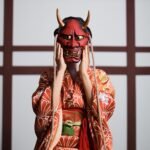
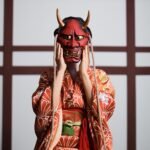
Izanagi’s Journey to Yomi
Introduction

Izanagi’s Journey to Yomi is one of the central episodes in Japanese mythology. It tells of the god Izanagi descending into Yomi, the land of the dead, in an attempt to recover his wife and creative partner, Izanami. The story is preserved in the earliest Japanese chronicles and has had a lasting influence on Shinto thought, Japanese literature, ritual purity concepts, and modern popular culture.
The myth is important because it explains several foundational ideas in Japanese religion and worldview: the boundary between life and death, the danger of pollution or kegare associated with death, and the origin of purification rites. It is also one of the most dramatic creation myths in East Asian tradition, presenting both cosmic grief and the irreversible separation of the living from the dead.
Origin and Meaning
The name Izanagi is usually explained as deriving from the Japanese verb izanau, meaning “to invite” or “to entice.” The name is often rendered as “the male who invites.” His counterpart, Izanami, is commonly interpreted as “the female who invites.”
Yomi means “the underworld” or “land of the dead.” In the oldest sources, it is not a fully developed infernal realm in the later religious sense, but rather a shadowy, polluted realm of the dead. The term has close associations with darkness and separation from the world of the living.
The story is not an isolated folk tale. It appears in Japan’s earliest extant historical-mythological compilations:
- Kojiki (712)
- Nihon Shoki (720)
These works preserve multiple versions of early myth, and the Yomi episode varies in detail between them. The story likely reflects older oral traditions that were later edited into written form during the formation of the Japanese state.
Historical Context
The myth belongs to the religious and political world of early Japan, especially the period when the imperial court was compiling origin stories to legitimize imperial authority and to organize a shared mythic past.
Religious background
The myth is deeply connected with Shinto, though Shinto as a clearly defined system emerged gradually. At its core, the narrative reflects several major religious concerns:
- the sanctity of life and fertility
- the danger of death pollution
- the importance of ritual cleansing
- the separation between the human world and the realm of spirits
Unlike later religions that emphasize moral judgment after death, the Yomi narrative focuses on ontological separation and purity. Death is feared not primarily as punishment but as a condition that taints and transforms.
Political and cultural background
The early Japanese court used myth to explain the divine origins of the land and ruling house. Izanagi and Izanami are among the creator deities in Japanese mythology, and their story helps frame the cosmic order from which Japan, its islands, and its gods emerge.
The descent into Yomi also supports a key ideological principle: the world of the living must remain ritually distinct from death. This distinction later became central to shrine practice and purification ceremonies.
Main Characteristics
Izanagi’s Journey to Yomi is defined by several essential features:
- A descent into the dead’s realm: Izanagi enters Yomi seeking Izanami after her death.
- A failed reunion: what begins as a hopeful reunion becomes a terrifying encounter.
- The revelation of death as corruption: Izanami’s decayed state or transformed condition makes reunion impossible.
- A boundary-crossing taboo: Izanagi breaks his promise not to look at her, triggering disaster.
- Pursuit and escape: the myth becomes a chase scene as Izanagi flees from the denizens of Yomi.
- Ritual purification: after returning, Izanagi performs cleansing rites, which become mythically foundational.
The episode is therefore both a tragic love story and an origin myth for purification.
Family and Genealogy
The relationship at the center of the story is between Izanagi and Izanami.
Their role as divine couple
In Japanese cosmogony, they are a primordial pair often credited with the creation of the Japanese islands and many deities. Their union is both creative and tragic. Izanami dies after giving birth to the fire deity, and Izanagi’s journey to Yomi is driven by grief and longing.
Children and descendants
Different sources present the genealogy in somewhat different ways, but the pair are associated with the birth of:
- the Japanese islands
- numerous kami, or deities
- deities governing elements, natural forces, and social functions
In the broader mythic genealogy of the imperial tradition, several key gods and divine lineages are connected to later state mythology, especially through descendants associated with the sun goddess Amaterasu and other heavenly deities.
Family relations in the Yomi episode
In the Yomi myth, the most important relationship is not with offspring but with the spouse:
- Izanagi: the living husband who descends into the underworld
- Izanami: the deceased wife who remains in Yomi
Their bond embodies creation, kinship, and irrevocable loss.
Symbols
Several symbols are associated with the Yomi narrative and with the purification that follows it.
| Symbol | Meaning |
|---|---|
| The underworld (Yomi) | Death, separation, darkness, pollution |
| A threshold or gate | The boundary between life and death |
| A comb or torch in some versions | The attempt to see, reveal, or illuminate the forbidden |
| Mud, darkness, rot, or decay | The corruption linked to death |
| Water used in purification | Restoration of ritual purity |
| Clothing removed during cleansing | Release of contamination and transition back to the living world |
Purity and pollution
The strongest symbolic theme is the contrast between purity and pollution. Death is not merely an end but a contaminating condition. Izanagi’s cleansing after leaving Yomi becomes a mythic explanation for ritual washing in Shinto practice.
Sacred Animals
The Yomi episode itself does not center on animals in the way some myths do, but later Japanese tradition and related iconography associate certain animals with death, purity, and protection.
Indirect associations
- Dogs and foxes may appear in later folklore around boundaries, spirits, and the unseen world.
- Serpents are sometimes linked in Japanese mythology to chthonic or transformative powers, though not specifically as central figures in the Yomi episode.
- Bats and other nocturnal creatures may symbolically suggest darkness and the underworld in later artistic interpretations.
It is important to note that these associations are often later symbolic readings, not core elements of the ancient textual myth.
Sacred Plants
The core Yomi story does not assign a single plant to the underworld journey, but plants do appear in the wider symbolic world of purification and death.
Relevant plant associations
- Bamboo: frequently associated with purity and resilience in Japanese culture.
- Sakaki: an evergreen plant used in Shinto offerings and rituals, symbolizing sacred presence.
- Rice plants: closely connected to life, fertility, and divine blessing, standing in contrast to the dead land of Yomi.
In the mythic imagination, living greenery often represents renewal, while the underworld represents the absence or reversal of life.
Sacred Places
Yomi
The central sacred or mythic place in this story is Yomi, the land of the dead. It is not described as a geographically located region in the ordinary sense. Rather, it is a mythic space, separated from the living world by a boundary that cannot safely be crossed.
The plain of purification
After his escape, Izanagi undergoes purification at a place often associated with a river or stream. Some traditions identify the location with Awagihara or another site linked to cleansing, but the exact location is not uniformly fixed in the sources.
Places associated with purification rites
Later Japanese religious tradition treats bodies of water, especially rivers and streams, as spaces of ritual renewal. The myth supports this broader sacred geography, where water cleanses pollution and restores order.
Powers and Attributes
Izanagi is not a deity of the underworld. In the Yomi episode, his important attributes include:
- creative power as a primordial god
- initiative in seeking out the dead
- ritual authority, especially after purification
- connection to birth and renewal
- capacity to generate further gods after cleansing
Yomi as a realm
Yomi itself is characterized by:
- darkness
- stillness
- pollution
- irreversible separation
- fear and dread
The myth makes clear that the dead are not simply asleep; they belong to another condition of existence.
Izanagi’s post-Yomi powers
After cleansing, Izanagi’s body becomes the source of additional divine manifestations in some versions of the myth. This emphasizes a crucial Shinto idea: purity is not only moral but generative. After contamination is removed, sacred power can emerge again.
Main Myths
The Death of Izanami
The journey begins after Izanami dies. In many versions, her death follows the birth of Kagutsuchi, the fire deity. Izanagi mourns deeply and decides to enter Yomi to retrieve her.
The Descent into Yomi
Izanagi travels to the underworld and finds Izanami there. At first, there is hope that she may return with him. However, Izanami explains that she has already eaten the food of Yomi, which binds her to the realm of the dead. This motif resembles other world mythologies in which eating in the underworld creates a fatal attachment to it.
The Forbidden Look
Izanagi asks Izanami not to let him see her. Impatient and fearful, he breaks his promise and looks upon her. In the Kojiki, he sees her in a horrifying state of decay. In some versions, the details differ, but the essential point remains: the dead cannot be restored to the living world.
Pursuit by the Dead
Once exposed, the situation collapses. Izanami becomes enraged and sends forces to pursue Izanagi. She also enlists various frightening beings or underworld attendants, depending on the source.
Izanagi flees, and the chase becomes one of the best-known scenes in Japanese myth. He blocks the entrance to Yomi with a boulder or barrier, severing the worlds of life and death.
The three great ruptures
The pursuit culminates in separation:
- Izanami declares that she will kill a thousand people each day.
- Izanagi responds that he will cause fifteen hundred people to be born each day.
- This exchange mythically explains the ongoing cycle of death and birth.
Different sources vary in how this dialogue is framed, but the symbolic balance between mortality and reproduction is central.
Purification and the Birth of New Deities
After returning from Yomi, Izanagi performs ritual cleansing. This act is among the most important in the entire myth.
During or after purification, deities emerge from different parts of his body in some versions. Among the most famous is Amaterasu, the sun goddess, associated with his left eye, and also Tsukuyomi and Susanoo in related traditions. The exact sequence and details vary by source.
This purification episode establishes:
- the necessity of cleansing after contact with death
- the sacred power of water
- the continuing fertility of the divine body
- the link between impurity and transformation
Relationship with Other Mythological Figures
Izanami
Izanami is the key figure in the Yomi episode. She is not merely a passive victim; in the story, she becomes both unreachable and formidable. Her transformation in Yomi marks the point at which personal grief becomes cosmic law.
Amaterasu
Although not central to the Yomi descent itself, Amaterasu is one of the deities associated with Izanagi after purification and is crucial in the later mythic genealogy of the Japanese imperial line.
Susanoo
Susanoo, the stormy and rebellious deity, is also linked to Izanagi’s post-purification divine births in some accounts. He becomes a major figure in later myths and is often contrasted with Amaterasu.
Kagutsuchi
Kagutsuchi, the fire deity whose birth is associated with Izanami’s death, is the indirect cause of the Yomi journey. His role links creation with destruction, a recurring pattern in the myth.
Other beings of Yomi
The underworld attendants and grotesque figures pursuing Izanagi are not consistently named across all sources. Their presence, however, reinforces the alien nature of Yomi and the danger of crossing into it.
Worship and Cult
The Yomi narrative is not typically the subject of worship in the way a single deity might be, but it is deeply embedded in ritual life.
Purification rites
The most important religious consequence of the story is the mythic authority it gives to purification rituals. In Shinto, cleansing practices include:
- washing hands and mouth
- ritual bathing
- purification before shrine entry
- special rites after contact with death or misfortune
Death pollution and taboo
The story helps explain why death is treated as polluting in many traditional Japanese contexts. Funerary spaces and shrine spaces are often separated. In historical practice, those involved in death-related activities were sometimes considered ritually affected by impurity.
Festivals and commemorative traditions
The Yomi myth is not usually celebrated through a single universal festival, but its themes influence shrine rituals and seasonal rites of renewal. The emphasis on renewal after contamination appears in many purification observances.
Ancient Sources
The main ancient sources for Izanagi’s Journey to Yomi are Japanese, not Greek or Roman.
Key Japanese texts
| Source | Date | Significance |
|---|---|---|
| Kojiki | 712 | Oldest surviving account of the myth in a literary-historical compilation |
| Nihon Shoki | 720 | Provides alternate and more elaborate variants |
| Fudoki | 8th century onward | Regional records that preserve related traditions, though not always this episode directly |
Variations between sources
The Kojiki and Nihon Shoki do not always agree in detail. Differences include:
- the exact sequence of events
- the appearance of Izanami in Yomi
- the nature of her transformed body
- the presence or role of attendants
- the wording of the exchange between Izanagi and Izanami
Because of these differences, it is best to read the myth as a tradition cluster, not as a single fixed narrative.
Classical Greek and Roman authors
Authors such as Homer, Hesiod, Apollodorus, Pausanias, and Ovid do not mention Izanagi or Yomi, since this is a Japanese myth. They are relevant only as comparative figures when scholars discuss descent-to-underworld stories across cultures.
Roman Equivalent
There is no direct Roman equivalent to Izanagi’s Journey to Yomi.
However, some broad comparisons can be made with Roman and Greco-Roman myths involving:
- journeys to the underworld
- the loss and attempted recovery of a loved one
- the difficulty of returning from death
- ritual purification after contact with the dead
Comparable narratives include stories of descent in classical mythology, but none match the specific Shinto emphasis on pollution, purification, and the origin of divine genealogy.
Influence on Modern Culture
The Yomi story continues to influence modern Japanese and global culture.
Literature and scholarship
Modern retellings often treat the myth as a foundational tragedy, a symbolic account of bereavement, or an origin story for purity rituals. It is also widely studied in religious studies, anthropology, and comparative mythology.
Cinema and television
Japanese films, anime, and television often reference Yomi, Izanagi, or the underworld imagery associated with death and purification. The names may appear directly or as thematic inspiration.
Games and popular media
In video games and fantasy settings, Izanagi, Izanami, and Yomi are frequently borrowed as names for characters, powers, or locations. Their presence often signals mythic gravity, darkness, or spiritual duality.
Visual art and illustration
Artists have long been drawn to the contrast between:
- the grieving husband
- the decayed or transformed wife
- the dark underworld
- the cleansing return to light
The myth’s visual possibilities make it a recurring subject in manga, illustration, and symbolic design.
Curiosities
- The myth is one of the clearest early Japanese explanations for why death and life must remain ritually separate.
- Izanagi’s failure is not the result of villainy but of human-like impatience and grief, making the story emotionally resonant.
- The episode helps explain why purification is central to Shinto practice.
- In some later interpretations, Yomi is compared to a shadow world rather than a fiery hell, which makes it structurally different from many Western underworld traditions.
- The story balances mourning and creation: a descent into death leads, paradoxically, to new divine births.
- Different manuscripts and oral traditions preserve multiple versions, so the myth should not be treated as a single uniform text.
- The myth influenced not only religion but also ideas about the proper boundaries between sacred space and spaces associated with death.
Frequently Asked Questions
What is Izanagi’s Journey to Yomi?
It is a Japanese myth in which the god Izanagi descends into the land of the dead, Yomi, to seek his deceased wife Izanami.
Why did Izanagi go to Yomi?
He went to Yomi out of grief and love, hoping to bring Izanami back to the world of the living.
Why could Izanami not return from Yomi?
In the myth, she had already become part of the realm of the dead, and in some versions she had eaten the food of Yomi, binding her to that realm.
What happens when Izanagi looks at Izanami?
He sees that she has become horrifyingly changed by death, and this revelation breaks the taboo of the journey, leading to pursuit and separation.
What does the myth explain?
It explains the separation between life and death, the danger of death pollution, and the importance of purification rites in Japanese religion.
Is Yomi the same as hell?
Not exactly. Yomi is better understood as the land of the dead in Japanese mythology, not necessarily a place of eternal punishment.
What is the significance of Izanagi’s purification?
His cleansing after leaving Yomi symbolizes the removal of death pollution and the restoration of ritual purity. It is also linked to the birth of new deities in some traditions.
Which ancient texts tell the story?
The main sources are the Kojiki and Nihon Shoki, both compiled in the early 8th century.
Conclusion
Izanagi’s Journey to Yomi is a cornerstone of Japanese mythology. It combines grief, taboo, death, ritual purity, and cosmic renewal in a single powerful narrative. Through the failed attempt to recover Izanami, the myth defines the boundary between the living and the dead and explains why cleansing is necessary after contact with death.
Its importance extends beyond mythology. The story shapes Shinto concepts of impurity and purification, enriches Japanese cultural memory, and continues to inspire literature, art, and popular media. As both a tragedy and an origin myth, Izanagi’s descent into Yomi remains one of the most enduring and meaningful stories in Japanese religious tradition.

Orin Vale has spent the better part of two decades tracing the threads that connect the world’s oldest stories — from the halls of Asgard to the banks of the Nile, from Olympus to the jungles of the Maya. What began as a childhood fascination with flood myths and trickster gods grew into years of independent study across comparative mythology and ancient religion, always chasing the same question: what did these stories mean to the people who first told them? Orin writes for readers who want more than trivia — the ones looking for the beliefs, fears, and truths that myths were built to carry.