How Did Horus of Behdet Defeat Ra’s Enemies?
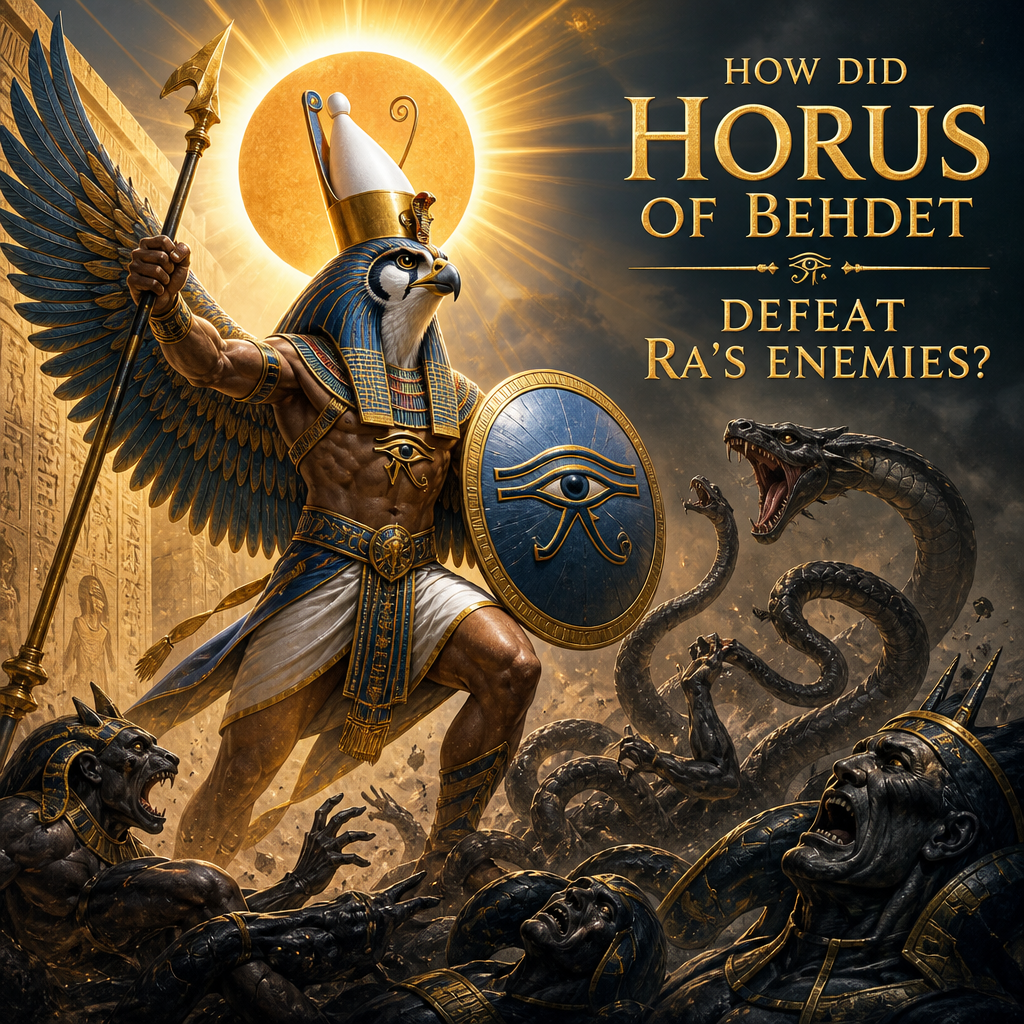
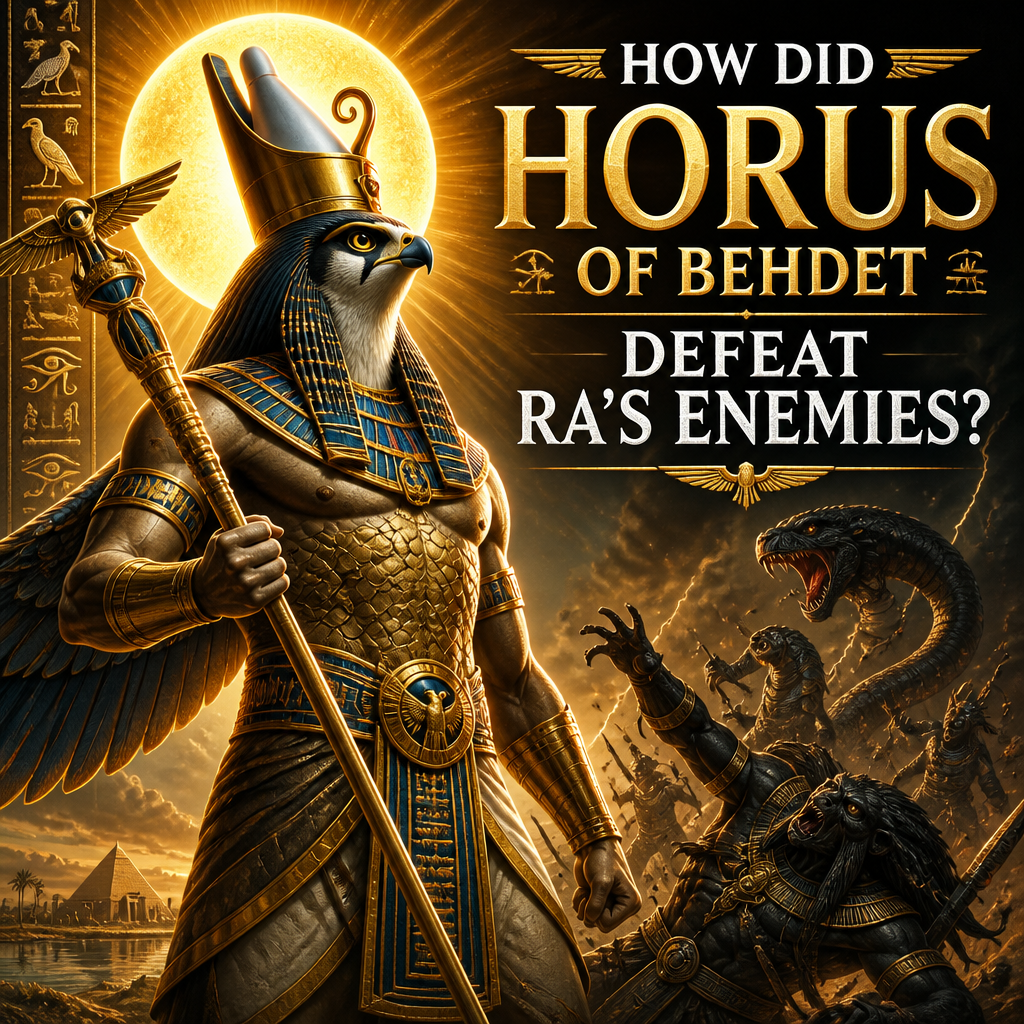
In ancient Egyptian mythology, Horus of Behdet was one of the most powerful protective forms of the falcon god Horus. He was closely associated with the sun god Ra and often appeared as a winged solar disk, a symbol placed above temple entrances, royal monuments, and sacred spaces. But how did Horus of Behdet defeat Ra’s enemies?
The story comes from Egyptian temple traditions, especially those connected with Edfu, where Horus was worshipped as a great divine warrior. In these myths, Horus of Behdet protects Ra during his journey across Egypt and destroys the forces of chaos that threaten the sun god’s rule.
Who Was Horus of Behdet?
Horus of Behdet was a local form of Horus worshipped at Behdet, a place often identified with Edfu in Upper Egypt. He was linked to kingship, the sky, warfare, and divine protection.
Unlike some other forms of Horus, Horus of Behdet was especially known for his role as a defender of Ra. He could appear in several forms, including:
- A falcon
- A falcon-headed god
- A winged solar disk
- A warrior armed with divine weapons
His most famous symbol, the winged sun disk, represented his ability to fly across the sky and strike down enemies from above. This image became one of the most widespread protective symbols in ancient Egypt.
The Threat Against Ra
In Egyptian belief, Ra represented order, sunlight, kingship, and life itself. His enemies were not merely physical opponents; they were forces of chaos that threatened the balance of the world.
These enemies were often linked with rebellion, darkness, disorder, and the mythic powers that opposed the gods. In some temple texts, they are described as hostile beings who plotted against Ra as he traveled in his solar boat.
Ra needed a divine champion to defend him. That champion was Horus of Behdet.
Horus Takes the Form of the Winged Disk
One of the most important parts of the myth explains how Horus of Behdet defeated Ra’s enemies by transforming into a winged solar disk. From this powerful form, he flew high above Ra’s boat and saw the enemies gathering below.
The winged disk gave Horus several advantages:
- He could move swiftly across the sky
- He could see enemies from a great distance
- He could attack from above
- He embodied both solar power and royal authority
As a sky god, Horus was naturally connected with height, vision, and flight. As the winged disk, he became a living weapon of the sun.
The Battle Against Ra’s Enemies
According to the myth, Ra was sailing through Egypt when his enemies began to rise against him. Horus of Behdet spotted them and asked Ra for permission to attack.
Ra approved, and Horus descended upon the enemies with overwhelming force. He struck them down so completely that they could not threaten the sun god again.
In some versions of the temple texts, Horus attacks with weapons such as spears, harpoons, or blades. In others, his power is described more symbolically: he burns, blinds, crushes, and scatters the enemies of Ra. His victory is not just a military triumph but a restoration of cosmic order.
The Role of the Followers of Horus
Horus of Behdet was not always alone in battle. He was often accompanied by divine followers or warrior companions who helped him destroy the enemies of Ra.
These followers may represent loyal forces of order, divine soldiers, or aspects of Horus’s own power. Together, they pursued the enemies, defeated rebels, and secured the land for Ra.
This detail also reflects the close connection between divine warfare and earthly kingship. Just as Horus defended Ra, the pharaoh was expected to defend Egypt from disorder and foreign threats.
Why the Enemies Were Called Forces of Chaos
To understand how Horus of Behdet defeated Ra’s enemies, it helps to understand what those enemies represented. In Egyptian religion, the universe depended on ma’at, the principle of truth, balance, justice, and order.
Ra upheld ma’at through his daily journey across the sky. Any enemy of Ra was therefore an enemy of creation itself.
Horus’s defeat of these enemies symbolized:
- Light overcoming darkness
- Order defeating chaos
- Kingship overcoming rebellion
- Divine power protecting the world
The myth was not simply about one god winning a battle. It explained how the world remained stable and why the sun continued to rise.
The Winged Sun Disk as a Protective Symbol
After Horus of Behdet defeated Ra’s enemies, Ra honored him by placing the winged solar disk in sacred locations. This is why the winged disk appears so often above the gateways of Egyptian temples.
It served as a warning and a blessing. To worshippers, it showed that the temple was protected by divine power. To enemies, it declared that Horus watched from above and would destroy anyone who threatened the gods.
The image became strongly associated with protection, victory, and royal legitimacy. Pharaohs used it to show that their rule was supported by Horus and Ra.
Connection to the Temple of Edfu
Much of what we know about Horus of Behdet comes from the Temple of Edfu, one of the best-preserved temples in Egypt. Its inscriptions describe myths, rituals, and festivals connected with Horus.
At Edfu, Horus was celebrated as a heroic god who defeated enemies and protected the divine order. The temple texts present his battles as sacred events that were remembered and renewed through ritual.
For the ancient Egyptians, retelling the victory of Horus was not just storytelling. It helped keep chaos under control and reaffirmed the power of the gods.
A Myth of Protection and Power
So, how did Horus of Behdet defeat Ra’s enemies? He did so by transforming into the winged solar disk, flying above the battlefield, striking the enemies of Ra, and restoring divine order. With speed, vision, and solar power, he became the perfect protector of the sun god.
His victory explains why the winged disk became such an important symbol in Egyptian temples. It represented the watchful power of Horus, the authority of Ra, and the eternal defeat of chaos.
In this myth, Horus of Behdet is more than a warrior. He is the guardian of the sun, the defender of creation, and the divine force that ensures order triumphs over disorder.

Orin Vale has spent the better part of two decades tracing the threads that connect the world’s oldest stories — from the halls of Asgard to the banks of the Nile, from Olympus to the jungles of the Maya. What began as a childhood fascination with flood myths and trickster gods grew into years of independent study across comparative mythology and ancient religion, always chasing the same question: what did these stories mean to the people who first told them? Orin writes for readers who want more than trivia — the ones looking for the beliefs, fears, and truths that myths were built to carry.