Historical and Geographic Context
Roman mythology developed across more than a thousand years, from the legendary founding of Rome in 753 BCE through the Regal period, the Roman Republic established around 509 BCE, and the Roman Empire that followed from 27 BCE onward. As Rome expanded across Italy and the wider Mediterranean, it absorbed and reshaped Greek mythology into its own state religion, while preserving distinctly Italic traditions tied to the household, the land, and civic order. Roman mythology survives today largely through the works of writers such as Virgil, Ovid, and Livy, alongside the natural-historical writings of Pliny the Elder, who together shaped how later generations understood Rome’s gods, legendary founders, and moral exemplars.
Explore Roman Mythology by Category
Roman Gods and Goddesses
From Jupiter’s rule atop the Capitoline Hill to uniquely Italic deities like Janus and Terminus, the Roman pantheon blended adapted Greek gods with distinctly Roman powers tied to the state, the household, and the land. See the full guide: Roman Gods and Goddesses: The Complete Guide.
Roman Symbols
Sacred objects like the fasces, the Aquila eagle standard, and the eternal flame of Vesta gave visible form to both religious devotion and Roman civic identity. See the full guide: Roman Symbols: The Complete Guide to the Sacred Objects and Signs of Roman Mythology.
Roman Creatures and Monsters
From the fire-breathing giant Cacus to the restless household spirits of the Roman dead, Roman mythology’s creatures reflect both borrowed Greek monsters and a genuinely distinct Roman folk and natural-historical tradition. See the full guide: Roman Creatures and Monsters: The Complete Guide.
Roman Myths and Legends
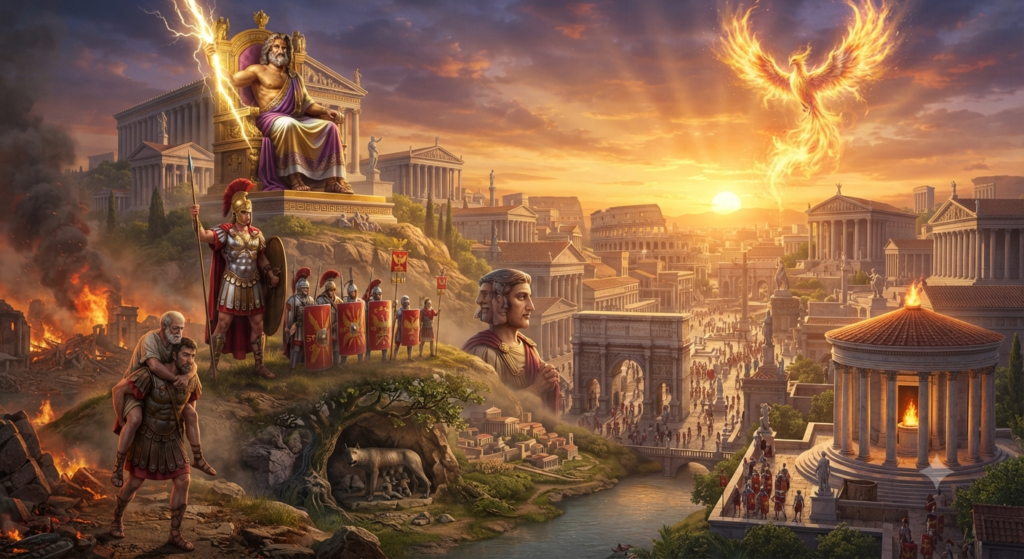
The great narratives of Roman mythology — Aeneas’s flight from Troy, the founding of Rome by Romulus and Remus, and the legendary virtue of early Roman heroes — wove gods, symbols, and creatures together into a foundational story of Roman identity. See the full guide: Roman Myths and Legends: The Complete Guide.
How the Four Categories Connect
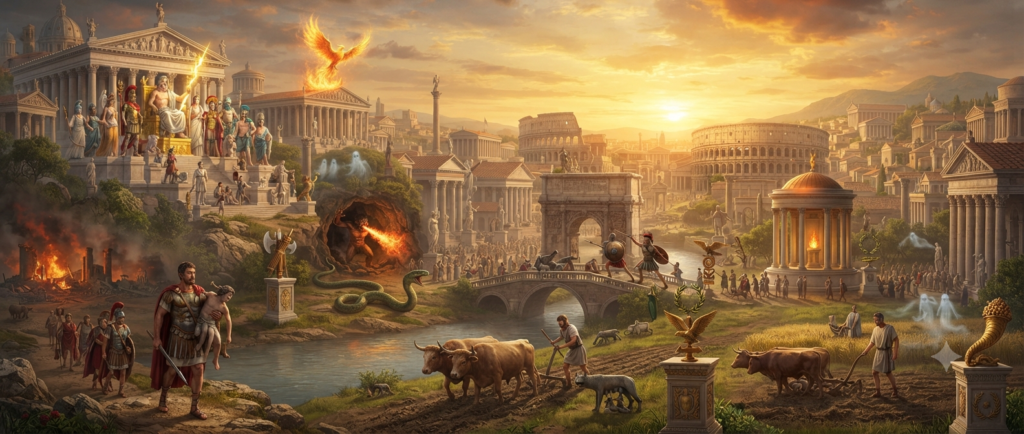
Roman mythology’s four categories consistently reinforce a single underlying theme: the sacred legitimacy of Rome itself. The fire-breathing giant Cacus, defeated by Hercules on the future site of Rome, marks the very ground where the city would later rise — the same ground where the eternal Sacred Fire of Vesta would come to symbolize Rome’s continuity as a state, tended in the goddess Vesta’s honor by the Vestal Virgins. In this way, a single creature’s defeat becomes tied to a founding myth, which is in turn embodied by a sacred symbol, which finally points back to the god who guarantees its meaning — illustrating how thoroughly Roman mythology’s categories serve the same civic and religious purpose.
Frequently Asked Questions
What is Roman mythology?
Roman mythology is the body of myths, legendary history, and religious tradition belonging to ancient Rome, encompassing its gods, legendary founders, and the moral and civic stories tied to Roman identity.
How is Roman mythology different from Roman religion?
Roman mythology refers to the narrative tradition of stories about gods and legendary figures, while Roman religion encompasses the actual rituals, priesthoods, and state-sponsored worship through which Romans honored those same figures.
How much of Roman mythology was borrowed from the Greeks?
Many major Roman gods and myths were directly adapted from Greek sources, but Roman mythology also preserved a substantial body of native Italic tradition, particularly around household religion, civic founding legends, and natural history.
What are the main written sources for Roman mythology?
Key sources include Virgil’s Aeneid, Ovid’s Metamorphoses, Livy’s early history of Rome, and Pliny the Elder’s Natural History, each shaping different aspects of the surviving tradition.
How did Roman mythology support the Roman state?
Roman mythology consistently reinforced civic virtues like duty, discipline, and sacrifice, while linking Rome’s political legitimacy directly to divine favor and a legendary lineage stretching back to Troy.
Did Roman mythology survive the fall of the Roman Empire?
Roman mythology was gradually displaced by Christianity as the empire’s dominant religion, but its stories, symbols, and language survived extensively through Western art, literature, and cultural tradition.
Why do many English words come from Roman mythology?
Roman gods and mythological figures gave their names to numerous English words and concepts, from the days of the week and planets to terms like “cereal,” “martial,” and “mercurial.”
Is Roman mythology still relevant today?
Yes — Roman mythological figures and symbols continue to appear widely in modern government emblems, astronomy, literature, and popular culture, reflecting the tradition’s deep and lasting influence on Western civilization.

Orin Vale has spent the better part of two decades tracing the threads that connect the world’s oldest stories — from the halls of Asgard to the banks of the Nile, from Olympus to the jungles of the Maya. What began as a childhood fascination with flood myths and trickster gods grew into years of independent study across comparative mythology and ancient religion, always chasing the same question: what did these stories mean to the people who first told them? Orin writes for readers who want more than trivia — the ones looking for the beliefs, fears, and truths that myths were built to carry.