Norse myths and legends are the narratives that give the gods, giants, and creatures of Norse mythology their motivations — why Loki turns against the other gods, why the world will eventually burn, why Odin sacrificed part of himself for wisdom. This guide walks through the central Norse myths and legends in four groups: the beginning and end of the cosmos, Loki’s crimes and punishment, the gods in conflict and courtship, and the trials and tricks that test the gods themselves.
The Beginning and the End of the World
Norse myths and legends bookend the cosmos with two matching stories: the world’s violent creation and its equally violent destruction, connected by the long decline that leads from one to the other.
What Is the Norse Creation Myth?
The Norse creation myth begins in Ginnungagap, the yawning void where the fire of Muspelheim met the ice of Niflheim. From that meeting the primeval giant Ymir formed, along with the cosmic cow Audhumla, who nourished Ymir and, by licking the salty ice, freed Buri, the first of the gods, from the frost. Buri’s grandsons — Odin, Vili, and Ve — later killed Ymir and built the world from his body. The same three brothers then found two pieces of driftwood on a beach and shaped them into the first humans, Ask and Embla, each brother giving a different gift: breath and life, understanding and movement, and finally form, speech, hearing, and sight. This creation of the first man and woman completes the Norse creation myth and sets the stage for every other Norse myth and legend that follows.
What Is the Fimbulwinter in Norse Mythology?
The Fimbulwinter is the three consecutive winters, unbroken by any summer, that precede Ragnarok in Norse mythology. Sources describe a period of moral collapse alongside the physical cold: brothers turn against brothers, and the bonds of kinship and honor that hold society together begin to fail. During this time, the wolves Skoll and Hati, who have chased the sun and moon since the beginning of the world, finally catch and devour them, plunging the world into darkness just before the final battle begins.
What Happens During Ragnarok in Norse Mythology?
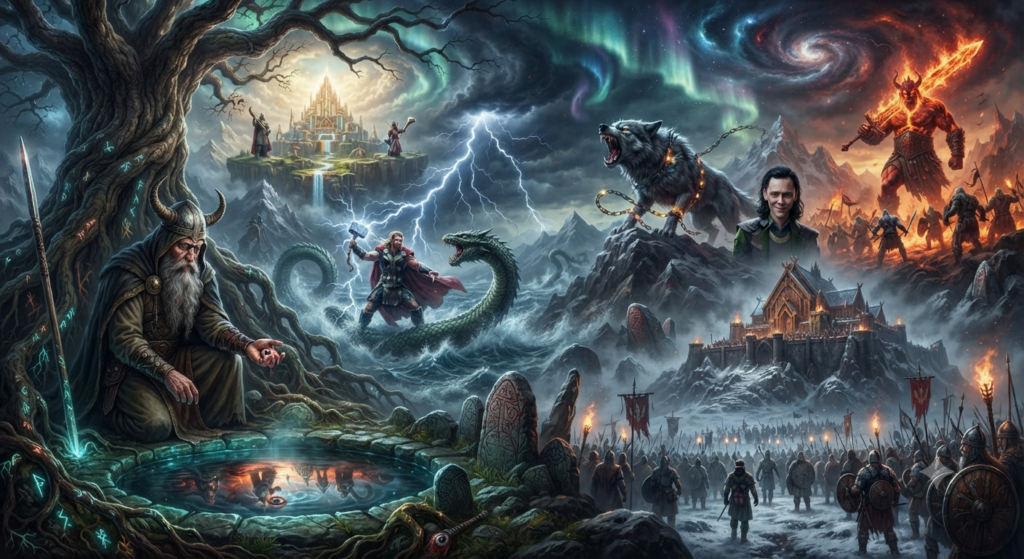
Ragnarok is the prophesied final battle of Norse mythology, in which most of the major gods and their great enemies kill each other simultaneously. Fenrir breaks free and kills Odin, and is immediately slain by Odin’s son Vidar. Thor and Jormungandr kill each other in single combat. Freyr, having given away his sword generations earlier, falls to the fire giant Surtr, who then sets the entire world ablaze. Tyr and Garmr kill one another at the gates of the underworld, and Heimdall and Loki do the same. Yet Ragnarok is not a true ending: sources describe the world rising again from the sea afterward, green and renewed, with Baldr returning from the dead and a handful of surviving gods — including Vidar, Vali, and Thor’s sons Modi and Magni, who inherit Mjolnir — beginning the cosmos anew.
Loki’s Crimes and Punishment
No figure drives the plot of Norse myths and legends toward disaster more directly than Loki, whose actions escalate from mischief to outright betrayal.
Why Is Baldr’s Death Important in Norse Mythology?
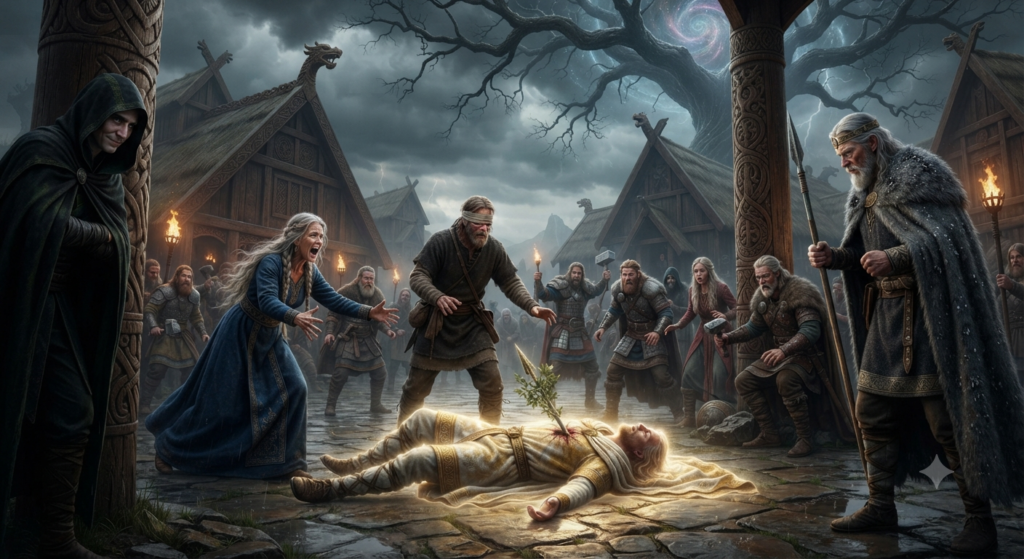
Baldr’s death is the turning point of Norse mythology, the event that pushes the gods irreversibly toward Ragnarok. After Baldr dreamed of his own death, his mother Frigg extracted an oath from every object and creature in existence never to harm him — except mistletoe, which she judged too young and harmless to bother asking. Loki, discovering this gap, fashioned a dart from mistletoe and guided the blind god Hodr’s hand as he threw it at Baldr during a game, killing him instantly. Baldr’s mother Frigg then sent a messenger to Hel, who agreed to release Baldr if every single thing in the world wept for him. All did, except one giantess, Thökk, almost universally understood to be Loki in disguise, who refused — sealing Baldr’s fate to remain in the underworld until after Ragnarok.
Why Is Loki Punished in Norse Mythology?
Loki is bound and punished in Norse mythology as direct retribution for his role in Baldr’s death and for his final, unforgivable insult to the gods at Aegir’s feast. The gods captured Loki’s son Narfi and transformed his brother Vali into a wolf, who tore Narfi apart; the gods then bound Loki with his own son’s entrails, which hardened into iron chains. A serpent was fixed above him, dripping venom onto his face, with only his wife Sigyn able to ease his suffering by catching the poison in a bowl. When Sigyn must empty the bowl, the venom strikes Loki directly, and his convulsions are said to cause earthquakes. He remains bound this way until Ragnarok, when he finally breaks free to lead the giants against the gods.
What Happens in the Lokasenna in Norse Mythology?
The Lokasenna, a poem preserved in the Poetic Edda, describes Loki crashing a feast hosted by the sea god Aegir for the assembled gods. Uninvited and already resented, Loki proceeds to insult nearly every god and goddess present in turn, hurling accusations of cowardice, infidelity, and disgrace at figures including Odin, Frigg, Freyja, and Tyr. The gods’ patience finally breaks when Thor arrives and threatens to crush Loki with Mjolnir, forcing him to flee the hall. The Lokasenna marks the last time Loki appears among the gods as a nominal member of their circle before his role in Baldr’s death permanently severs the relationship.
Gods in Conflict and Courtship
Not every major Norse myth ends in violence. Several of the most enduring stories involve negotiation, trickery in service of love, or the uneasy merger of two divine families.
What Caused the Aesir-Vanir War in Norse Mythology?
The Aesir-Vanir War is the first war in Norse cosmology, fought between the Aesir, led by Odin, and the Vanir, the fertility-associated family that includes Njord, Freyr, and Freyja. Sources trace its origin to the arrival of a witch named Gullveig among the Aesir, whose mistreatment at their hands provoked the Vanir to retaliate. Neither side could gain a decisive advantage, and the war ended in a truce sealed by an exchange of hostages: Njord, Freyr, and Freyja went to live among the Aesir, while Hoenir and the wise Mimir went to the Vanir. This exchange is what merges the two families into the single pantheon familiar from most later Norse myths and legends.
Why Was Idun Kidnapped in Norse Mythology?
Idun, keeper of the golden apples that keep the gods eternally youthful, was kidnapped after the giant Thiazi trapped Loki and forced him, under threat, to lure her out of Asgard with a trick. Once outside the walls, Thiazi seized Idun in the form of an eagle and carried her back to his hall. Without her apples, the gods began to age rapidly, and they forced Loki to fix the mistake he had caused: disguised as a falcon, Loki flew to Thiazi’s hall, turned Idun into a nut, and carried her back to Asgard, with the enraged Thiazi in pursuit as an eagle. The gods lit a fire at the walls of Asgard that burned Thiazi’s wings as he arrived, killing him — a death that later drives his daughter Skadi to demand compensation from the gods.
Why Does Freyr Marry the Giantess Gerd in Norse Mythology?
Freyr falls in love with the giantess Gerd after glimpsing her from Odin’s high seat, Hlidskjalf, a vantage point that lets its occupant see across all Nine Worlds. Overcome with longing, Freyr sends his servant Skirnir to woo her on his behalf, giving up his own magic sword as payment for Skirnir’s horse and the errand itself. Gerd initially refuses every gift Skirnir offers, relenting only after he threatens her with a series of escalating magical curses. The marriage secures Gerd as Freyr’s wife, but it leaves Freyr permanently without his sword — the same weakness that costs him his life against Surtr at Ragnarok.
Trials, Tricks, and Sacrifice
The final group of Norse myths and legends tests the gods directly, often through contests they don’t fully understand until it’s too late.
How Did Odin Lose His Eye in Norse Mythology?
Odin sacrifices one of his eyes at Mimir’s well, located beneath the roots of Yggdrasil, in exchange for a single drink from the well’s waters, which grants him cosmic wisdom. This is a distinct act of sacrifice from Odin’s later self-hanging on Yggdrasil to obtain the runes — the two episodes are frequently confused, but Norse myths and legends treat them as separate prices Odin pays at different points for different kinds of knowledge: the eye for wisdom drawn from Mimir’s well, and the ordeal on the tree for the secret of the runes themselves.
How Did the Gods Trick the Builder of Asgard’s Wall in Norse Mythology?
An unnamed giant mason offered to build a wall around Asgard strong enough to repel any invader, in exchange for the sun, the moon, and the goddess Freyja, provided he could finish within three seasons with the help of his stallion Svadilfari. As the deadline approached and the builder’s inhumanly fast progress made success look certain, the gods, on Loki’s advice, forced Loki to intervene. Loki transformed into a mare to lure Svadilfari away from his work, causing the builder to miss his deadline. Revealed as a giant in disguise once he lost his temper, the builder was killed by Thor. The same distraction that saved Asgard also produced an unexpected result: Loki, still in mare form, later gave birth to Sleipnir, Odin’s eight-legged horse.
How Does Thor Get Tricked by Utgard-Loki in Norse Mythology?
On a journey into the giants’ realm, Thor, Loki, and their traveling companions arrive at the hall of the giant king Utgard-Loki, who challenges each of them to a contest designed around illusion rather than fair competition. Loki loses an eating contest against an opponent who turns out to be wildfire itself; the servant Thjalfi loses a footrace against thought itself. Thor fails to empty a drinking horn secretly connected to the ocean, fails to lift what looks like a cat but is actually Jormungandr in disguise, and is fought to a draw by an old woman who is, in fact, old age personified. Only after Thor and his companions leave does Utgard-Loki reveal the truth: each apparent failure was, in reality, a superhuman feat against an opponent no mortal or god could ever defeat outright.
Frequently Asked Questions About Norse Myths and Legends
What Is the Difference Between a Norse Myth and a Norse Legend?
A Norse myth typically involves gods, giants, and the structure of the cosmos itself — creation, Ragnarok, the deeds of Odin and Thor. A Norse legend more often centers on human or semi-human heroes, such as the Volsungs or the saga heroes of medieval Iceland, whose stories intersect with the gods but focus on mortal deeds. In practice, both terms are used together, since many sources blend divine and human narrative material.
Which Norse Myth Is Considered the Most Important?
Baldr’s death is widely treated as the single most consequential myth in the corpus, since it directly triggers the chain of events — Loki’s punishment, his eventual escape, and the alliances that form at Ragnarok — that determines the fate of the entire cosmos.
How Does Ragnarok End, and Does Anything Survive?
Ragnarok ends with the deaths of most major gods and their enemies and the burning of the known world by Surtr, but it is not a final ending. A small number of gods survive, the world rises again from the sea, and Baldr returns from the underworld, suggesting Norse mythology envisioned renewal rather than permanent annihilation.
Why Does Loki Betray the Other Gods?
Norse myths and legends do not give a single clear motive for Loki’s betrayal; his actions escalate gradually, from mischief that occasionally helps the gods to genuine malice culminating in Baldr’s death. His mixed ancestry — a god by residence in Asgard but a giant by blood — is often read as a symbolic root of his eventual turn against the Aesir.
Are Norse Myths and Legends Based on Real Historical Events?
Norse myths and legends are religious and cultural narratives rather than historical records, though they emerged from real Scandinavian societies and sometimes reference real geography, customs, and social structures of the Viking Age. Separate saga literature about legendary human heroes sometimes blends historical figures with mythological elements, but the myths of the gods themselves are not treated as history.
What Is the Oldest Source for Norse Myths and Legends?
The Poetic Edda, a collection of anonymous poems compiled in 13th-century Iceland from older oral material, is generally considered the oldest surviving textual source for Norse myths and legends, alongside the Prose Edda, written by the Icelandic scholar Snorri Sturluson in the same century as a more structured retelling.
How Many Major Myths Make Up Norse Mythology?
There is no single official count, since Norse myths and legends survive across multiple overlapping sources — the Poetic Edda, the Prose Edda, and various sagas — that sometimes tell the same story differently. This guide covers twelve of the most central and most frequently referenced myths, from creation through Ragnarok.
Do Norse Myths and Legends Influence Modern Popular Culture?
Norse myths and legends have a significant presence in modern film, television, comics, and video games, most visibly through adaptations of Thor, Loki, and Ragnarok, though these adaptations frequently simplify or alter details — such as family relationships and character motivations — found in the original Norse sources.

Orin Vale has spent the better part of two decades tracing the threads that connect the world’s oldest stories — from the halls of Asgard to the banks of the Nile, from Olympus to the jungles of the Maya. What began as a childhood fascination with flood myths and trickster gods grew into years of independent study across comparative mythology and ancient religion, always chasing the same question: what did these stories mean to the people who first told them? Orin writes for readers who want more than trivia — the ones looking for the beliefs, fears, and truths that myths were built to carry.