Norse mythology is the body of religious belief and storytelling that emerged among the North Germanic peoples of Scandinavia, centered on a pantheon led by Odin and Thor, a cosmos built from the body of a slain giant, and a prophesied end that the gods themselves cannot avoid. This guide brings together everything covered across our full coverage of Norse mythology — the gods, the symbols, the creatures, and the myths — into a single starting point, and shows how those four pillars connect into one coherent tradition.
Historical and Geographical Context
Norse mythology took shape across Scandinavia — the regions now known as Denmark, Norway, and Sweden — over centuries of oral tradition before being written down. Its most visible historical expression is the Viking Age, conventionally dated from the raid on the monastery of Lindisfarne in 793 CE to the Battle of Stamford Bridge in 1066 CE, during which Norse-speaking peoples raided, traded, and settled across the British Isles, Iceland, Greenland, and parts of continental Europe, carrying their gods and stories with them. Christianity spread gradually through Scandinavia across the 10th to 12th centuries, and it was only after this conversion, in 13th-century Iceland, that the myths were compiled into the written sources that survive today: the anonymous poems of the Poetic Edda and Snorri Sturluson’s Prose Edda. Because these accounts were recorded by Christian, or recently Christianized, scholars looking back at a fading oral tradition, Norse mythology reaches us through a specific cultural filter rather than as a direct transcription of Viking Age belief.
The Four Pillars of Norse Mythology
Norse mythology, as covered across this site, breaks down into four interconnected areas — the gods who inhabit it, the symbols that represent it, the creatures that threaten or serve it, and the myths that give it a narrative arc from creation to Ragnarok.
Norse Gods and Goddesses
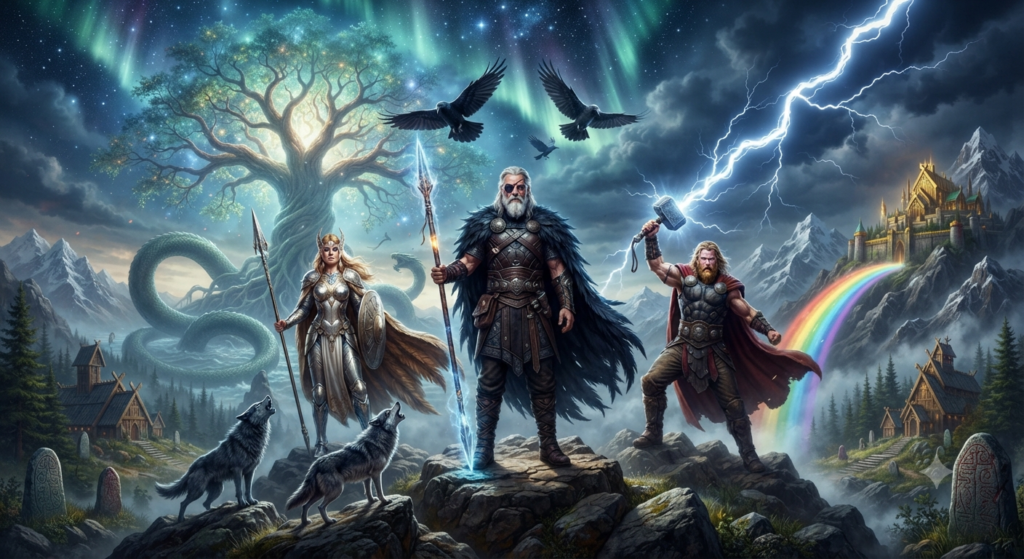
The gods of Norse mythology are divided between two families, the Aesir and the Vanir, unified after a war between them. Odin rules as chief of the Aesir, seeking wisdom at any cost, while Thor defends both gods and humans with his hammer, and figures like Frigg, Freyja, Tyr, and Loki each carry distinct domains and loyalties. Our full guide to Norse gods and goddesses profiles every major deity individually, along with the structural questions — how many gods there are, why Odin carries so many names, and what separates a god from a giant — that define the pantheon as a whole.
Norse Symbols
Norse symbols express the beliefs and fears of this mythology in visual form, but not all of them come from the same historical layer. Mjolnir, the Valknut, and the runes of the Elder Futhark are confirmed through genuine Viking Age archaeology and literature, while symbols like the Vegvisir and the Aegishjalmur come from Icelandic magical manuscripts written centuries after the Viking Age ended. Our full guide to Norse symbols covers all of these signs individually and draws a clear line between Viking Age artifacts and later reinterpretations.
Norse Creatures and Monsters
Norse mythology is populated by beings that exist alongside the gods without being gods themselves — Loki’s monstrous children Fenrir, Jormungandr, and Hel; primeval giants like Ymir and Surtr; companions of the gods like Sleipnir and the ravens Huginn and Muninn; and guardians of death like Nidhogg and Garmr. Our full guide to Norse creatures and monsters profiles each of these figures and explains how the categories of “giant” and “monster” overlap without being identical.
Norse Myths and Legends
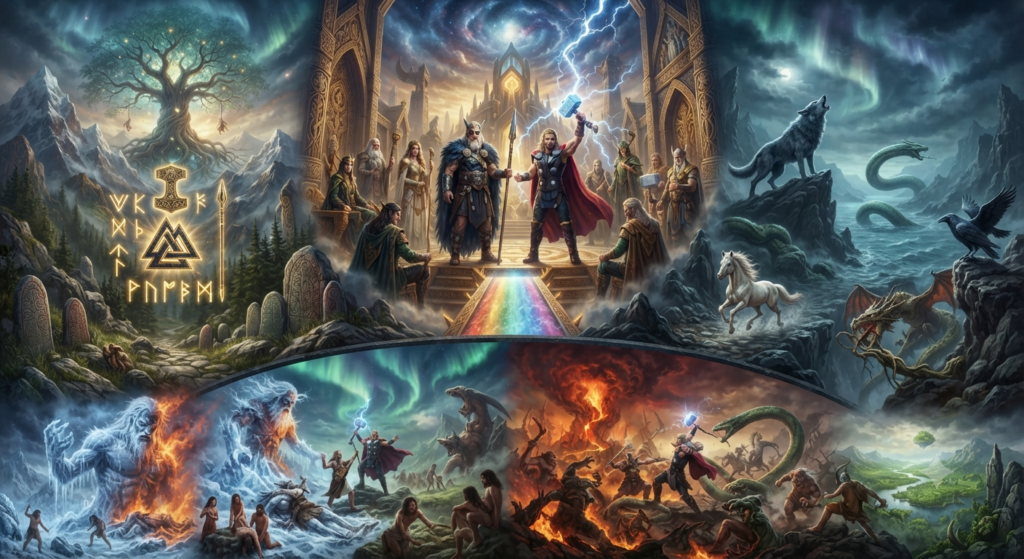
The myths and legends of Norse mythology supply the narrative that connects everything else: the creation of the world from Ymir’s body, Baldr’s death at Loki’s hand, the punishment that follows it, and the final battle of Ragnarok that most of the pantheon does not survive. Our full guide to Norse myths and legends walks through these central stories in sequence, from the world’s beginning to its prophesied end and eventual renewal.
How the Four Pillars Connect
The gods, symbols, creatures, and myths of Norse mythology are not four separate subjects — they are four ways of looking at the same interconnected tradition. A single chain makes the connection clear: Mjolnir is a Norse symbol, but it only has meaning because it belongs to Thor, a Norse god. Thor’s defining rivalry is with Jormungandr, a Norse creature and the child of Loki. That rivalry is resolved only in the myth of Ragnarok, where Thor and Jormungandr kill each other in the same moment. Trace the symbol back far enough, and it leads through a god and a creature into the central myth of the entire tradition.
A second chain runs through Odin. Gungnir, his spear, is a Norse symbol tied to his authority as a god. His ravens, Huginn and Muninn, are Norse creatures that extend his awareness across the world. Both converge in the myth of Ragnarok, where Odin, despite all the knowledge his ravens gather and all the authority his spear represents, is killed by Fenrir — a fate the gods had tried to prevent by binding the wolf in the first place. Norse mythology repeatedly builds toward Ragnarok this way: no symbol, no creature, and no god exists apart from the ending that all of them are moving toward.
Frequently Asked Questions About Norse Mythology
What Are the Main Written Sources for Norse Mythology?
The two primary sources are the Poetic Edda, a collection of anonymous poems compiled from older oral material in 13th-century Iceland, and the Prose Edda, written by the Icelandic scholar Snorri Sturluson in the same century as a more structured retelling. Various Icelandic sagas supply additional material, particularly around legendary heroes and creatures like the draugr.
How Does Norse Mythology Differ from Greek Mythology?
Norse mythology centers on a cosmos moving toward a foretold, largely unavoidable end at Ragnarok, in which most gods die, whereas Greek mythology has no single unifying end-of-the-world event and instead spans an open-ended set of myths across many generations of gods and heroes. Norse gods are also generally mortal in the long run — Odin, Thor, and their peers are all destined to die — while the Greek Olympians are immortal by nature.
Is Norse Mythology Practiced as a Religion Today?
Modern heathenry and Ásatrú are contemporary religious movements that draw on Norse mythology, practiced by a relatively small number of adherents primarily in Scandinavia, Iceland, and parts of North America and Western Europe. These modern practices are reconstructions and reinterpretations rather than an unbroken continuation of Viking Age religion, which ended with the Christianization of Scandinavia over a thousand years ago.
What Was Norse Mythology’s Original Language, and How Did It Survive?
Norse mythology was originally transmitted orally in Old Norse, the language of medieval Scandinavia, and survived into writing primarily through Old Icelandic manuscripts of the 13th century, after Iceland’s conversion to Christianity. Iceland’s relative isolation and its strong tradition of written sagas are widely credited with preserving far more mythological material than survived on the Scandinavian mainland.
What Role Did the Vikings Play in Preserving Norse Mythology?
The Vikings themselves left behind physical evidence of Norse mythology — pendants, runestones, and carvings — but did not write extended mythological narratives during the Viking Age itself, since runic inscriptions were generally short. The fuller narratives were recorded afterward, in Christian-era Iceland, by descendants of Viking-Age Scandinavians drawing on oral tradition that had survived the conversion.
What Ties Norse Mythology’s Gods, Symbols, Creatures, and Myths Together?
Every symbol in Norse mythology belongs to a god or represents a concept tied to one; every creature is either an ally or an enemy of the gods; and every myth resolves those relationships into a single ongoing story that points toward Ragnarok. None of the four categories functions as a self-contained subject — each one only makes full sense in light of the other three.
Why Does Everything in Norse Mythology Point Toward Ragnarok?
Ragnarok functions as the organizing endpoint of Norse mythology: prophecy of the gods’ eventual defeat appears early and repeatedly across the sources, shaping how individual myths are told. Baldr’s death, Loki’s punishment, and the binding of Fenrir are all presented as steps in a sequence the gods already know is coming, giving Norse mythology a forward momentum that many other mythological traditions lack.
Where Should Someone New to Norse Mythology Start Reading?
Readers new to Norse mythology are generally best served by starting with the gods — particularly Odin, Thor, and Loki — before moving on to the central myths of Baldr’s death and Ragnarok, since most symbols and creatures in Norse mythology only make full sense once those core relationships and that central prophecy are already understood.

Orin Vale has spent the better part of two decades tracing the threads that connect the world’s oldest stories — from the halls of Asgard to the banks of the Nile, from Olympus to the jungles of the Maya. What began as a childhood fascination with flood myths and trickster gods grew into years of independent study across comparative mythology and ancient religion, always chasing the same question: what did these stories mean to the people who first told them? Orin writes for readers who want more than trivia — the ones looking for the beliefs, fears, and truths that myths were built to carry.