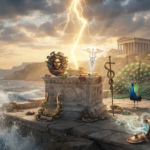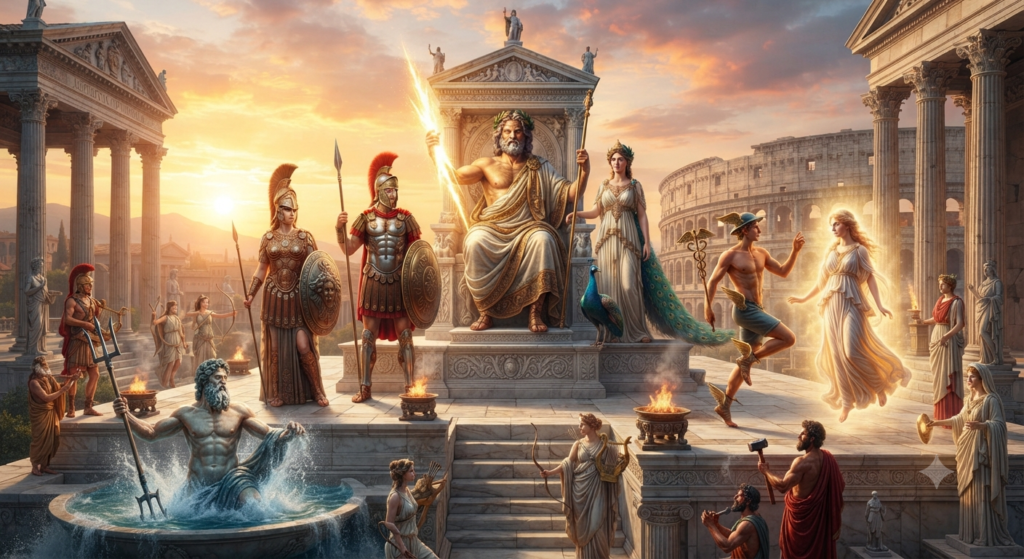
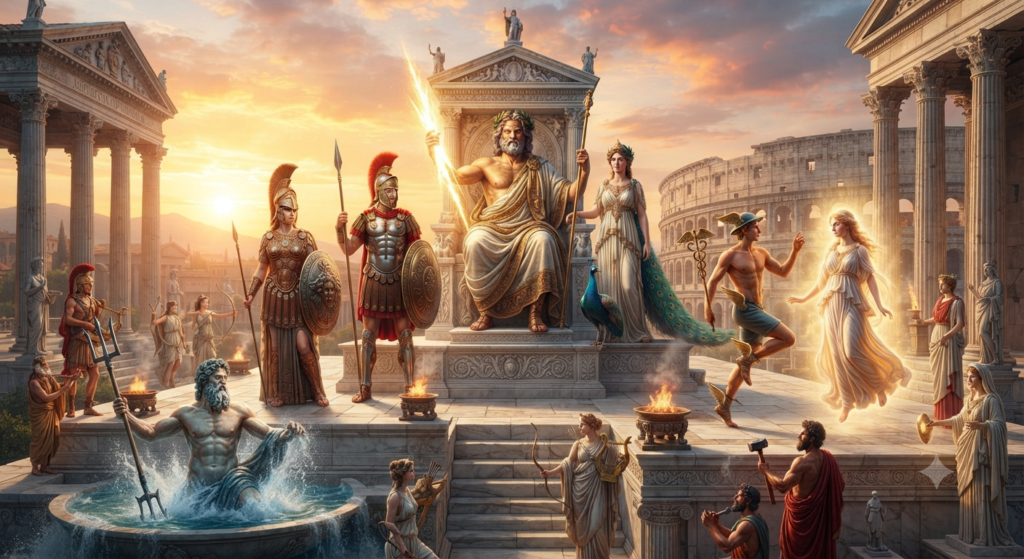
Roman mythology is often introduced as simply Greek mythology with new names, but the truth is more layered. Rome absorbed and reshaped Greek deities into its own state religion while also preserving distinctly Italic gods tied to boundaries, doorways, harvests, and fortune — figures with no Greek counterpart at all. This guide brings together the essential gods and goddesses of ancient Rome, organized by domain, from the ruling Capitoline Triad to the uniquely Roman powers that shaped daily life.
The Capitoline Triad and State Religion
Jupiter
The supreme god of the Roman pantheon, Jupiter ruled the sky, thunder, and the state itself from his great temple on the Capitoline Hill. As the Roman equivalent of Zeus, he presided over oaths, treaties, and the fate of Rome, making him the central figure of official state religion.
Juno
Queen of the Roman gods and protector of the Roman state, Juno watched over marriage, women, and the wellbeing of Rome. Worshipped alongside Jupiter and Minerva in the Capitoline Triad, she was closely associated with the peacock and civic guardianship.
Minerva
Goddess of wisdom, strategy, and crafts, Minerva completed the Capitoline Triad alongside Jupiter and Juno. Corresponding to the Greek Athena, she was honored as a patron of both military strategy and skilled trades throughout Roman civic life.
War, Sea, and Craft
Mars
Second only to Jupiter in importance to the Roman state, Mars was the god of war and, notably, the mythical father of Romulus and Remus, making him a divine ancestor of Rome itself. His role in Roman religion was more central and dignified than his Greek counterpart Ares.
Neptune
Ruler of the seas, Neptune commanded storms, earthquakes, and the ocean’s vast power. Identified with the Greek Poseidon, he was invoked by sailors and was also credited, in some traditions, with the creation of the horse.
Vulcan
God of fire, volcanoes, and metalworking, Vulcan forged weapons and tools for gods and heroes alike from his subterranean smithy. His Greek counterpart Hephaestus shares his role as master craftsman of the divine world.
Bellona
A fierce goddess of war closely linked to Mars, Bellona embodied the frenzy and violence of battle. Her temple in Rome served as a formal site for declarations of war and diplomatic ceremonies involving foreign nations.
Love, Beauty, and Messengers
Venus
Goddess of love, beauty, and desire, Venus held special importance in Rome as the mythical mother of Aeneas, linking her directly to the legendary founding of the Roman people. She corresponds to the Greek Aphrodite.
Cupid
The winged god of desire, Cupid was Venus’s son, famous for his arrows that could inspire uncontrollable love. His most celebrated myth involves his secret romance with the mortal Psyche.
Psyche
Originally a mortal woman of extraordinary beauty, Psyche was granted immortality after enduring a series of trials imposed by Venus to prove her worthiness of Cupid’s love, becoming a goddess of the soul.
Mercury
The swift messenger of the gods, Mercury governed trade, travel, and communication, recognizable by his winged sandals and caduceus. He shares his role directly with the Greek Hermes.
Harvest, Hearth, and Home
Ceres
Goddess of agriculture and grain, Ceres’s grief over her abducted daughter Proserpina was said to cause the barrenness of winter, explaining the cycle of the seasons. She corresponds to the Greek Demeter.
Vesta
Goddess of the hearth and home, Vesta’s sacred flame was tended continuously by the Vestal Virgins in her round temple in the Roman Forum, symbolizing the enduring stability of the Roman state.
Flora
Goddess of flowers, spring, and blossoming, Flora was honored each year at the festival of Floralia, a distinctly Roman celebration of fertility and renewal with no direct Greek equivalent.
Pomona
A uniquely Roman goddess of fruit trees and orchards, Pomona cared for cultivated gardens rather than wild nature, and was famously courted by the shapeshifting god Vertumnus.
Pales
An ancient Roman deity of shepherds and livestock, Pales was honored at the rustic festival of Parilia, which marked the founding of Rome itself and blessed flocks against disease.
Light, Hunt, and Sky
Apollo
One of the few major gods the Romans adopted with his name unchanged, Apollo governed light, prophecy, music, and healing, and was closely tied to Rome’s growing engagement with Greek culture and religion.
Diana
Goddess of the hunt, the moon, and wild places, Diana was fiercely independent and closely associated with the Greek Artemis, worshipped widely across the Roman countryside as protector of both animals and women.
Sol
The Roman sun god, Sol drove a blazing chariot across the sky each day. His worship grew significantly in later Roman history under the title Sol Invictus, the “Unconquered Sun.”
Luna
Goddess of the moon, Luna complemented Sol as the celestial ruler of the night sky, corresponding to the Greek Selene and often invoked alongside her solar counterpart in Roman astrology and ritual.
Aurora
Goddess of the dawn, Aurora scattered rose-colored light across the sky each morning, heralding the arrival of Sol. She corresponds directly to the Greek Eos.
The Underworld and the Old Order
Pluto
Ruler of the underworld and its hidden wealth, Pluto governed the realm of the dead alongside his wife Proserpina. Also known as Dis Pater, he corresponds to the Greek Hades.
Proserpina
Abducted by Pluto to become queen of the underworld, Proserpina’s yearly return to the surface world explained the changing of the seasons, mirroring her Greek counterpart Persephone.
Saturn
Father of Jupiter and ruler of a legendary Golden Age of peace and abundance, Saturn was honored during the festival of Saturnalia, one of the most beloved celebrations in Roman culture.
Ops
Goddess of abundance and the earth’s fertility, Ops was the consort of Saturn and was closely tied to agricultural prosperity, corresponding to the Greek Rhea.
Bacchus
God of wine, ecstasy, and religious frenzy, Bacchus inspired both celebrated festivals and, at times, controversial secret rites known as the Bacchanalia. He corresponds to the Greek Dionysus.
Uniquely Roman Powers
Janus
The two-faced god of beginnings, transitions, and doorways, Janus had no Greek equivalent and was uniquely Roman, lending his name to the month of January and presiding over the start of every significant undertaking.
Quirinus
Originally linked to the deified spirit of Romulus, Quirinus formed part of Rome’s archaic religious triad alongside Jupiter and Mars, representing the Roman people organized as a civic and military community.
Terminus
God of boundaries and property markers, Terminus was worshipped through simple boundary stones and honored at the festival of Terminalia, reflecting the deep Roman concern with property rights and territorial order.
Fortuna
Goddess of luck, chance, and fate, Fortuna was often depicted balanced upon a turning wheel, symbolizing the unpredictable rise and fall of fortune in both public and private Roman life.
Faunus
A rustic god of the wild and prophecy, Faunus was closely associated with the Greek Pan and was consulted through dreams and oracular rites in secluded natural settings.
Vertumnus
God of seasonal change and transformation, Vertumnus could shift his form at will, famously using this power to woo the orchard goddess Pomona.
Silvanus
A protective god of woods, fields, and boundaries between cultivated and wild land, Silvanus was especially honored by farmers and rural landowners throughout the Roman countryside.
Robigus
A minor but important agricultural deity, Robigus was honored at the festival of Robigalia to protect grain crops from wheat rust and other destructive blights.
Understanding the Roman Pantheon
How Many Major Roman Gods Are There
While Roman religion recognized countless minor spirits and local deities, most modern overviews focus on around twenty to forty major gods and goddesses central to state religion, agriculture, and daily life.
The Twelve Dii Consentes
The Dii Consentes were the twelve principal deities of the Roman state pantheon, six gods and six goddesses, honored together in the Roman Forum and roughly paralleling the Twelve Olympians of Greek religion.
King of the Roman Gods
Jupiter held supreme authority among the Roman gods, ruling from the Capitoline Hill as the divine guarantor of oaths, treaties, and the Roman state’s welfare.
Difference Between Roman and Greek Gods
While many Roman gods were directly adapted from Greek deities, Roman religion placed greater emphasis on ritual precision, civic duty, and state function over personal mythology, and preserved a number of distinctly Italic gods with no Greek origin at all.
Di Indigetes vs Di Novensiles
Roman religion distinguished between the Di Indigetes, ancient native deities rooted in early Roman and Italic tradition, and the Di Novensiles, gods later adopted from Greek and other foreign religious traditions.
What Is a Roman Numen
A numen referred to the divine power or will believed to inhabit a place, object, or action, reflecting the Roman tendency to recognize sacred presence in everyday life beyond the major named gods.
Difference Between Jupiter and Zeus
Although closely equated, Jupiter carried a more formal, state-oriented religious role centered on Roman law and governance, while Zeus’s mythology in Greek tradition involved a far larger body of personal narrative and family drama.
Frequently Asked Questions
Did the Romans worship the same gods as the Greeks?
The Romans adapted many Greek gods under new names and blended them into their own religious system, but they also maintained a number of native Italic deities with no direct Greek counterpart, such as Janus and Terminus.
What made Roman religion different from Greek religion in practice?
Roman religious practice emphasized precise ritual, correct formula, and civic duty over personal devotion or elaborate mythological storytelling, treating proper worship as essential to the state’s success and stability.
Why do some Roman gods have no Greek equivalent?
Gods like Janus, Terminus, and Quirinus emerged from Rome’s own early Italic religious traditions before extensive contact with Greek culture, reflecting concerns specific to Roman civic and agricultural life.
What is the difference between a Roman god and a Roman hero?
Roman gods were divine beings with cosmic or civic domains of power, while heroes and legendary founders, such as Romulus, were mortals or demigods whose extraordinary deeds sometimes led to later deification.
How did Christianity affect Roman religious practice?
As Christianity spread through the Roman Empire, traditional worship of the Roman gods gradually declined, culminating in the fourth century when Christianity became the empire’s dominant and eventually official religion.
What role did household gods play in Roman religion?
Roman households maintained their own domestic cults centered on the Lares and Penates, protective spirits of the home and family, worshipped daily alongside the major state gods.
Which Roman god was most important to ordinary citizens?
While Jupiter held supreme state authority, household deities, Fortuna, and agricultural gods like Ceres often held greater day-to-day significance for ordinary Romans concerned with luck, harvest, and family wellbeing.
Are Roman gods still referenced in modern culture?
Roman gods remain widely referenced in modern language, astronomy, and culture, from the names of the planets to countless works of art, literature, and film drawing on their stories and symbolism.

Orin Vale has spent the better part of two decades tracing the threads that connect the world’s oldest stories — from the halls of Asgard to the banks of the Nile, from Olympus to the jungles of the Maya. What began as a childhood fascination with flood myths and trickster gods grew into years of independent study across comparative mythology and ancient religion, always chasing the same question: what did these stories mean to the people who first told them? Orin writes for readers who want more than trivia — the ones looking for the beliefs, fears, and truths that myths were built to carry.