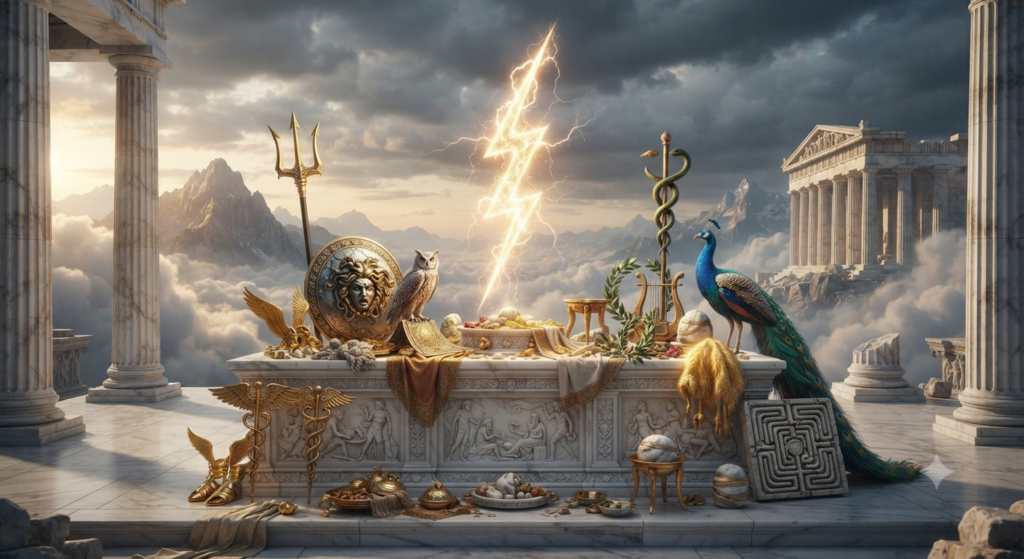
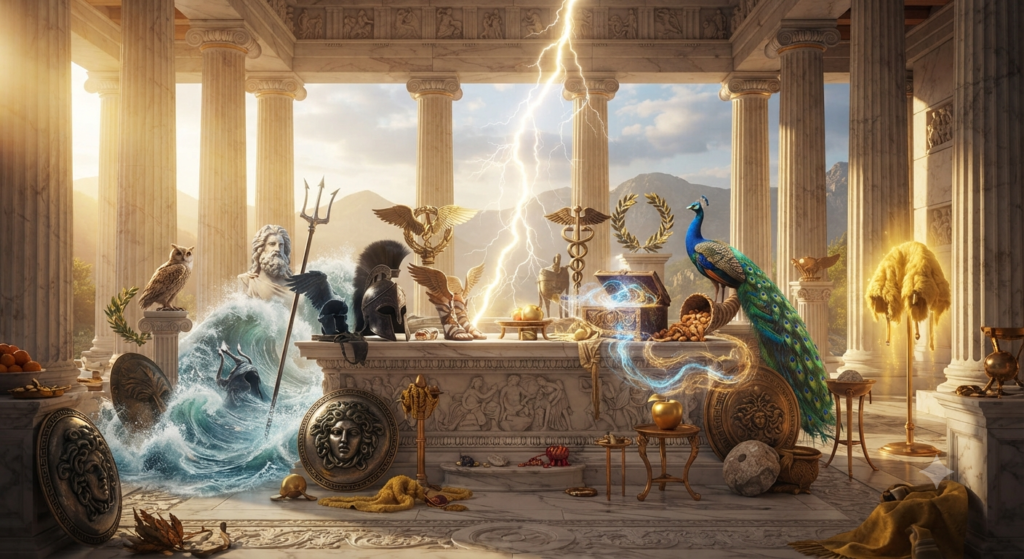
Greek mythology’s sacred objects gave visible, recognizable form to divine power, allowing worshippers, artists, and storytellers to identify a god’s presence at a glance. This guide brings together the essential symbols of Greek mythology, organized by the powers they represent, from the thunderbolt of Zeus to the sacred tripod of Delphi.
Divine Authority
Zeus’s Thunderbolt
Zeus’s thunderbolt, forged by the Cyclopes, was the ultimate weapon of divine authority in Greek mythology, capable of striking down gods, Titans, and mortals alike. It remains the most recognizable symbol of Zeus’s supreme rule over Mount Olympus.
Aegis
The aegis was a protective shield or cloak associated with both Zeus and Athena, often depicted fringed with serpents and bearing the head of a Gorgon. It symbolized divine protection so absolute that its bearer was considered untouchable in battle.
Poseidon’s Trident
Poseidon’s three-pronged trident could summon storms, shatter the earth, and calm or churn the seas at will. As his defining weapon, it represented his dominion over water, earthquakes, and the untamed power of the ocean.
Zeus’s Eagle
The eagle served as Zeus’s sacred messenger and living emblem, often depicted carrying his thunderbolts or perched beside his throne. Its soaring flight symbolized Zeus’s authority stretching across sky and earth alike.
Wisdom, Healing, and Messages
Caduceus
The caduceus, a winged staff entwined by two serpents, belonged to Hermes and represented commerce, negotiation, and safe passage between worlds, including the boundary between the living and the dead.
Staff of Asclepius
Frequently confused with the caduceus, the single-serpent Staff of Asclepius belonged to the god of medicine and symbolized healing, rejuvenation, and the practice of medicine itself — it remains a common medical emblem today.
Athena’s Owl
The owl accompanied Athena as a symbol of wisdom, watchfulness, and clear insight even in darkness. Its image appeared widely on Athenian coinage, reinforcing the goddess’s close bond with the city she protected.
Hermes’s Winged Sandals
Hermes’s winged sandals granted him extraordinary speed as messenger of the gods, allowing him to move freely between Olympus, the mortal world, and the underworld to deliver divine communications.
Victory, Peace, and Abundance
Laurel Wreath
Sacred to Apollo, the laurel wreath crowned victors in athletic and poetic competitions, including the ancient Pythian Games, symbolizing honor, achievement, and divine favor.
Olive Branch
Sacred to Athena following her mythical gift of the first olive tree to Athens, the olive branch came to represent peace, prosperity, and the fruits of civilized life.
Cornucopia
The cornucopia, or horn of plenty, symbolized inexhaustible abundance and nourishment, often associated with earth goddesses and harvest deities as a promise of prosperity.
Hera’s Peacock
The peacock, with its eye-marked tail feathers, symbolized Hera’s watchful authority as queen of the gods, its many “eyes” recalling the myth of the giant Argus placed there after his death.
Fate, Conflict, and Warning
Golden Apple of Discord
Inscribed “for the fairest,” the golden apple thrown among the goddesses by Eris sparked the Judgment of Paris and, ultimately, the Trojan War, making it a lasting symbol of vanity, rivalry, and unintended consequence.
Pandora’s Box
Pandora’s sealed jar, opened against warning, released suffering and hardship into the world, leaving only Hope behind — a symbol of both human curiosity and the fragile line between blessing and ruin.
Gorgoneion
The Gorgoneion, a stylized depiction of Medusa’s severed head, was used as a protective and apotropaic symbol, believed to ward off evil by mirroring its own terrifying power back at any threat.
Helm of Darkness
Belonging to Hades, the Helm of Darkness granted its wearer invisibility, symbolizing the hidden, unseen nature of death and the underworld itself.
Eros’s Bow
Eros’s golden arrows inspired uncontrollable love, while his leaden arrows provoked aversion, making his bow a symbol of desire’s unpredictable and often involuntary power over gods and mortals alike.
Sacred Places and Legendary Journeys
Golden Fleece
The Golden Fleece, guarded by a sleepless dragon in Colchis, symbolized kingship, legitimacy, and the reward of a heroic quest, central to the myth of Jason and the Argonauts.
Labyrinth
Designed by Daedalus to contain the Minotaur, the labyrinth symbolized confinement, complexity, and the trials a hero must navigate to overcome monstrous threats.
Omphalos
The omphalos, or “navel of the world,” marked Delphi as the mythological center of the earth, determined when Zeus released two eagles from opposite ends of the world to meet there.
Delphi Tripod
The sacred tripod at Delphi served as the seat of the Pythia, Apollo’s oracle, and became a lasting symbol of prophecy, divine communication, and the authority of Apollo’s sanctuary.
Clarifications and Distinctions
Caduceus vs. Staff of Asclepius
Though frequently confused, especially in medical branding, the two symbols are distinct: the single-serpent Staff of Asclepius represents healing and medicine, while the double-serpent, winged Caduceus belongs to Hermes and represents commerce and messages.
Is the Greek Eye (Mati) Part of Greek Mythology?
The evil-eye-warding “mati” is a widespread folk-cultural and religious practice across Greece and the Mediterranean rather than a symbol drawn from classical Greek mythology proper; it belongs to folk tradition and popular religion rather than the Olympian mythological canon.
Why Does Every God Have Their Own Symbols?
Distinct attributes and symbols allowed ancient worshippers and artists to instantly identify each deity in art, cult ritual, and storytelling, reinforcing each god’s specific domain and personality within a crowded, elaborate pantheon.
Frequently Asked Questions
What is the most powerful symbol in Greek mythology?
Zeus’s thunderbolt is often considered the most powerful symbol, representing supreme divine authority capable of overturning both gods and mortals.
Are Greek symbols used in modern medicine?
Yes — the Staff of Asclepius remains a widely used medical symbol today, sometimes confused with the unrelated Caduceus of Hermes.
What does the olive branch symbolize in Greek mythology?
The olive branch represents peace and prosperity, tracing back to Athena’s mythical gift that won her patronage of Athens over Poseidon.
Why is the Gorgon head used as a protective symbol?
The Gorgoneion was believed to ward off evil through its own frightening power, a common apotropaic practice in ancient Mediterranean cultures.
What is the significance of the Golden Fleece?
The Golden Fleece symbolized royal legitimacy and heroic achievement, serving as the object of Jason and the Argonauts’ famous quest.
Did every Greek city worship the same symbols?
While major Panhellenic symbols were widely recognized, local cults often emphasized regional variations and additional symbols specific to their patron deities.
How were these symbols represented in ancient art?
These symbols appeared extensively on pottery, coinage, temple friezes, and sculpture, serving as visual shorthand for specific gods and their myths.
Do Greek symbols still appear in popular culture today?
Yes — symbols like the laurel wreath, thunderbolt, and caduceus remain widely used today in everything from Olympic imagery to corporate logos and medical branding.

Orin Vale has spent the better part of two decades tracing the threads that connect the world’s oldest stories — from the halls of Asgard to the banks of the Nile, from Olympus to the jungles of the Maya. What began as a childhood fascination with flood myths and trickster gods grew into years of independent study across comparative mythology and ancient religion, always chasing the same question: what did these stories mean to the people who first told them? Orin writes for readers who want more than trivia — the ones looking for the beliefs, fears, and truths that myths were built to carry.