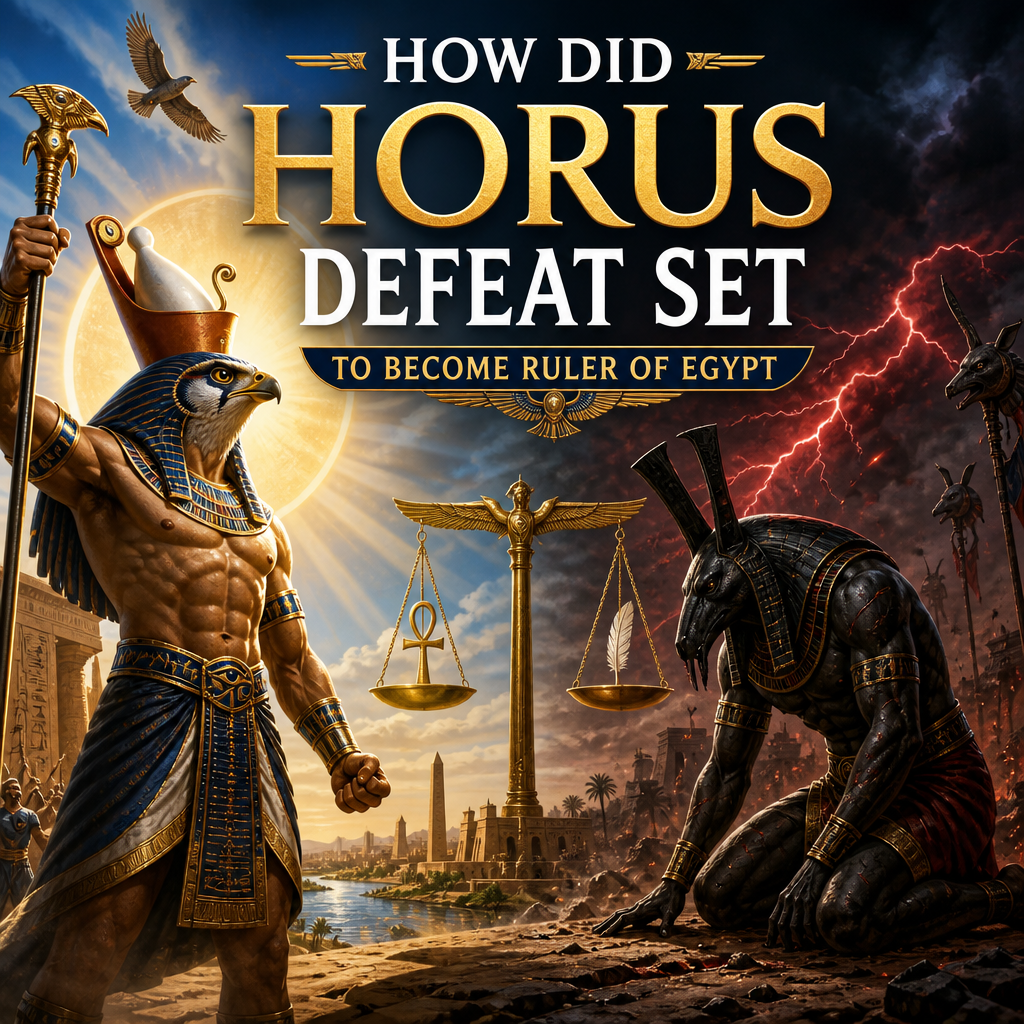
How Did Horus Defeat Set to Become Ruler of Egypt?
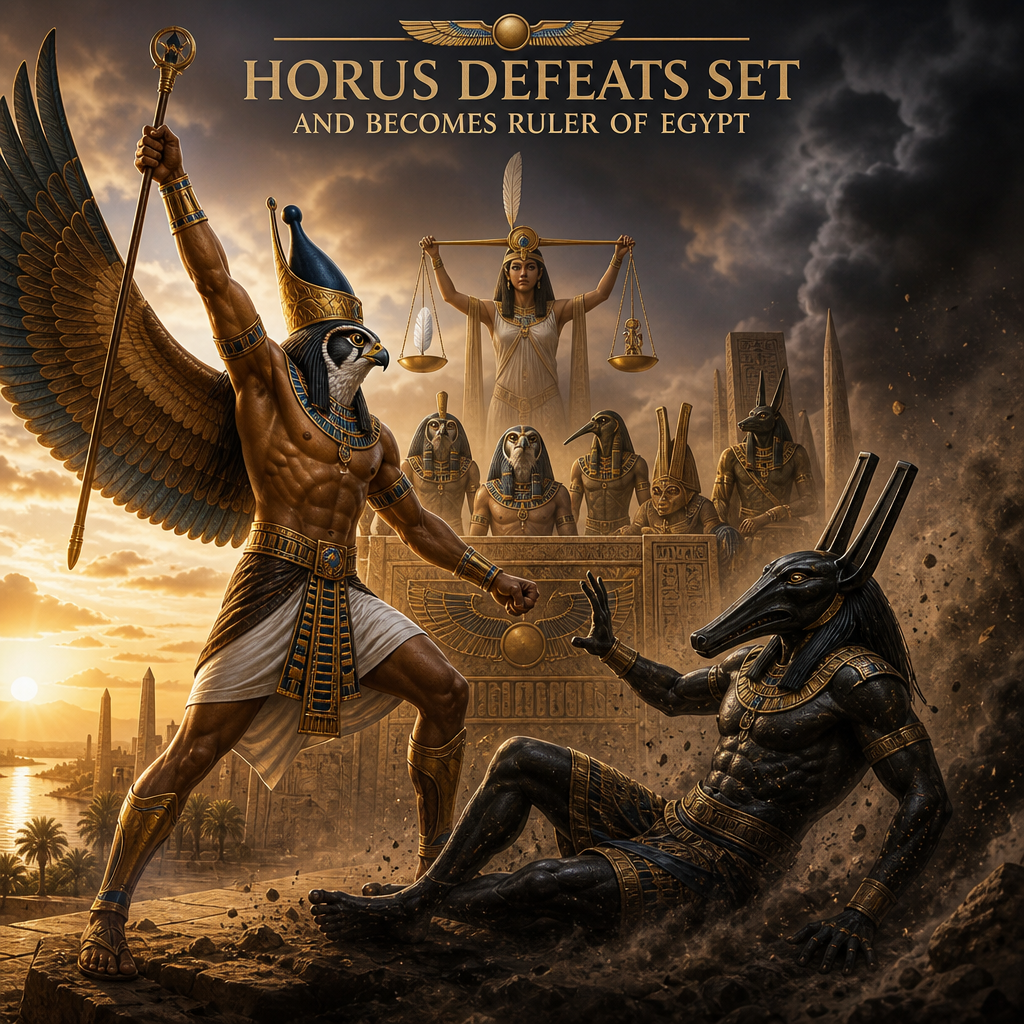
The story of how did Horus defeat Set to become ruler of Egypt is one of the most famous myths from ancient Egyptian religion. It is a tale of murder, revenge, divine justice, and the struggle for rightful kingship.
At its heart, the myth explains why Horus became the divine symbol of the Egyptian pharaoh and why order was believed to triumph over chaos.
The Conflict Begins With Osiris
To understand Horus’s victory, the story begins with his father, Osiris.
Osiris was a wise and beloved king of Egypt. He brought civilization, agriculture, and law to the land. His brother Set, however, was jealous of his power and popularity. Set was associated with storms, deserts, violence, and disorder.
Driven by envy, Set murdered Osiris and took the throne for himself. In many versions of the myth, Set trapped Osiris in a coffin and cast it into the Nile. Later, he cut Osiris’s body into pieces and scattered them across Egypt.
Osiris’s wife, Isis, searched for the remains of her husband. Through magic and devotion, she restored him long enough to conceive their son, Horus.
Horus Is Hidden and Raised by Isis
After Horus was born, Isis knew he was in danger. Set would try to destroy any heir who could challenge his rule.
So Isis hid Horus in the marshes of the Nile Delta. There, she protected him from snakes, scorpions, wild animals, and Set’s spies. Horus grew up knowing that he was the rightful heir to the throne of Egypt.
When he became strong enough, Horus challenged Set for kingship.
This was not only a family dispute. In Egyptian belief, it was a cosmic struggle between:
- Horus, representing order, rightful rule, and kingship
- Set, representing chaos, violence, and disruption
The Divine Trial Before the Gods
Horus did not simply attack Set and take the throne. The dispute was brought before a divine council, often called the Ennead, a group of powerful Egyptian gods.
The gods had to decide who had the rightful claim to rule Egypt.
Horus argued that he was the son of Osiris and therefore the legitimate heir. Set argued that he was stronger and more experienced, making him better suited to rule.
The trial lasted a long time. Some gods supported Horus because of his rightful inheritance. Others were impressed by Set’s strength.
Ra, the sun god, sometimes favored Set because Set was powerful and useful in defending the solar boat against enemies of the sun. Isis, however, used cleverness and magic to support her son’s claim.
Battles Between Horus and Set
The myth includes several contests between Horus and Set. These battles were physical, magical, and symbolic.
In one famous episode, Horus and Set fought violently, and Horus lost one of his eyes. This injured eye later became known as the Eye of Horus, a powerful symbol of healing, protection, and restoration.
Set was also wounded in the struggle. Their injuries showed that the battle for kingship came at a great cost.
The Boat Race
In another well-known contest, the gods ordered Horus and Set to race in boats made of stone. Set carved his boat from real stone, which sank immediately.
Horus, however, made a wooden boat and covered it with plaster so it looked like stone. His boat floated, giving him an advantage.
This episode shows Horus as intelligent and strategic, while Set is often portrayed as forceful but less wise.
Isis Intervenes
Isis repeatedly helped Horus during the conflict. At times, she used magic to expose Set’s wrongdoing. In one story, she disguised herself as a woman seeking justice and tricked Set into admitting that a son should inherit his father’s property.
By his own words, Set confirmed Horus’s right to the throne.
This moment was important because Egyptian kingship depended not only on strength but also on legitimacy and divine order.
The Judgment of the Gods
Eventually, the gods decided that Horus was the rightful ruler of Egypt.
In some versions, the final decision came after Osiris, now ruler of the underworld, sent a powerful message to the gods. Osiris reminded them that he had authority over the dead and that justice must be honored.
The gods then awarded the throne to Horus.
Set was defeated, but he was not always destroyed. In many traditions, he was given a different role. Rather than ruling Egypt, Set was sometimes placed in the service of Ra, helping fight the serpent Apophis, the enemy of the sun.
This reflects an important idea in Egyptian religion: chaos could not be completely removed, but it could be controlled and put in its proper place.
Horus Becomes Ruler of Egypt
When Horus became ruler, he restored balance to the world. His victory represented the triumph of ma’at, the Egyptian concept of truth, justice, harmony, and cosmic order.
From that point on, Egyptian pharaohs were closely associated with Horus. Each living king was seen as the earthly form of Horus, while a deceased king was linked with Osiris.
This connection gave the pharaoh divine authority. By ruling as Horus, the king was expected to protect Egypt from chaos and preserve order.
Why the Myth Mattered
The story of how Horus defeated Set to become ruler of Egypt was more than entertainment. It explained the nature of kingship, justice, and the balance of the universe.
For ancient Egyptians, the myth taught that:
- rightful rule must be defended
- chaos is dangerous but can be controlled
- justice may take time, but order should prevail
- the pharaoh’s authority came from the gods
Horus’s victory over Set became one of the central myths of Egyptian civilization. It shaped royal ideology for thousands of years and gave meaning to the role of every pharaoh who ruled the Nile Valley.
Conclusion
So, how did Horus defeat Set to become ruler of Egypt? He did it through a combination of strength, endurance, intelligence, divine support, and legitimate inheritance.
Horus fought Set in battle, competed against him in contests, survived injury and betrayal, and finally won the judgment of the gods. His victory restored order after the murder of Osiris and established Horus as the rightful king.
In ancient Egyptian belief, this was not just the victory of one god over another. It was the victory of order over chaos, justice over violence, and rightful kingship over unlawful power.

Orin Vale has spent the better part of two decades tracing the threads that connect the world’s oldest stories — from the halls of Asgard to the banks of the Nile, from Olympus to the jungles of the Maya. What began as a childhood fascination with flood myths and trickster gods grew into years of independent study across comparative mythology and ancient religion, always chasing the same question: what did these stories mean to the people who first told them? Orin writes for readers who want more than trivia — the ones looking for the beliefs, fears, and truths that myths were built to carry.