Anyone asking who is the goddess of war in Norse mythology arrives at Freyja, a deity whose authority over battle exists alongside an equally significant role governing love, fertility, and magic. Freyja in Norse mythology stands apart from single-domain war deities found in other mythological traditions, embodying instead a duality that connects the passions of love with the brutal reality of the battlefield. Understanding who is the goddess of war in Norse mythology requires recognizing that Freyja’s power over war was never separate from her broader identity — in the Norse worldview, desire, death, and glory were bound together within the same divine figure.
Freyja — The Norse Goddess of War and Love
Freyja ruled over an unusually wide combination of domains, including love, fertility, beauty, magic, and war, making her one of the most multifaceted deities within Norse mythology. As the goddess of war in Norse mythology, Freyja claimed a share of warriors who died in battle, a role that placed her firmly within the mythological framework surrounding death, combat, and honor, even as she remained equally associated with romantic and sensual matters.
This dual identity often surprises those first encountering Freyja, since modern assumptions frequently expect a goddess of war to embody only aggression or martial discipline. Instead, Norse mythology presents Freyja as a figure whose command over both love and war reflects the tightly interconnected nature of Norse cosmology, where fate, passion, and violence were rarely treated as entirely separate forces.
Freyja’s authority over war becomes especially clear through her right to choose among slain warriors on the battlefield, taking half of them to her hall while the remainder went to Odin. This arrangement placed Freyja on comparable footing with Odin himself regarding the fate of fallen warriors, reinforcing that her role as goddess of war in Norse mythology carried genuine weight rather than existing as a secondary or minor function within the pantheon.
Freyja’s prominence within Norse mythology, then, cannot be reduced to a single domain. Her identity as goddess of war in Norse mythology exists in constant dialogue with her equally significant roles governing love and magic, illustrating a distinctly Norse understanding of divinity in which power over life’s most intense experiences — desire, death, and glory — converged within one deity rather than being distributed among several separate figures.
Origins and Family of Freyja
Freyja belonged to the Vanir, a group of Norse gods associated with fertility, prosperity, and nature, distinguishing her origin from deities born directly among the Aesir, such as Odin or Thor. Her father, Njörðr, ruled over the sea and wealth, and this Vanir heritage shaped much of Freyja’s early identity before her eventual integration into the wider Norse pantheon following the war between the Aesir and the Vanir.
Freyja’s twin brother, Freyr, shared many of the same associations with fertility and prosperity, and the two siblings remained closely linked throughout Norse mythological tradition. This sibling relationship reinforced Freyja’s connection to the Vanir even after she came to live among the Aesir, illustrating how thoroughly her identity remained tied to her original divine lineage even as her influence expanded into new territory, including her role as goddess of war in Norse mythology.
The conflict between the Aesir and the Vanir, one of the foundational wars in Norse mythology, resulted in an exchange of hostages between the two groups, bringing Freyja and Freyr into Asgard alongside the Aesir gods. This transition marked a significant turning point, as Freyja’s presence among the Aesir allowed her influence — including her authority over slain warriors — to become fully integrated into the broader Norse mythological structure surrounding war and the afterlife.
Freyja’s family life also included a husband, Óðr, whose mysterious disappearance became the subject of several myths involving Freyja’s grief and search for him. Alongside this relationship, Freyja had daughters, further expanding her family narrative beyond her role as goddess of war in Norse mythology into a more personal, emotionally resonant dimension that distinguished her from more distant or purely authoritative deities.
Symbols and Depictions of Freyja
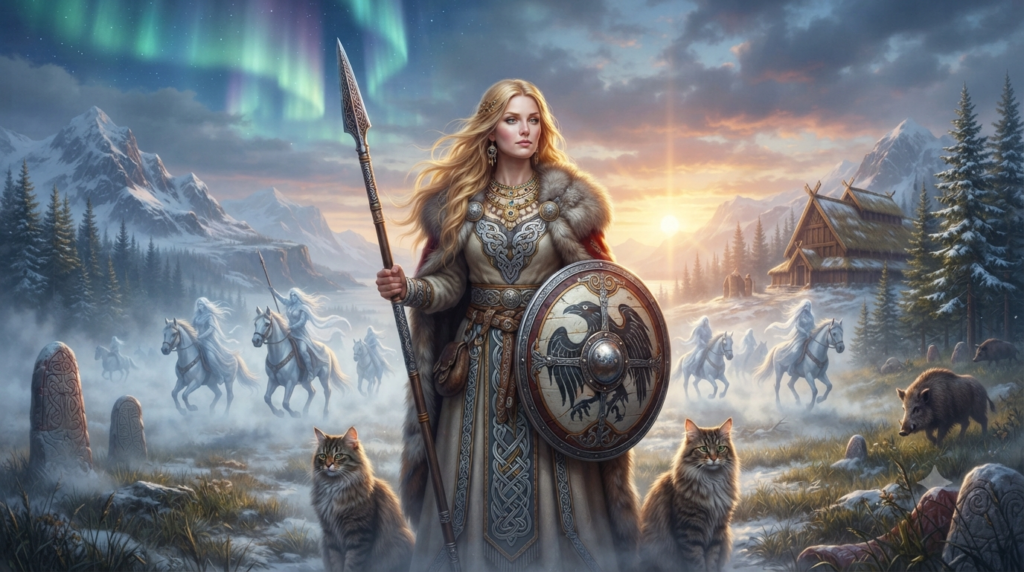
Freyja’s falcon-feather cloak stands among her most distinctive symbols, granting her the ability to transform into a falcon and travel swiftly between realms. This symbol reinforced her association with both magic and mobility, qualities that complemented her role as goddess of war in Norse mythology by emphasizing her active, far-reaching involvement in the affairs of both gods and mortals.
The necklace Brísingamen represents another central symbol tied to Freyja, acquired through a myth involving dwarven craftsmen and often associated with her beauty, desirability, and personal power. This object appears repeatedly throughout Norse mythological sources, reinforcing Freyja’s connection to both material wealth and the deeper magical authority she held as one of the most powerful figures among the Vanir and Aesir alike.
Freyja was frequently depicted traveling in a chariot pulled by cats, an image that distinguished her visually from other Norse deities and reinforced her association with both domestic and wild elements of the natural world. This unusual mode of transportation added a distinctive, memorable dimension to her mythological identity, setting her apart even among the goddess of war in Norse mythology despite her serious, battle-related responsibilities.
Freyja’s connection to the boar Hildisvíni further reinforced her ties to protection and battle readiness, as boars held strong symbolic associations with strength and ferocity throughout Norse culture. Combined with her falcon cloak and Brísingamen necklace, these symbols collectively illustrate a goddess whose identity blended beauty, magic, and martial authority into a single, cohesive mythological figure.
Freyja’s Role Among the Gods
Freyja’s most direct connection to war within Norse mythology came through her authority over Fólkvangr, her heavenly field where she received half of all warriors who died in battle. This arrangement placed her in direct parallel with Odin, who received the other half into Valhalla, establishing Freyja as a genuinely co-equal authority over the fate of fallen warriors rather than a subordinate or minor figure in matters of war and death.
Beyond her role receiving slain warriors, Freyja was recognized as a master of seiðr, a form of Norse magic associated with foresight, fate, and influence over future events. This magical authority added another dimension to her power, suggesting that her role as goddess of war in Norse mythology extended beyond the battlefield itself into the deeper, more mysterious forces believed to shape the outcomes of conflict and destiny.
Following the integration of the Vanir into Asgard, Freyja held a respected position among the Aesir gods, bridging the two divine groups through her presence and continued influence. This standing reinforced her importance within the broader Norse pantheon, as her authority over both love and war made her a uniquely versatile figure whose influence touched multiple aspects of both divine and mortal life.
Freyja’s role among the gods, therefore, extended well beyond a narrow definition of martial authority. Her combined influence over war, magic, and desire positioned her as one of the most powerful and multifaceted deities in Norse mythology, reinforcing why she remains the clearest answer whenever the question of who is the goddess of war in Norse mythology arises.
Key Myths Featuring Freyja
The myth surrounding Freyja’s acquisition of the necklace Brísingamen describes her negotiating with a group of dwarven craftsmen to obtain the legendary object, a story that highlights both her determination and her willingness to pursue what she desired regardless of difficulty. This myth reinforced Freyja’s reputation as a goddess unafraid to act decisively, a trait that aligns closely with her broader identity as goddess of war in Norse mythology.
One of the more dramatic myths involving Freyja describes an attempt by the giant Þrymr to force her into marriage after stealing Thor’s hammer, Mjölnir, as leverage. Rather than comply, the gods devised a plan in which Thor disguised himself as Freyja to retrieve the hammer, a story that, while comedic in tone, underscores just how highly Freyja’s status was valued among the gods — significant enough that her forced marriage was treated as an unacceptable outcome requiring direct intervention.
Freyja’s search for her missing husband, Óðr, appears across several Norse sources, describing her extensive travels and grief as she sought him throughout the world. During this search, Freyja was said to weep tears of gold, further connecting her personal sorrow to her association with wealth and material symbolism, while also reinforcing the emotional depth present within her mythology beyond her role in battle.
These myths collectively demonstrate that Freyja’s significance within Norse mythology extended well beyond her function as goddess of war. Her personal struggles, determination, and magical capabilities added considerable depth to her character, illustrating why she remains one of the most compelling and thoroughly developed figures within the entire Norse mythological tradition.
Freyja vs. Odin — Two Rulers of the Slain
Freyja and Odin shared a unique arrangement within Norse mythology regarding the fate of warriors killed in battle, with each receiving half of the fallen to their respective halls. This division placed Freyja on remarkably equal footing with Odin in matters directly related to war and death, reinforcing that her role as goddess of war in Norse mythology carried authority comparable to even the chief god of the Aesir.
Despite this shared authority, Odin’s role emphasized strategy, wisdom, and the accumulation of warriors for the eventual battle of Ragnarök, while Freyja’s connection to the slain existed alongside her broader domains of love, fertility, and magic. This distinction illustrates a key difference in emphasis: where Odin’s involvement in war centered on preparation and foresight, Freyja’s authority reflected a more holistic connection between love, death, and glory.
This comparison between Freyja and Odin highlights how Norse mythology distributed authority over war across multiple deities rather than concentrating it within a single figure. Rather than diminishing Freyja’s importance, this shared arrangement reinforces her standing as a genuinely powerful goddess of war in Norse mythology, whose authority existed independently rather than as a lesser extension of Odin’s own role.
Understanding this parallel between Freyja and Odin provides essential context for anyone exploring who is the goddess of war in Norse mythology, as it clarifies that Freyja’s power was not incidental or secondary but formally recognized through her direct claim over a significant portion of Norse mythology’s most consequential outcome — the fate of warriors who died in battle.
Why Freyja Matters in Norse Mythology Today
Modern interest in Freyja continues to grow, driven largely by her uniquely multifaceted identity compared to more narrowly defined mythological figures. As goddess of war in Norse mythology who simultaneously governs love, magic, and fertility, Freyja offers a strikingly complex model of divine power that resonates with contemporary audiences interested in nuanced, multidimensional characters.
Freyja’s presence in modern literature, games, and popular culture has introduced her name and mythology to audiences who may otherwise know little about Norse religious tradition, often drawing directly on her combined associations with beauty, magic, and battle. This continued visibility demonstrates how thoroughly her original mythological complexity has translated into modern reinterpretations of Norse mythology.
The combination of vulnerability and authority present in Freyja’s mythology — from her grief over Óðr’s disappearance to her firm claim over slain warriors — offers modern audiences a figure whose power feels genuinely earned rather than simply granted. This balance is central to why the question of who is the goddess of war in Norse mythology continues to generate deep interest rather than a simple, surface-level answer.
Ultimately, Freyja matters in Norse mythology today because she represents a distinctly Norse understanding of power: one in which love, magic, and war are not separate domains but interconnected forces governed by the same formidable deity. Her enduring legacy confirms that this integrated vision of divine authority remains as compelling now as it was within the original Norse mythological tradition.
FAQ — Quick Answers About the Norse Goddess of War
Who is the goddess of war in Norse mythology?
Freyja is the goddess of war in Norse mythology, receiving half of all warriors slain in battle while also governing love, fertility, beauty, and magic.
Is Freyja part of the Aesir or the Vanir?
Freyja originally belonged to the Vanir gods but joined the Aesir in Asgard following the war and subsequent exchange of hostages between the two divine groups.
What is Fólkvangr?
Fólkvangr is Freyja’s heavenly field, where she receives half of the warriors who die in battle, paralleling Odin’s hall, Valhalla.
Who is Freyja’s brother?
Freyja’s twin brother is Freyr, another prominent deity among the Vanir associated with fertility and prosperity.
What is Freyja’s necklace called?
Freyja’s necklace is called Brísingamen, a legendary object she acquired from dwarven craftsmen, closely tied to her beauty and personal power.
Conclusion
Anyone who sets out to answer who is the goddess of war in Norse mythology arrives at Freyja, a deity whose authority over battle exists inseparably from her power over love, magic, and fertility. From her origins among the Vanir to her equal claim alongside Odin over the fate of slain warriors, Freyja’s mythology reflects a distinctly Norse vision of divinity where passion and violence remain deeply intertwined.
Her symbols — the falcon cloak, the necklace Brísingamen, and her chariot of cats — alongside myths detailing her determination, grief, and magical mastery, reveal a goddess of remarkable depth and complexity. Her parallel role with Odin over the fallen further confirms that her authority over war was genuine and formally recognized, not a secondary aspect of a primarily romantic identity.
Ultimately, Freyja endures as the goddess of war in Norse mythology precisely because her story resists simplification, embodying the Norse belief that love, death, and glory were never truly separate forces, but different expressions of the same profound and formidable divine power.

Orin Vale has spent the better part of two decades tracing the threads that connect the world’s oldest stories — from the halls of Asgard to the banks of the Nile, from Olympus to the jungles of the Maya. What began as a childhood fascination with flood myths and trickster gods grew into years of independent study across comparative mythology and ancient religion, always chasing the same question: what did these stories mean to the people who first told them? Orin writes for readers who want more than trivia — the ones looking for the beliefs, fears, and truths that myths were built to carry.