What does fire symbolize in Greek mythology?
In Greek mythology, fire symbolizes far more than heat or destruction. It can stand for divine authority, stolen knowledge, ritual purity, domestic order, artistic skill, punishment, and the dangerous boundary between gods and mortals. The same element that warms the household and lights the altar can also consume cities, test heroes, and reveal the power of Zeus. Because Greek myth preserves many voices and versions, fire appears not as a single symbol but as a force whose meaning changes with the god, the setting, and the story. ## Fire as divine power in Greek myth
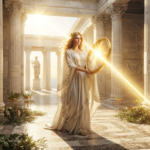
In the oldest Greek poetic sources, fire belongs first to the gods. It is not simply a useful discovery, but a mark of divine presence and command. When mortals encounter sacred fire in myth and ritual, they are approaching a power that exceeds ordinary human control. Zeus can send lightning, Apollo can carry radiant force, and the gods of Olympus are imagined in a realm where fire signifies brilliance, authority, and separateness from mortal life. The element is thus tied to transcendence: to possess fire is to touch something that belongs to the divine order.
At the same time, Greek myth treats fire as ambivalent power. It illuminates, but it also judges; it purifies, but it also destroys. This double nature appears throughout epic and later mythic tradition. Fire is never merely material. It is a sign of nearness to the gods, and therefore a reminder that the boundary between human use and divine possession is fragile. Mortals may benefit from it, but they never fully command it without risk.
Prometheus and the stolen gift of fire
The most famous myth of fire in Greek tradition is the tale of Prometheus, especially as told by Hesiod. In Theogony and Works and Days, Prometheus deceives Zeus in the division of sacrificial meat and later steals fire for humanity. In some versions, he hides the flame in a fennel stalk; in others, the details vary, but the central act is the same: fire is taken from the gods and given to mortals. This makes fire a symbol of cunning intelligence, technological progress, and the tension between human advancement and divine authority.
Prometheus’s gift is also a wound in the cosmic order. Zeus punishes both the Titan and humankind, showing that fire carries consequences as well as benefits. For humans, the stolen flame means civilization: cooking, craft, warmth, and a life no longer entirely dependent on raw nature. Yet it also marks the beginning of suffering, because Zeus responds with the creation of Pandora and the hardships that follow. In this myth, fire symbolizes knowledge gained through transgression, a gift that cannot be separated from loss.
Sacred fire in Olympus and mortal life
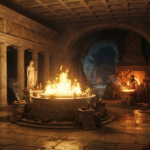
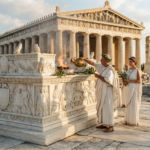
In Homeric and later tradition, fire appears as a sacred medium linking Olympus and earth. The gods themselves are associated with brightness, and sacrificial fire becomes the human means of addressing them. Altars, offerings, and smoke rising upward all depend on flame. In this setting, fire symbolizes communication: it carries the mortal gift toward the divine and transforms raw matter into something fit for holy exchange. The altar fire is not merely practical; it is part of the language of worship.
Mortal life, too, is structured by fire. A household without a hearth is exposed and incomplete, while a community without sacrificial flame lacks a clear bond with the gods. Fire therefore stands at the center of Greek social and religious life. It marks the difference between wilderness and settlement, between survival and ordered existence. To keep fire is to maintain culture itself, and to lose it is to risk a return to vulnerability.
Hephaestus, forge flames, and craft
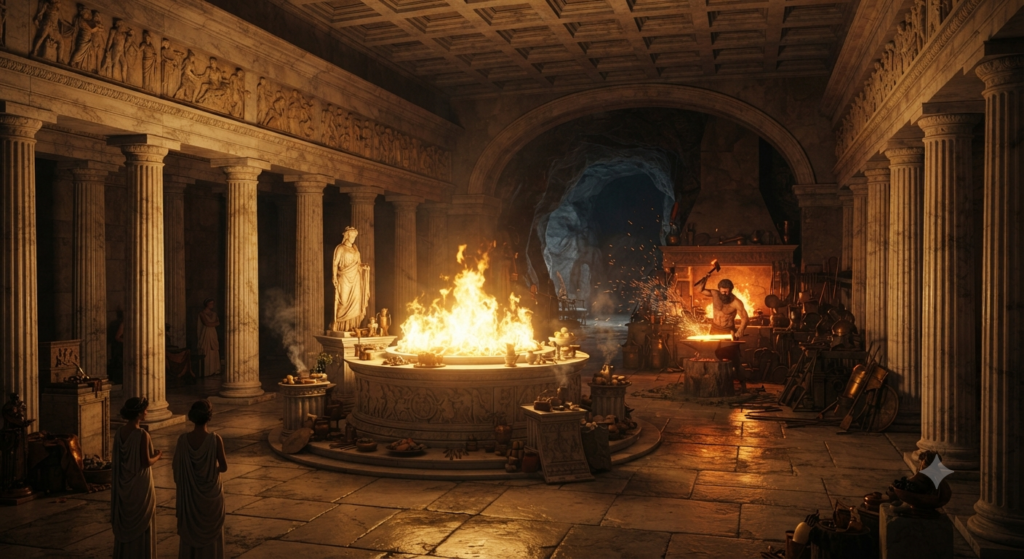
Hephaestus embodies the constructive side of fire. As divine smith, he governs the forge, where flame becomes metal, shape, and weapon. In Homer and later myth, his craftsmanship produces the arms of heroes, marvelous automatons, and objects of extraordinary precision. His fire symbolizes not destruction but transformation through skill. It is the force that makes civilization visible in bronze, iron, and gold.
Yet Hephaestus’s fire is also difficult and liminal. The forge is not a domestic hearth; it is an intensely controlled blaze, linked to labor, pain, and mastery over resistant materials. The god himself is often portrayed as physically impaired, which deepens the symbolism: the work of fire is not graceful in the ordinary sense, but exacting and powerful. Through Hephaestus, Greek myth presents fire as the source of art, technology, and productive intelligence.
Hestia’s hearth and the order of home
If Hephaestus represents fire as craft, Hestia represents fire as stability. Her hearth is the center of the household and, by extension, the city. In Greek thought and ritual, the hearth flame symbolizes continuity, kinship, hospitality, and lawful order. A home’s fire is not simply for cooking; it is the sign that a household is alive as a social unit. In civic life, public hearths also signal the unity and endurance of the community.
Hestia’s symbolism is quiet but profound. Unlike the violent blaze of battle or the consuming fire of punishment, the hearth flame must be steady. It gathers people rather than scattering them. Because of this, fire under Hestia’s guardianship stands for domestic peace, public cohesion, and the sacred permanence of settled life. It is the most human form of flame in Greek myth, one that transforms wilderness into home.
Fire as punishment in Zeus’s justice
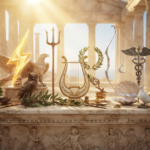
Greek myth often uses fire as an instrument of divine retribution. Zeus’s justice is not always subtle, and fire can appear as the visible expression of his power. The thunderbolt, a fiery weapon, is one of his clearest symbols: it strikes down offenders, destroys hubris, and affirms the hierarchy between god and mortal. In this sense, fire represents judgment made visible in the natural world. It is not random violence, but cosmic correction as the Greeks understood it.
This punitive symbolism also extends to stories in which fire exposes overreaching ambition. When mortals or lesser gods seek what should not be theirs, fire often returns as consequence. The brilliance of flame becomes a warning that the universe is not morally neutral. Zeus’s fire is therefore both dazzling and terrifying, a sign that divine order can be enforced with overwhelming force. It reminds mythic audiences that sacred power can illuminate, but it can also erase.
Purification rites and cleansing flames
Fire in Greek religion was also a means of purification. In ritual practice, flame could cleanse what was polluted by bloodshed, death, or contact with the impure. This does not mean fire was understood as morally “good” in a modern sense. Rather, it was a transforming force that could separate, reduce, and renew. Its heat consumed contamination and restored a person, object, or space to a condition suitable for sacred use.
This cleansing symbolism appears in many ancient Mediterranean religious systems, and Greek practice fits within that broader world. A burnt offering, a purifying flame, or a ritual fire at a shrine all depend on the idea that fire can remove what should not remain. In mythology, this makes fire a bridge between danger and restoration. It destroys the unclean so that order may return. Its power lies not only in burning, but in making possible a new beginning.
Destruction, renewal, and volcanic fire
Greek myth knows very well that fire can destroy cities, forests, and even entire landscapes. This destructive aspect is not separate from its sacred meaning; rather, it is part of the same power. Volcanic regions, burning fields, and divine fires in myth all suggest a world in which the earth itself can become unstable. Later ancient writers and local traditions sometimes linked volcanoes with the depths of divine or monstrous activity, reinforcing the sense that fire comes from beneath as well as above.
At the same time, destruction can imply renewal. A burned field may later become fertile, and a ruined order may give rise to another. Greek myth often works through cycles rather than simple endings. Fire clears, reduces, and exposes, making new growth possible even when the immediate result is devastation. That tension gives fire one of its deepest meanings in the Greek imagination: it is the force that ends one form of life so that another may eventually emerge.
Torchlight, ritual, and mystery cults
Torches occupy a special place in Greek religious symbolism. They appear in processions, nocturnal rites, and the mysteries associated with Demeter and Persephone, among others. In these settings, fire symbolizes guidance through darkness, sacred revelation, and the crossing of thresholds. A torch does not banish all darkness; it marks a path through it. This makes it especially suited to rites that involve searching, descent, return, or hidden knowledge.
The ritual torch also carries emotional and symbolic weight. It can suggest grief, longing, vigilance, or initiation into sacred secrets. In mystery cult contexts, fire often signals a passage from ignorance to recognition, though the specifics varied by cult and location. Because these rites were deliberately secretive, ancient testimony is partial, but the broader pattern is clear: fire stands for illumination that is not merely visual, but spiritual and ceremonial.
Fire symbolism in heroes and monsters
Heroes in Greek myth often encounter fire as a test of character. They may receive it as a divine aid, wield it through crafted weapons, or confront it as a danger that measures courage and intelligence. Fire can accompany heroic strength, but it is rarely tamed completely. The successful hero understands when to use flame, when to endure it, and when to respect its limits. In this sense, fire symbolizes the dangerous edge of excellence.
Monsters, by contrast, may be associated with fire as a sign of their unnatural force. Dragons, giants, and other threatening beings often inhabit fiery landscapes or possess burning breath and volcanic associations in later traditions. Even when the exact details differ across sources, the symbolism is consistent: fire marks beings that stand outside ordinary order. Whether in heroic hands or monstrous ones, it remains an element of power that reveals what lies beyond the human norm.
In Greek mythology, fire symbolizes divine authority, stolen intelligence, sacred ritual, domestic stability, craftsmanship, punishment, purification, destruction, and renewal. It belongs to gods and mortals alike, but never in the same way. As a result, fire becomes one of the richest symbols in the Greek imagination: a single element that can warm the hearth, light the altar, forge a weapon, or bring a city to ruin.

Orin Vale has spent the better part of two decades tracing the threads that connect the world’s oldest stories — from the halls of Asgard to the banks of the Nile, from Olympus to the jungles of the Maya. What began as a childhood fascination with flood myths and trickster gods grew into years of independent study across comparative mythology and ancient religion, always chasing the same question: what did these stories mean to the people who first told them? Orin writes for readers who want more than trivia — the ones looking for the beliefs, fears, and truths that myths were built to carry.