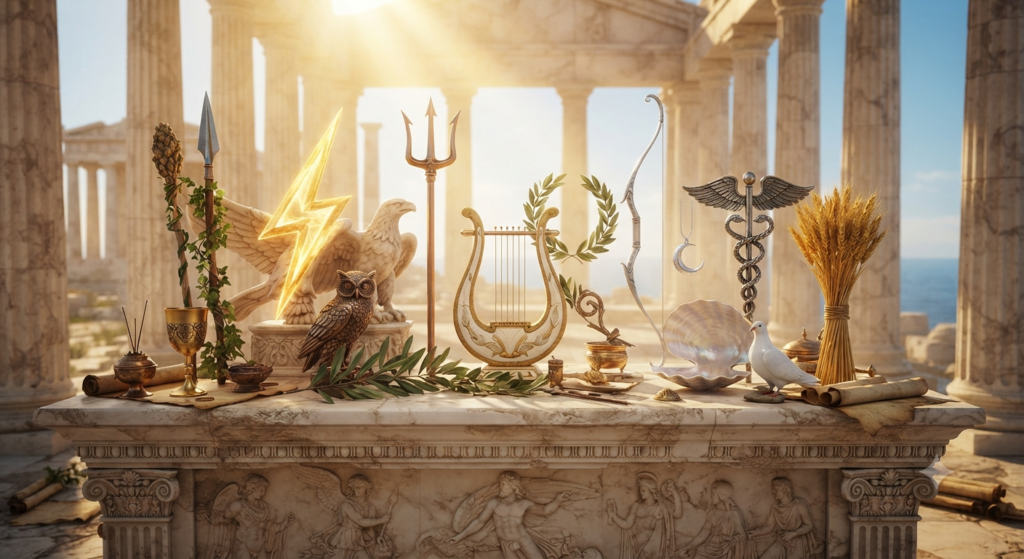
In Greek mythology, gods are often recognized not by portraits alone but by the symbols that gather around them: the thunderbolt in Zeus’s hand, the owl beside Athena, the vine entwined with Dionysus. These emblems appear in poetry, vase painting, sculpture, and later artistic traditions, and they help identify each deity’s sphere of power, character, and worship. Some symbols are firmly attested in classical sources, while others emerged through long use in art and local cult practice.
Greek gods and their sacred symbols
Greek divine symbols are more than decorative shorthand. They reflect how the gods were understood in relation to the natural world, human life, and civic order. A lightning bolt suggests authority over the sky; an olive tree points to peace, wisdom, and prosperity; a mask can signal the ritual world of theater and altered identity. In many cases, these signs became so closely associated with a god that they remained recognizable across centuries of retelling.
The list of Greek god symbols is not entirely uniform, since different city-states and authors emphasized different aspects of each deity. Homer, Hesiod, the Homeric Hymns, Apollodorus, Pausanias, and later Roman writers all preserve overlapping but sometimes distinct traditions. Even so, the major symbols of the Olympian gods are stable enough to form a shared visual language that has endured from antiquity to the present.
Zeus symbols: thunderbolt, eagle, and oak
Zeus is most strongly identified with the thunderbolt, the weapon of divine kingship and sky power. In Homeric poetry, Zeus rules from high heaven and hurls thunder as a sign of judgment and authority; the thunderbolt became his unmistakable emblem in art and cult. It is not merely a tool of destruction but a symbol of the ordered force that secures Zeus’s dominion over gods and mortals alike.
The eagle and the oak complete this royal imagery. The eagle appears as Zeus’s sacred bird in a wide range of classical art, a creature associated with height, watchfulness, and supreme power. The oak, especially at Dodona, belonged to one of Zeus’s oldest sanctuaries and was linked to his oracle; its rustling leaves were understood as a voice through which the god could speak. Together these symbols present Zeus as ruler of storm, sky, and sacred law.
Poseidon symbols of sea power and horses
Poseidon is commonly represented by the trident, though the sea itself is equally central to his identity. The trident appears in myth and art as an instrument of force, capable of striking the earth, stirring the waters, or asserting control over the deep. In Homer and later tradition, Poseidon’s realm extends beyond the sea to earthquakes, which helped shape his image as a god of immense, unstable power.
Horses are another defining symbol of Poseidon. Ancient sources connect him with horse creation and with the title Hippios, “of horses,” especially in regions where he was honored as a deity of both sea and land. In some myths he fathers or commands horses of extraordinary speed, and in artistic tradition the horse-drawn chariot often accompanies him. This pairing of sea and horse reflects his dual mastery over elemental motion and raw strength.
Athena symbols: owl, olive tree, and shield
Athena’s best-known symbols are the owl, the olive tree, and the shield, especially the aegis. The owl became a familiar emblem of watchfulness and intelligent perception, fitting a goddess who governs wisdom, strategy, and disciplined judgment. In Athens, the owl was especially prominent, appearing on coins and in civic imagery as a sign of the city’s patron deity.
The olive tree belongs to the founding myth of Athens, where Athena won patronage of the city by offering the olive to its people. In Pausanias and other sources, the gift stands for nourishment, peace, and practical prosperity, distinguishing Athena’s favor from more violent forms of power. Her shield, often paired with the Gorgon head on the aegis, expresses a different side of her nature: not reckless aggression, but protective force, tactical defense, and divine authority in battle.
Apollo symbols in lyre, laurel, and sun
Apollo’s lyre is one of the clearest symbols in Greek mythology, linking him to music, harmony, and poetic order. In the Homeric Hymns and later literature, Apollo is the god who leads the chorus of the Muses and brings pattern to sound, while the lyre marks him as a patron of civilized arts. It also reflects his role as a deity of measured balance, in contrast to disorder or excess.
The laurel and the sun broaden Apollo’s image. The laurel is tied to the myth of Daphne as told by Ovid, where Apollo’s pursuit ends in her transformation into the tree; from then on, laurel crowns become his emblem and a sign of poetic and athletic victory. The sun is a later but enduring association, especially in Hellenistic and Roman traditions that increasingly linked Apollo with solar brilliance. Classical sources do not always make this identification in the same way, so it is best understood as a developing tradition rather than a single fixed ancient doctrine.
Artemis symbols of moon, bow, and deer
Artemis is most securely identified with the bow and deer. In Homer and the Homeric Hymns, she appears as a fierce huntress, mistress of wild spaces, carrying a bow and arrows and roaming beyond the city’s walls. The deer, as one of her sacred animals, reflects her association with untamed nature, swift movement, and the boundary between civilization and wilderness.
The moon became a major symbol of Artemis in later tradition, often linked with her as a luminous counterpart to Apollo. This lunar association is especially visible in post-classical and syncretic interpretations, where Artemis blends with Selene and other moon figures. Even so, the bow remains her oldest and most stable emblem, and the deer continues to express the qualities that define her in classical mythology: freedom, speed, and a fierce protection of her own domain.
Hermes symbols: caduceus, sandals, and cap
Hermes is recognized by the caduceus, the herald’s staff marked by entwined serpents. In myth and art, it signals his role as messenger, guide, and intermediary between worlds. Hermes moves between Olympus, the human realm, and the underworld, and the staff fits this function of passage and negotiation rather than brute power.
His winged sandals and traveler’s cap, often called the petasos, emphasize speed and mobility. These items are especially visible in later artistic depictions, where Hermes becomes the swift divine courier. The cap also marks him as a god of journeys, trade, and boundary-crossing, while the sandals suggest effortless movement through both mortal space and divine distance. Together, these symbols make Hermes the most liminal of the Olympians.
Ares symbols of spear, helm, and shield
Ares is commonly associated with the spear, helm, and shield, all symbols of direct warfare. Unlike Athena, whose martial imagery often suggests strategy and disciplined defense, Ares embodies the violent rush of battle itself. In classical literature he is the god of bloodshed, conflict, and the raw force that erupts when armies meet.
The helmet and shield reinforce this military identity, placing Ares within the armor of the warrior rather than the symbols of civic wisdom. While he is not always portrayed with a stable sacred animal or object in the way some other gods are, his weapons are enough to define him. In art and myth, Ares is less a ruler of war’s order than its dangerous, chaotic presence.
Aphrodite symbols: dove, rose, and girdle
Aphrodite is linked to the dove, the rose, and the girdle, all symbols of beauty, attraction, and desire. The dove appears frequently in later art and literary tradition as a bird sacred to the goddess of love. Its gentleness and association with pairing make it a natural emblem for her sphere, though specific cult practices varied across regions.
The rose and the girdle deepen this symbolism. The rose became associated with Aphrodite through poetic tradition and later visual culture, representing beauty that is admired and fleeting. The girdle, especially the famous kestos of Homeric poetry, is one of her most important mythic attributes: it contains the power of seduction, persuasion, and allure. When Hera borrows it in the Iliad, the object’s significance is made unmistakable. Aphrodite’s symbols therefore do not merely stand for romance; they capture the ancient Greek understanding of love as an enchanting force with real divine power.
Dionysus symbols: vine, staff, and mask
Dionysus is most often represented by the vine, the staff, and the mask. The vine is central to his identity as god of wine, fertility, and cultivated abundance, appearing in both myth and ritual. In the Homeric Hymns and later sources, he is closely linked with growth, seasonal transformation, and ecstatic release, all of which the vine expresses in a visible and living form.
The staff, usually the thyrsus, is wrapped with ivy or vine leaves and topped with a pine cone, making it one of the most recognizable symbols in Greek religion. It belongs to Dionysian procession and ritual frenzy, marking a sphere in which ordinary social limits are loosened. The mask, meanwhile, reflects his connection to theater, altered identity, and the shifting line between human and divine presence. In Dionysus, symbol and experience are closely joined: the emblem is not only a sign of the god, but a doorway into his transforming power.
Greek gods are remembered through symbols because the symbols concentrate what each deity means: Zeus through storm and sovereignty, Athena through wisdom and civic protection, Dionysus through wine and metamorphosis. These objects, animals, and plants were not arbitrary decorations. They were part of a living mythic language that ancient artists, poets, and worshippers used to recognize divine presence.
Seen together, the symbols of the Greek gods reveal how ancient Greece imagined power in many forms: political, natural, martial, creative, and erotic. A single eagle, owl, laurel branch, or trident could carry centuries of story. That is why these emblems remain so enduring: they still speak with the clarity of myth.

Orin Vale has spent the better part of two decades tracing the threads that connect the world’s oldest stories — from the halls of Asgard to the banks of the Nile, from Olympus to the jungles of the Maya. What began as a childhood fascination with flood myths and trickster gods grew into years of independent study across comparative mythology and ancient religion, always chasing the same question: what did these stories mean to the people who first told them? Orin writes for readers who want more than trivia — the ones looking for the beliefs, fears, and truths that myths were built to carry.