When ancient Greeks honored Athena, they did not imagine a single fixed altar known to all cities and centuries. Athena, as goddess of wisdom, war, craftsmanship, and civic order, received worship at many local shrines, each shaped by its own city’s traditions. Her altar might stand in front of a temple, beside a statue, within an open precinct, or at the heart of a festival route. What united these places was not a single form, but a shared sense that Athena’s cult belonged to public life, civic identity, and careful ritual.
Athena’s altar in Greek sacred architecture
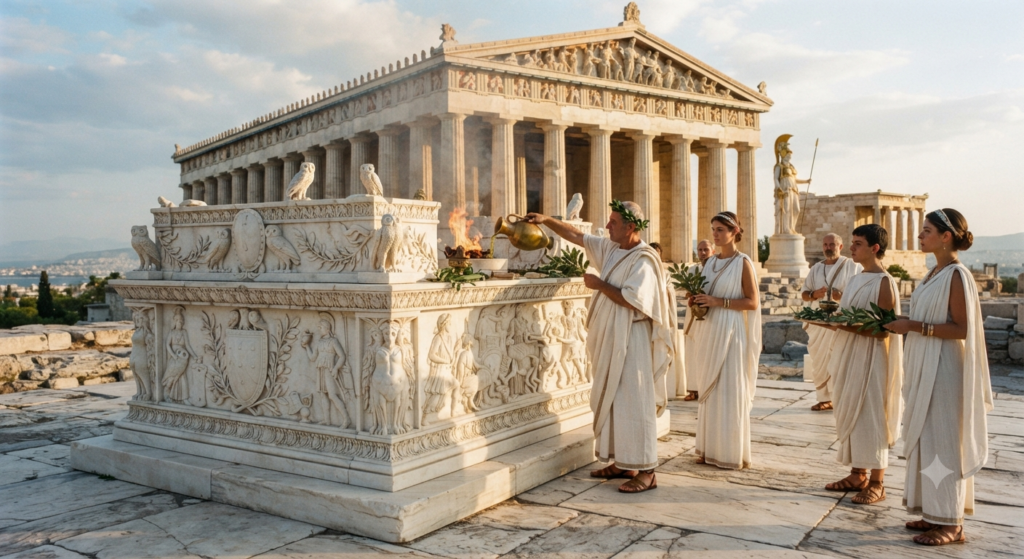
In Greek sacred architecture, an altar was usually the central working surface of worship rather than an enclosed sacred room. For Athena, this meant a structure placed where offerings could be made in open view, often before the temple or within a temenos, the sacred precinct. Unlike a modern idea of a shrine as an indoor sanctuary, the altar was where action happened: prayers, libations, burning of portions from sacrifice, and the presentation of gifts.
Athena’s altar could serve different cult titles and local traditions, so its appearance varied widely. In some sanctuaries it was modest and functional; in others, especially in major civic centers, it formed part of a grand ceremonial landscape. The altar framed the relationship between deity and city, giving worshippers a fixed point where public religion became visible, communal, and ritually ordered.
Materials, form, and the altar’s construction
Altars dedicated to Athena were commonly built of stone, though earlier or smaller examples could be made of packed earth, rubble, or ash. Over time, prestigious sanctuaries favored carefully cut masonry, sometimes finished with moldings or inscriptions. In Greek religion, the materials mattered less as decoration than as durability and visibility; an altar had to withstand repeated use, weather, and the heat of offerings.
Its form was usually simple: a rectangular block, a low platform, or a raised structure with a flat top. Some altars were large enough to receive whole animal sacrifices, while others were intended mainly for libations and small offerings. The construction reflected ritual function. A broad surface allowed the priest or sacrificer to place grain, wine, incense, or the prepared animal before Athena in a controlled and public act.
Votive offerings placed before Athena’s shrine
Before Athena’s altar, worshippers presented votive offerings that expressed gratitude, supplication, or fulfillment of a vow. These could include woven textiles, weapons, helmets, miniature tools, terracotta figures, jewelry, and inscribed dedications. Because Athena was associated with weaving, crafts, and martial protection, such gifts often reflected the giver’s occupation, triumph, or civic service.
In major sanctuaries, especially in Athens, votives accumulated over generations and formed a visible record of devotion. Some were modest tokens from private worshippers; others were expensive offerings from cities, elites, or victorious commanders. The altar and the shrine around it became a memory-place, where Athena’s favor was marked not only by ritual acts but by physical gifts that remained in the sacred precinct.
Sacrifice, libation, and ritual use of the altar
At Athena’s altar, ritual usually centered on sacrifice and libation rather than on any idea of the altar itself being magical or animate. Worshippers poured wine, water, milk, honey, or oil, and in some rites they burned portions of an animal, keeping the practice within the norms of Greek civic religion. Homer and later authors show sacrifice as a formal exchange: humans honored the goddess, and the goddess received the smell, smoke, and due portion of the rite.
Athena was not among the deities most strongly associated with the bloodiest sacrificial patterns in every context, but animal sacrifice certainly occurred in her cult. More often than not, the altar was the point where human order met divine favor. The offerings, prayers, and smoke all announced the city’s dependence on Athena’s guidance, whether the occasion was a domestic request, a military concern, or a state festival.
The Acropolis and Athens’ most famous altar
The most famous altar of Athena stood in Athens, especially on the Acropolis, where Athena Polias was worshipped as protectress of the city. The Acropolis was not just a religious hill but a concentrated sacred and civic landscape, and the goddess’s altar belonged to that world of temples, processions, and ancestral memory. Classical sources and archaeological remains show a long tradition of cult on the rock, with different phases of building and ritual use.
In Athens, the altar of Athena was tied closely to the city’s identity. Processions such as the Panathenaia culminated in offerings to Athena, and the sacred precinct around the Acropolis reinforced her role as guardian of the polis. The altar was therefore more than a ritual platform; it was a civic threshold, where public devotion affirmed the bond between goddess and city-state.
Pausanias on altars of Athena in Greece
Pausanias is one of the most valuable sources for altars and sanctuaries of Athena across Greece. In his Description of Greece, he records local traditions, temple locations, cult statues, and altars that differed from place to place. He does not give one uniform picture of Athena’s altar, because the Greek world itself did not have one. Instead, he shows a network of local cults, each preserving its own story and ritual arrangement.
His account is especially useful because he often notes what was unusual or ancient about a site. In one place Athena may have an altar associated with a legendary king, in another an altar linked to an older epithet, and elsewhere a precinct where the goddess shared space with other powers. Pausanias reveals that Athena’s worship was deeply regional, even as her name was known throughout the Greek world.
Chthonia, Polias, and local cult traditions
Athena’s cult titles often tell more about her altar than the altar’s stonework itself. As Athena Polias, she was the guardian of the city and its ordered life; as Athena Chthonia in some local traditions, she could be connected with the earth, ancestral rites, or older layers of worship. These titles indicate that the goddess was not experienced in one abstract form, but through local religious memory.
Different cities emphasized different aspects of Athena, and the altar followed suit. In one sanctuary, offerings might stress civic protection and public prosperity; in another, the goddess might be linked to foundation myths, seasonal observances, or ancient heroic times. Local cult traditions shaped both ritual and architecture, so the altar was never merely a generic object. It was a place where a particular community understood Athena in its own language of devotion.
Altars beside temples, statues, and precincts
Athena’s altar was often positioned beside a temple rather than inside it, since Greek worship generally took place outdoors. The cult statue could stand within the temple cella, while the altar remained in front, open to sky and procession. This arrangement made the act of worship visible and allowed the congregation to gather in the sacred precinct. In many sanctuaries, the spatial relationship between temple, altar, and statue defined the entire ritual setting.
Some altars also stood near older cult images, open-air shrines, or boundary markers within the precinct. This flexibility was typical of Greek sacred space. A goddess like Athena, who belonged to both military and domestic spheres, could be honored in a compact urban sanctuary or in a broad sacred enclosure. The altar gave form to that relationship, anchoring the goddess’s presence in the landscape of the city.
Priesthood, festivals, and civic worship rites
The altar of Athena was not used only in isolated acts of private devotion. It was also central to priestly and civic ritual, especially during festivals such as the Panathenaia in Athens. Priests, priestesses, magistrates, and citizens all had roles in maintaining the cult, arranging offerings, and guiding processions. In many cities, Athena’s worship belonged to official religion, woven into the calendar of the polis.
These rites could include sacrifices, incense, libations, and the presentation of woven peploi or other gifts. The altar was where the public meaning of the festival became concrete. It turned civic memory into action, allowing the community to renew its bond with the goddess through repeated, visible ceremony. In that sense, Athena’s altar was both religious and political, since Greek civic life rarely separated the two.
What the altar of Athena revealed to worshippers
To ancient worshippers, the altar of Athena revealed that divine power was approached through order, skill, and communal ritual. It was usually not a hidden mystery object, but a public and practical structure that gave shape to devotion. Whether built of stone or simpler materials, whether in Athens or a smaller city, it marked the place where offerings met divine attention.
At the same time, the altar showed the variety of Athena herself. She could be city guardian, war protector, patron of crafts, and presence in ancestral cult all at once. Her altar reflected that richness through local form and use. What worshippers saw was not only a religious structure, but a sign that their city stood under the care of a goddess who belonged to both the battlefield and the loom, both the temple and the assembly place.
The altar of Athena in ancient Greece was never a single universal model, but a family of sacred places shaped by local history and cult practice. Its stone, placement, offerings, and rites all expressed the same core idea: Athena was honored in the open, before the city, through acts that joined piety with public life. In that sense, her altar was one of the clearest symbols of Greek religion itself, where architecture, ritual, and civic identity were bound together in a living tradition.

Orin Vale has spent the better part of two decades tracing the threads that connect the world’s oldest stories — from the halls of Asgard to the banks of the Nile, from Olympus to the jungles of the Maya. What began as a childhood fascination with flood myths and trickster gods grew into years of independent study across comparative mythology and ancient religion, always chasing the same question: what did these stories mean to the people who first told them? Orin writes for readers who want more than trivia — the ones looking for the beliefs, fears, and truths that myths were built to carry.