Hecate is the Greek goddess most often linked with darkness, thresholds, night wandering, witchcraft, and the unseen powers that stand between worlds. In ancient sources, she is not assigned a single fixed sacred color in the way later devotional traditions sometimes imagine; instead, her associations emerge from ritual practice, literary imagery, and the symbolic language of her cult. Black, red, silver, white, bronze, and, in later interpretation, purple all appear in different contexts around her presence, each shade reflecting a different aspect of her domain.
Hecate and the colors tied to her cult
The question of what colors are associated with Hecate depends partly on period and source. Classical texts do not present a formal color canon for the goddess, but Greek religion often expressed divine qualities through material symbols rather than abstract doctrine. Hecate’s cult was especially rich in such symbols: torches, keys, dogs, crossroads, the moon, and offerings placed at household thresholds. From these, later readers and modern devotees have inferred a palette that feels appropriate to her mysteries.
Among the colors most consistently connected to Hecate are black and the pale light of the moon, followed by red, white, and the metallic glow of bronze. These are not arbitrary choices. They arise from her role as a goddess of night, purification, protection, and liminal passage. In later esoteric traditions, purple also becomes important because it suggests hidden knowledge, sovereignty, and mystery, though this is more a later symbolic development than a firmly classical one.
Black, night, and the goddess of the crossroads
Black is the color most naturally associated with Hecate because she is deeply tied to night, the underworld, and the dangerous spaces where roads divide. Ancient Greek sources often place her at boundaries: gates, thresholds, crossroads, and the edges of settled life. Black as a ritual color fits this landscape of absence, concealment, and power that does not announce itself openly. It is less a color of evil than of the unseen.
In cult and later devotion, black also suits Hecate’s role as a goddess approached with caution and reverence. Offerings left at crossroads were commonly meant to appease or honor her, and nocturnal rites naturally gathered a darker symbolism over time. Even where the sources do not explicitly say “black,” the goddess’s atmosphere is unmistakably nocturnal, and black became the clearest visual shorthand for that sacred darkness.
Red in Hecate imagery and ritual fire
Red enters Hecate’s imagery through blood, fire, and the life-force associated with powerful ritual acts. Ancient magic and sacrifice both used red as a sign of potency, danger, and transformation. Hecate is repeatedly connected with spells, ghostly apparitions, and rites performed in the night, and red becomes an apt color for the heat and intensity of such practices. It is a color of crossing into charged sacred space.
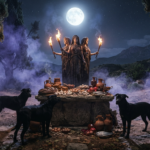
Fire is especially important here. Hecate is famously linked with torches, and torch flame brings a red-gold glow into the darkness. In ritual settings, that light would have stood out sharply against the night and made her presence visible without dispelling her mystery. Red, then, can be understood not as Hecate’s primary color in a strict ancient sense, but as one of the most fitting colors for the fiery edge of her cult.
Silver moonlight in Greek depictions of Hecate
Silver is strongly associated with Hecate through the moon, especially in later Greek and Hellenistic imagination. While Hecate was not originally a moon goddess in the earliest strata of Greek religion, she gradually came to be linked with lunar power, especially in magical and poetic contexts. Silver evokes moonlight, and moonlight suits a goddess who moves through the night with knowledge of hidden things.
This lunar connection is most visible in later literary and devotional traditions, where Hecate stands near other chthonic and astral powers. Silver suggests reflection rather than direct brightness, which is a fitting image for a deity who governs what is half-seen, concealed, or revealed only at the right moment. In that sense, silver is less about ornament and more about the kind of light that belongs to Hecate’s realm.
White offerings and purity in her rites
White appears in Hecate’s worship through offerings, purification, and ritual cleanliness. Greek religion often emphasized the importance of purity before contact with powerful deities, especially those connected with the dead, liminality, and protection of the home. Hecate was no exception. In some rites, food offerings and sacrificial materials could be selected for their purity or brightness, and white animals or white objects could symbolize a clean approach to a potentially dangerous divine force.
White is also meaningful because Hecate is not only feared but honored as a guardian. She can protect households, help with transitions, and guide petitioners through uncertain spaces. In that context, white functions as a counterbalance to her darker associations. It does not replace black or night, but it tempers them with the idea of ritual order, clearance, and safe passage.
Bronze, torchlight, and sacred metal symbols
Bronze is one of the most evocative materials associated with Hecate because it belongs to the world of Greek ritual objects: cauldrons, lamps, tools, and doors. Metal in cult practice often mattered as much as color, and bronze in particular carries a warm, ancient glow that suits torchlight and sacred implements. Hecate’s torches and keys belong to this material world of practical ritual power.
The color of bronze also bridges darkness and light. It is neither the complete obscurity of black nor the brilliance of silver; it catches fire when lit and deepens in dim spaces. That makes it a strong symbol for Hecate’s in-between nature. As goddess of crossroads and thresholds, she is often figured through objects that mediate rather than divide absolutely, and bronze is one of the most fitting of those mediating shades.
Purple and the later symbolism of mystery
Purple is more prominent in later symbolic readings than in the surviving classical evidence. It became associated in many cultures with dignity, secrecy, magical authority, and the sacred. For Hecate, purple works well as a modern devotional color because it suggests hidden wisdom and a domain that is both regal and veiled. It is a color of depth, not display.
That said, it is important to separate later devotional aesthetics from the ancient record. Greek texts do not consistently describe Hecate in purple garments or surround her cult with a formal purple symbolism. Still, because her power is elusive and her presence often appears at the edge of human knowledge, purple has become a natural interpretive color in modern Hecate practice, especially where mystery and spiritual authority are emphasized.
Dark robes in ancient and modern devotion
Dark robes are now among the most familiar visual markers of Hecate, but this image is largely shaped by later reconstruction and modern devotional practice. Ancient sources do present Hecate as a nocturnal and fearsome presence, yet they do not preserve a standard costume for her worshipers. The idea of dark clothing follows logically from her association with night, tombs, crossroads, and the unseen.
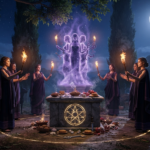
In modern devotion, black robes or dark garments often serve as a symbolic alignment with Hecate’s realm. They express seriousness, discretion, and a turning away from spectacle. Even so, this is best understood as a devotional development rather than a direct classical prescription. The sources give us the goddess’s atmosphere, not a uniform, and the robe is a later human attempt to dress that atmosphere in visible form.
Color meanings in Hecate’s magical associations
Hecate’s magical associations explain why her colors feel so charged. In Greek magical papyri and later esoteric traditions, she is often invoked in rites of protection, coercion, guidance, and contact with spirits. Colors in such contexts are rarely decorative alone; they mark intention. Black may guard or conceal, red may activate, white may purify, silver may reflect lunar influence, and bronze may anchor the ritual in a tangible sacred object.
Because Hecate stands at the border between worlds, her color symbolism often reflects transition rather than fixed identity. She can belong to night without being reduced to darkness, and to purification without losing her chthonic force. This layered symbolism is one reason she remains so potent in later religious imagination: her colors are not simple labels, but signs of movement, threshold, and controlled access to power.
Which shades are most often linked to Hecate?
If one asks which colors are most often linked to Hecate, black and silver are usually the strongest answers in modern understanding, with red, white, and bronze close behind. Black best captures her night-crossing, crossroads, and underworld associations. Silver reflects the moonlit aspect that later traditions gave her. Red speaks to fire and ritual intensity, while white and bronze recall purity, protection, and sacred implements.
The ancient evidence, however, suggests a more fluid picture than any single palette. Hecate’s worship was shaped by place, ritual practice, and evolving mythic imagination, so her colors are best understood as symbolic layers rather than official emblems. What remains constant is the mood they create: dark, luminous, protective, and mysterious, like torchlight seen at a crossroads after sunset.
Hecate’s colors are part of what makes her so enduringly vivid in Greek myth. Black, silver, red, white, bronze, and sometimes purple do not define her by rule, but by atmosphere and meaning. Together they reflect a goddess who belongs to thresholds, hidden knowledge, sacred fire, and the uneasy beauty of the night.

Orin Vale has spent the better part of two decades tracing the threads that connect the world’s oldest stories — from the halls of Asgard to the banks of the Nile, from Olympus to the jungles of the Maya. What began as a childhood fascination with flood myths and trickster gods grew into years of independent study across comparative mythology and ancient religion, always chasing the same question: what did these stories mean to the people who first told them? Orin writes for readers who want more than trivia — the ones looking for the beliefs, fears, and truths that myths were built to carry.