Hecate is the Greek goddess of crossroads, thresholds, nocturnal wandering, witchcraft, and the liminal spaces where one world touches another. In classical sources she is not assigned a fixed canon of “official” crystals in the modern sense, because ancient Greek religion worked more through offerings, herbs, stones, lamps, keys, and ritual acts than through a standardized crystal system. Still, later devotional practice and modern Hellenic witchcraft often associate her with dark protective stones, lunar gems, and materials linked to the underworld, the moon, and warding magic.
Hecate’s sacred stones in Greek tradition
In the surviving Greek sources, Hecate’s sacred associations are broad rather than mineral-specific. Hesiod presents her as a powerful goddess honored by Zeus, with influence across earth, sea, and sky, while later traditions connect her strongly to crossroads, night, and ghosts. Because the ancient record rarely names particular gemstones for her, the idea of “Hecate’s crystals” belongs more to modern devotional symbolism than to a single classical prescription. The deeper pattern is clear, however: stones linked to darkness, protection, the moon, and boundary spaces fit her sphere naturally.
Greek religion often treated sacred objects through function rather than through a rigid list of correspondences. A stone placed at a threshold, a lamp carried at night, or an apotropaic charm could all belong to the same ritual world as Hecate. That is why modern practitioners often choose minerals that echo her myths and cult roles. The emphasis is not on luxury or brightness, but on power at the edge of things: the road junction, the grave boundary, the midnight path, and the hidden gate.
Black tourmaline and protective warding rites
Black tourmaline is a modern favorite in Hecate devotion because it is strongly associated with protection, grounding, and the turning back of harmful influence. That symbolism aligns well with Hecate as a guardian at thresholds and as a goddess who stands where danger may approach. Ancient sources do not name black tourmaline for her, of course, but the stone’s modern reputation as a warding material makes it a natural devotional choice in contemporary practice.
In ritual use, black tourmaline is often placed near doors, altars, or working spaces associated with banishing and boundary-setting. For a Hecate altar, it can serve as a quiet sentinel beside keys, small offerings, or a triple-lamp image. The stone’s dark appearance also matches the goddess’s night-facing character, though the meaning comes less from color alone than from the protective role the stone plays in the rite.
Obsidian in crossroads magic and the underworld
Obsidian is one of the most common stones linked with Hecate in modern occult practice because of its volcanic origin and deep black sheen. It carries strong symbolic ties to hidden things, sharp truth, and the underworld, all of which harmonize with Hecate’s liminal nature. While obsidian is not a classical Greek “sacred stone” in the strict historical sense, its dark, mirror-like surface has made it especially compelling for divination and shadow work in her name.
Crossroads magic often relies on objects that feel both protective and revealing, and obsidian suits that tension well. It can symbolize the descent into what is concealed, the meeting of worlds, and the hard clarity that comes from facing fear. In modern Hecate practice, obsidian may be used as a meditation stone, a focus for boundary work, or a companion to offerings made at night, especially where the rite seeks insight rather than comfort.
Moonstone, lunar power, and Hecate’s night
Moonstone is widely associated with lunar energy, intuition, and nocturnal mystery, which makes it an appealing crystal for Hecate devotion. Although Hecate is not simply a moon goddess in the earliest Greek tradition, later imagery and some Hellenistic associations often bring her close to the moon, especially in her role as a night-walker and guide through darkness. Moonstone therefore fits the devotional atmosphere of her cult more through symbolism than through direct ancient attestation.
In ritual settings, moonstone is often chosen for workings that ask for dreams, divination, emotional clarity, or guidance through uncertain passages. Its pale, shifting light can stand beside darker stones to represent the balance between revelation and concealment. Where obsidian draws one into the depths, moonstone suggests the light that still reaches those depths, a useful pairing for devotees who approach Hecate as a guide through hidden knowledge.
Onyx, incense, and altar stones for Hecate
Onyx is another stone frequently linked to Hecate because of its dark banding and its reputation for strength, discipline, and endurance. In modern esoteric circles, onyx is often used for protection and self-mastery, qualities that suit a goddess associated with guarding thresholds and holding power in difficult places. The ancient Greeks knew many dark stones, but the specific devotional pairing of onyx with Hecate belongs mainly to later ritual interpretation.
On an altar, onyx works well beside incense, especially scents associated with purification and solemnity such as myrrh, frankincense, or storax in modern reconstruction. The stone can anchor the altar physically and symbolically, giving form to the gravity of the rite. For devotees who build a Hecate shrine with keys, candles, and offerings, onyx often serves as a stable centerpiece, suggesting steadfastness rather than spectacle.
Crystal correspondences in Hellenic witchcraft
Modern Hellenic witchcraft often uses crystal correspondences as a devotional language, even though ancient Greek practice was not organized around the same system. In this framework, stones are selected for resonance with a deity’s domain: dark minerals for chthonic power, reflective stones for divination, and lunar stones for night rites. Hecate, as a goddess of boundaries and hidden pathways, is especially suited to this style of symbolic alignment.
The most common correspondences for Hecate in contemporary use include black tourmaline, obsidian, onyx, moonstone, and sometimes jet or smoky quartz. Each stone emphasizes a different aspect of her presence: warding, revelation, lunar guidance, or the quiet gravity of the underworld. The key is not rigid doctrine but thoughtful coherence, using objects that support the kind of prayer or rite being performed.
Hecate’s symbols beside modern ritual crystals
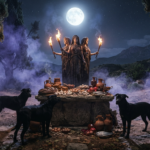
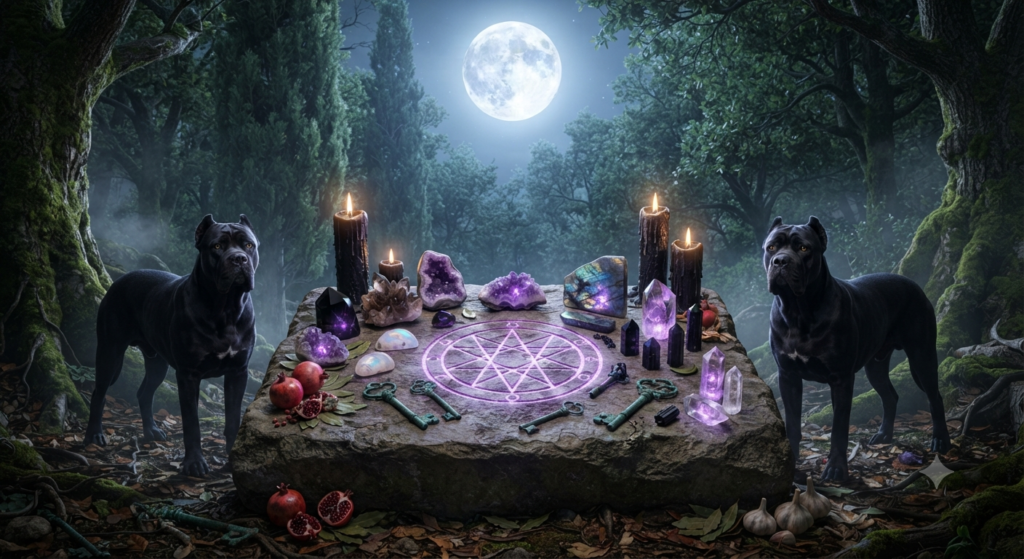
Hecate is traditionally associated with keys, torches, dogs, crossroads, the moon, and sometimes serpents or daggers in later artistic and magical traditions. When crystals are placed beside these symbols, they help extend the same visual and ritual language. A black stone near keys suggests the power to guard or unlock, while a pale lunar stone beside a torch can symbolize guidance through obscurity.
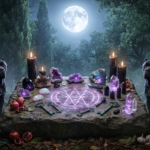
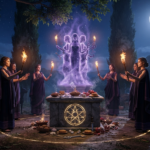
Modern devotees often arrange crystals to complement the goddess’s older emblems rather than replace them. A crossroads altar might include two or three stones marking direction, with a central offering bowl or candle to represent Hecate’s presence. In this way, crystals become part of a larger devotional grammar, one that remains rooted in the goddess’s traditional symbols even when the materials themselves are modern.
Historical sources and the limits of gemstone lore
The classical sources for Hecate do not offer a neat list of gemstones. Hesiod, the Homeric Hymns, Apollodorus, Pausanias, and later authors describe her power, cult honors, and mythic roles, but they do not preserve a standardized crystal system comparable to contemporary metaphysical practice. This matters, because claims that “the ancients used this exact crystal for Hecate” often go beyond what the evidence can support.
What the sources do support is a pattern of ritual meaning: darkness, liminality, protection, and contact with chthonic forces. Modern gemstone lore grows from that pattern, not from a direct ancient inventory. A careful approach honors both history and living devotion by distinguishing between what the Greeks actually recorded and what later practitioners have developed to serve present spiritual needs.
Choosing offerings for a Hecate devotion altar
A Hecate altar often benefits from offerings that reflect her ancient and modern spheres: bread, eggs, garlic, honey, wine, small cakes, candles, keys, and incense are all commonly used in contemporary devotion. Crystals can join these offerings as supporting symbols rather than as replacements for them. Their role is to shape the atmosphere of the altar, giving material form to protection, mystery, and guidance.
When choosing stones, many devotees prefer one dark protective crystal and one lunar or reflective stone, so the altar expresses both Hecate’s guarding power and her nocturnal, knowing aspect. Black tourmaline with moonstone, or obsidian with onyx, are common pairings. The best offering arrangement is one that feels deliberate and respectful, shaped by study, silence, and the specific intent of the rite.
Using crystals in respectful Hecate practice
Respectful Hecate practice begins with the recognition that she is an ancient goddess whose worship predates modern crystal spirituality by many centuries. Crystals can be meaningful tools in her devotion, but they should be treated as additions to a thoughtful practice, not as substitutes for learning her myths, titles, and historical cult. The more firmly the ritual rests in knowledge, the more naturally the symbols can speak.
For modern devotees, the most suitable crystals are those that reflect Hecate’s domains: black tourmaline for warding, obsidian for depth and crossroads magic, moonstone for lunar guidance, and onyx for strength and altar presence. Used with care, they can enrich prayer, meditation, and offering without claiming false antiquity. Their value lies in how well they support reverence, not in any promise of universal power.
Hecate’s crystal associations belong to the meeting place between ancient reverence and later devotional symbolism. The classical record does not hand down a single approved list, but it does reveal the goddess’s enduring realm: thresholds, night, protection, and the unseen road. Crystals chosen for her are most meaningful when they echo those qualities with restraint and respect, allowing stone, flame, and offering to stand together at the crossroads.

Orin Vale has spent the better part of two decades tracing the threads that connect the world’s oldest stories — from the halls of Asgard to the banks of the Nile, from Olympus to the jungles of the Maya. What began as a childhood fascination with flood myths and trickster gods grew into years of independent study across comparative mythology and ancient religion, always chasing the same question: what did these stories mean to the people who first told them? Orin writes for readers who want more than trivia — the ones looking for the beliefs, fears, and truths that myths were built to carry.