Hecate, the Greek goddess of liminal spaces, magic, ghosts, and the night, was invoked in ancient ritual not as a distant Olympian ruler but as a power who moved at doorways, crossroads, graveyards, and the edges of human life. The sources present her in many forms: Hesiod praises her unusual breadth of power, while later poets and ritual texts place her among household thresholds, nocturnal processions, and chthonic rites. To ask how Hecate was invoked is to follow her through prayer, offering, torchlight, and silence, where her presence was sought for protection, for magical aid, and sometimes for the very forces that unsettled ordinary life.
Hecate in Greek ritual and sacred space
In Greek religion, Hecate was typically approached at boundaries rather than within the bright center of a temple cult. Her sacred space was often marked by the threshold, the crossroads, the roadside, or the place where the human and divine worlds could touch uneasily. Hesiod’s Theogony gives her a prominent and honored role among the gods, but later ritual practice shows that she was especially called upon where passage, danger, and transition were concentrated.
She was invoked through gestures and placements that made space ritually charged: standing at a doorway, setting food outside the house, or addressing her at night. Greek religion rarely depended on fixed liturgy in the later sense; instead, invocation could be local, practical, and responsive to immediate need. Hecate was especially suited to such rites because she governed crossings and transitions, the very places where people felt exposed.
Offerings left at crossroads and thresholds
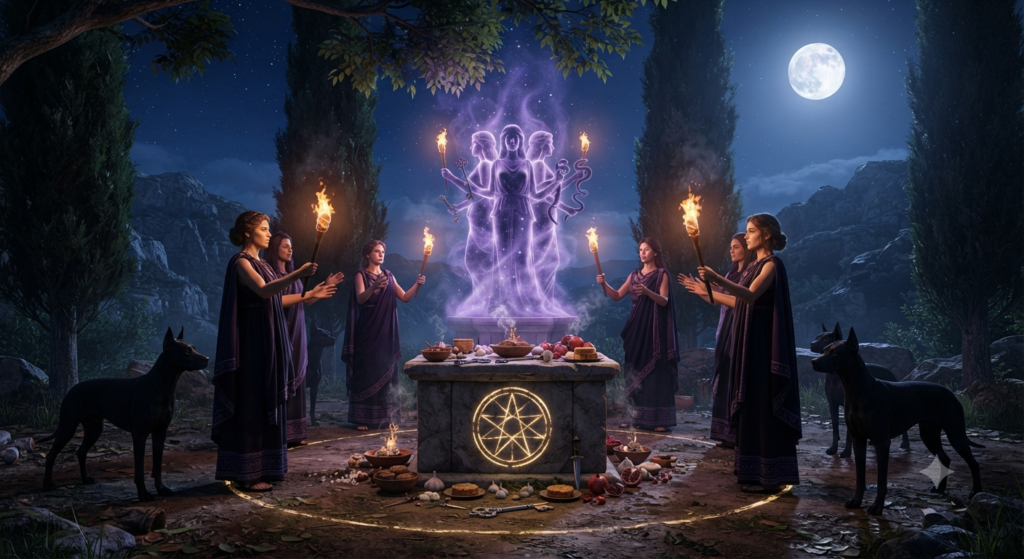
One of the clearest ancient associations of Hecate is the offering left at the crossroads. These gifts, often called Hecate’s suppers in later sources, were placed where roads met, especially at night, as a means of honoring the goddess and securing her favor. The crossroads mattered because they were liminal ground, neither here nor there, and thus under her authority.
Threshold offerings served a similar purpose inside the home. A meal, small portions of food, or other tokens might be left at the door or at the boundary between private and public space. Such acts were not merely symbolic; they were meant to acknowledge the goddess as a powerful presence able to guard or disturb the household depending on whether she was respected.
Torches, night, and the goddess’s epiphanies
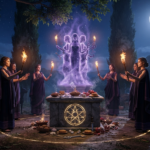
Hecate is frequently linked with torches, a detail that became central to her ritual identity. In myth and cult alike, torches suggest movement through darkness, guidance at the edge of uncertainty, and a goddess who could be present without being fully seen. When worshippers invoked her, fire served not only as light but as a sign of her approach.
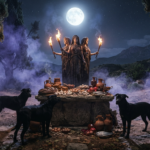
Night was the natural time for such invocations, since Hecate’s powers were tied to moonlit streets, hidden places, and the hours when ordinary order thinned. Ancient poetry often presents her appearing with companions, dogs, or torchlight in nocturnal contexts. These epiphanies were not always benevolent in tone, yet they made her a goddess one might call upon precisely because she belonged to the dangerous beauty of darkness.
Hecate Deipnon and household purification rites
The Hecate Deipnon was a recurring household ritual in Athens and elsewhere, performed at the dark of the moon. Families prepared a meal for Hecate and set it out at the crossroads or at the house’s boundary, often as part of a broader effort to cleanse the home. The rite seems to have combined appeasement, purification, and social memory, since food could also be offered for the dead and for those who had died without proper rites.
This ritual shows how Hecate was invoked not only in formal sanctuaries but in domestic life. The household recognized that disorder, pollution, and unseen presence could accumulate around thresholds and corners. By offering to Hecate, people sought to send away what was harmful, restore purity, and ask for continued protection in the month ahead.
Dogs, honey, eggs, and other ancient offerings
Ancient sources connect Hecate with dogs, and dogs themselves could be offered or sacrificed in some ritual contexts, especially where her chthonic power was emphasized. The association is old and persistent, appearing in literary and ritual traditions that place barking, roaming, and the dog’s uncanny vigilance at Hecate’s side. The animal suited a goddess who guarded edges and responded to hidden presences.
Other offerings included honey, eggs, cakes, garlic, fish, and small portions of food, though practices varied by place and purpose. Honey and eggs carried strong associations with fertility, life, and transformation, while cakes and mixed foods could be fashioned especially for her. What mattered most was not extravagance but appropriateness: offerings were often modest, left with care, and dedicated at the right place and hour.
Prayer formulas in curse tablets and spells
Hecate appears frequently in Greek magical texts, especially in curse tablets and binding spells, where she is invoked as a powerful intermediary with the underworld. Such texts could call on her alongside Hermes, Persephone, or chthonic daimones, asking her to carry a request downward or to restrain an enemy. The language is often stark and instrumental, reflecting practical magic rather than public cult.
These invocations reveal a different relationship to the goddess than household piety does. In spells, Hecate is addressed by names, epithets, and commands that stress her nocturnal authority and command over ghosts and crossroads. The magician might appeal to her with threats, promises, or precise instructions, showing how ancient ritual could combine reverence with coercive technique.
Lunar phases and the timing of invocations
The moon governed much of Hecate’s ritual timing, especially the dark or waning moon. The end of the lunar month was considered a fitting moment for offerings, purifications, and the settling of spiritual disorder. Darkness here was not simply absence but a charged interval in which Hecate’s power was most closely felt.
Later traditions also strengthen her lunar identity, associating her with the moon’s changing face and its hidden or diminished phases. Even when not explicitly tied to the moon in early sources, she was often invoked at times when visibility was low and boundaries were unstable. The timing of the rite therefore mattered as much as the words spoken, since ancient ritual was built on correspondence between cosmic rhythm and human action.
Chthonic powers in burial and protection rites
Hecate’s chthonic dimension made her relevant in burial contexts and in rites meant to protect the living from the dead. She could be asked to guard against restless spirits, to control forces from below, or to help keep the household and grave boundary secure. In this respect she belonged to the same broad religious sphere as other underworld-linked powers, though her role remained distinct.
Because she stood at the edge between worlds, Hecate could protect as well as threaten. This double aspect appears in ritual practice: a goddess who was respected at funerals, crossroads, and purifications could also be invoked to prevent haunting or malicious return. Her presence was sought where the dead, the bereaved, and the vulnerable intersected.
Temples, shrines, and roadside cult sites
Although Hecate was often worshipped at thresholds and crossroads, she also had recognized sanctuaries and cult sites. Pausanias mentions places where her worship was established, and archaeological evidence confirms that she was not only a folk deity of the road but also part of formal religious landscapes. Her shrines could stand near gates, city edges, or in areas suited to her liminal character.
Roadside cult sites are especially important because they show how public movement and sacred presence met. Travelers could acknowledge her, and local communities could maintain shrines where she watched over passages into and out of inhabited space. Such places made her accessible without reducing her power to the domestic sphere; she remained a goddess of distance, arrival, and departure.
Later testimonies on invoking Hecate’s aid
Later classical and post-classical writers continue to treat Hecate as a deity whose aid could be invoked for magic, protection, and guidance through darkness. The Greek Magical Papyri, though later than the classical period, preserve a rich ritual imagination in which she is called with epithets, songs, and material tokens. These texts suggest continuity with older traditions even as they reflect changing ritual language.
Across time, the pattern remains consistent: Hecate was invoked with offerings, torches, prayer formulas, and careful timing, usually at places where one state changed into another. Whether at a household door, a crossroads, or a tomb, the worshipper addressed a goddess of passage and power. Her ancient rituals were less about distant worship than about negotiating the borders of life itself.
Hecate was invoked through acts that matched her nature: gifts at boundaries, torches in darkness, words spoken at the moon’s turning, and offerings placed where roads met or homes opened to the night. The surviving sources show a goddess both intimate and formidable, honored in household purification and feared in magical coercion, present in public cult yet most vividly felt at the edges of ordinary space. To study her rites is to see how the Greeks imagined safety, danger, and transition as sacred conditions, and how one goddess came to preside over all three.

Orin Vale has spent the better part of two decades tracing the threads that connect the world’s oldest stories — from the halls of Asgard to the banks of the Nile, from Olympus to the jungles of the Maya. What began as a childhood fascination with flood myths and trickster gods grew into years of independent study across comparative mythology and ancient religion, always chasing the same question: what did these stories mean to the people who first told them? Orin writes for readers who want more than trivia — the ones looking for the beliefs, fears, and truths that myths were built to carry.