Hecate, the Greek goddess of crossroads, night, thresholds, and certain forms of magic, received offerings that were often unlike the great animal sacrifices given to Olympus. Her cult was marked by restraint, darkness, and boundary places rather than by public feasting alone. The gifts left to her could be humble or severe: dogs, eggs, fish, honey cakes, milk, torches, incense, and in some rites even black lambs. What was offered depended on local custom, ritual purpose, and the ancient idea that Hecate stood close to the chthonic world, where the dead and the unseen were never far away.
Hecate’s offerings: dogs, eggs, and fish
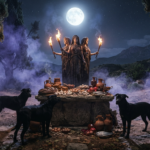
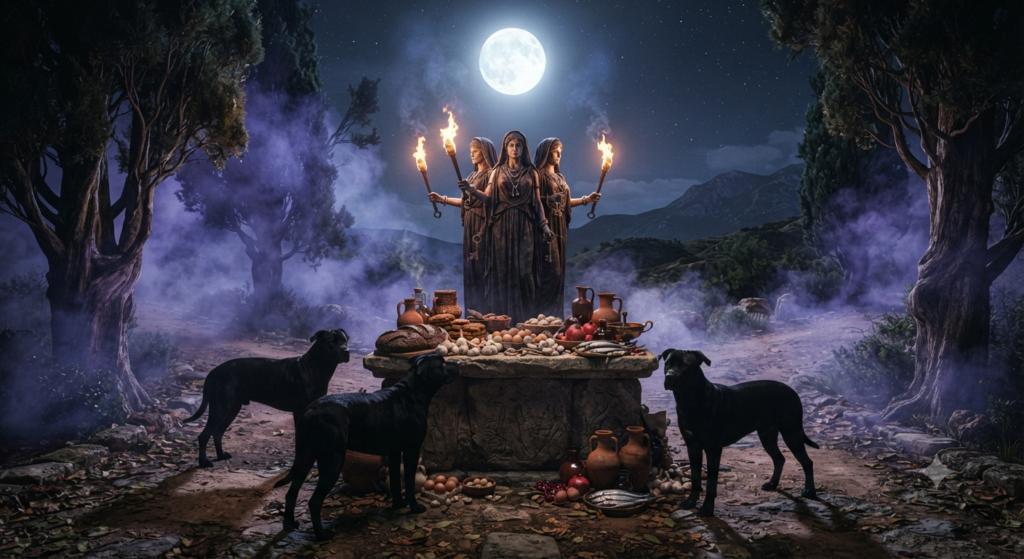
Dogs were among the most characteristic sacrificial animals associated with Hecate. Ancient sources and later ritual practice connect her especially with the dog as a chthonic and liminal creature, and at times dogs were offered at night or at crossroads. In some Greek contexts, the dog’s role was not that of a common temple victim but of an apotropaic sacrifice, meant to avert evil or mark a sacred boundary. Because of this association, Hecate was one of the few major deities whose rites could include animals that were not typical for civic altar sacrifice.
Eggs and fish appear in the broader pattern of Hecate’s offerings, though not always as formal blood sacrifices. Eggs were easily linked to fertility, hidden life, and the enclosed promise of rebirth, while fish belonged to the nocturnal and marginal world of food offerings rather than lavish banquet sacrifice. Literary and ritual evidence suggests that such gifts were often set out rather than burned in the grand Olympian style, reflecting Hecate’s place between worlds. Her offerings tended to be practical, symbolic, and suited to a goddess honored at the edges of domestic and civic space.
Crossroads sacrifices in Greek religious practice
The crossroads were one of Hecate’s most distinctive sacred spaces. Greek religion treated intersections as places of danger and transition, where travel, fate, and spirits might converge. Hecate’s worship at these sites developed naturally from her role as a guardian of thresholds and a power invoked in uncertainty. Sacrifices there were often modest, private, and carefully placed, since the crossroads were not simply roads but charged ritual boundaries.
At such places, offerings could be deposited to secure passage, protection, or purification. Ancient testimony shows that Hecate was approached with food, libations, and animal victims in settings where ordinary public cult rules did not always apply. The crossroads sacrifice was therefore less a communal feast than a negotiated gift to a goddess of liminality. The very location revealed the character of the rite: a meeting point of directions, but also of worlds, including the human and the unseen.
Black lambs and other nocturnal votive gifts
Black animals were especially suited to chthonic deities, and Hecate was no exception. A black lamb or other dark-coated victim could be offered in nocturnal rites because color itself carried symbolic weight in Greek ritual language. Dark animals were often chosen for powers connected with earth, night, the dead, or the underworld. In Hecate’s case, the black lamb expressed the goddess’s association with darkness and her nearness to regions beyond daylight worship.
Nocturnal votive gifts could also include objects rather than slaughtered animals. Lamps, cakes, small portions of food, and other items were left in darkness, sometimes at doorways or crossroads, where Hecate was thought to be especially present. The offerings were deliberately separated from the brightness and abundance of Olympian celebration. Their atmosphere was quieter, more severe, and more protective, as if the rite itself acknowledged that Hecate’s favor came through careful respect for the powers that move unseen.
Honey, milk, and cakes left for Hecate
Honey, milk, and cakes belong among the most familiar offerings associated with Hecate. These were not grand sacrificial victims, but they were deeply meaningful gifts, especially in household and monthly rites. Honey had strong ritual value in Greek religion because of its purity, sweetness, and ancient association with libation and the dead. Milk likewise carried connotations of nourishment and softness, while cakes could be shaped and arranged specifically for a deity’s altar or crossroads station.
Classical and later sources describe these food offerings as part of the gifts set out for Hecate, especially at the end of the month. The famous “Hecate’s supper” included such provisions, often left at night and not reclaimed. These gifts fit her character as a goddess approached through what was simple, intimate, and carefully measured. Rather than the smoke of a great hecatomb, Hecate received foods that could be placed in silence, marking a relationship built on boundary, respect, and restraint.
The Deipnon: monthly rites at the crossroads
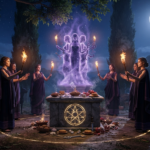
The Deipnon was the monthly dinner or supper offered to Hecate, usually at the end of the lunar month. It was a domestic and ritual practice in which households set out food at crossroads or threshold places, commonly for the goddess and the wandering dead. The timing mattered: the last day of the month belonged to endings, cleansing, and the clearing away of what was old before the new cycle began. Hecate’s presence at this moment made her a natural recipient of offerings tied to transition and renewal.
The Deipnon typically included leftovers, cakes, garlic, eggs, fish, and other foods that could be set aside after the household meal. Some ancient evidence also connects the rite with purification, especially after pollution or misfortune. The food was not simply charity for spirits; it functioned as a structured gift to a goddess who mediated between domestic life and the borderlands beyond it. In that sense, the Deipnon reveals Hecate not as a distant cosmic power, but as a figure intimately bound to the rhythms of the Greek home.
Torches, incense, and chthonic offerings
Hecate was famously connected with torches, and fire itself became part of her ritual vocabulary. Torches illuminated night processions, crossroads, and the approach to sacred space, echoing her image as a guide through darkness. Though not a sacrifice in the narrow sense, a torch was a ritual offering of presence and attention. It marked Hecate as a goddess who could be honored through light carried into places where ordinary daylight did not reach.
Incense and other fragrant substances also belonged to her cult, especially where burning offerings were appropriate for chthonic powers. Greek ritual often distinguished between offerings burned for gods above and those directed downward or set aside for the dead and underworld beings. Hecate stands at this intersection, receiving both smoke and deposited gifts depending on the rite. Such offerings emphasize her dual nature: she can be approached with flame, but she remains tied to the lower, hidden, and night-bound regions of divine life.
Sacrificial customs in Hecate’s cult festivals
Hecate’s cult was not uniform across the Greek world, and sacrificial customs varied from place to place. In some communities she was honored in ways that resembled broader civic religion, while elsewhere her rites leaned strongly toward private and chthonic practice. Festivals such as those connected with household purification or local goddess worship could include offerings of food, libations, and occasionally animal victims. The sources do not support a single fixed sacrificial formula for all Hecate cults.
Where festival rites did include blood sacrifice, the choice of victim often reflected Hecate’s liminal and underworld associations. Dogs, black animals, and smaller victims are especially relevant in the evidence, though local traditions sometimes differed widely. This variety is important, because it shows Hecate functioning across multiple ritual registers: household protector, underworld-linked goddess, and guardian of thresholds. Her sacrifices were therefore shaped less by uniform doctrine than by the needs of a particular place and moment.
Hecate as underworld goddess in ritual sources
Ritual sources consistently place Hecate near the underworld, even when they do not identify her exclusively as an underworld goddess. She is associated with ghosts, restless dead, and the night-side of divine power. This chthonic dimension helps explain why her sacrifices often look different from those of gods honored in bright public festivals. Offerings to her frequently take the form of deposits, nocturnal rites, and foods given at the edge of the household or road.
At the same time, Hecate is not simply a death goddess. She is a mediator who can protect the living from hostile forces, guide souls, and stand between upper and lower realms. In ritual terms, this meant that her sacrifices could be both propitiatory and protective. The sources show a goddess approached with caution, but also with trust, because her liminal position made her powerful in situations where ordinary cult boundaries no longer sufficed.
Apotropaic rites and food set aside at night
Many offerings to Hecate were apotropaic, intended to avert harm rather than simply to honor a deity. Food set aside at night could function as a buffer against ghosts, harmful influences, or bad fortune. The act of leaving offerings at a crossroads or threshold made the household symbolically safer, transferring danger outward and acknowledging Hecate’s authority over what moves beyond the home. In this sense, the gift itself was also a ritual boundary.
Night was essential to this practice. Hecate’s rites often took place in darkness, when movement between worlds was imagined to be more active. The food left for her was therefore not an afterthought, but part of a carefully managed ritual exchange. Whether the offering was a simple cake, a portion of fish, or a fuller supper, it carried the same basic purpose: to recognize Hecate as a power who could guard the vulnerable spaces of daily life.
What classical texts reveal about Hecate offerings
Classical texts do not give one single catalogue of sacrifices to Hecate, but taken together they reveal a clear pattern. Hesiod presents her as a powerful goddess with wide honors, while later ritual and literary sources show her receiving offerings suited to crossroads, night, and the dead. The evidence points to dogs, dark victims, and domestic foods such as honey cakes, milk, eggs, and fish, along with torches and incense in ceremonial settings. Her cult was practical, local, and deeply symbolic at once.
What emerges most strongly from the sources is not extravagance but specificity. Hecate was honored through offerings that matched her liminal nature and her role in moments of transition, purification, and protection. The sacrifices made to her reflect a goddess who stood at the threshold of the visible world, receiving gifts that were modest in form yet weighty in meaning. In Greek religion, few deities were served with such attention to the edge of things.Hecate’s offerings show how Greek ritual could be intimate, severe, and highly symbolic at the same time. Her sacrifices were shaped by night, by crossroads, and by the household boundary, where humans sought safety from what could not be seen. Whether through a black lamb, a bowl of honey cakes, or the monthly Deipnon left in silence, the gifts to Hecate reveal a goddess honored not with noise and spectacle, but with careful acts of recognition at the edge of the world.

Orin Vale has spent the better part of two decades tracing the threads that connect the world’s oldest stories — from the halls of Asgard to the banks of the Nile, from Olympus to the jungles of the Maya. What began as a childhood fascination with flood myths and trickster gods grew into years of independent study across comparative mythology and ancient religion, always chasing the same question: what did these stories mean to the people who first told them? Orin writes for readers who want more than trivia — the ones looking for the beliefs, fears, and truths that myths were built to carry.