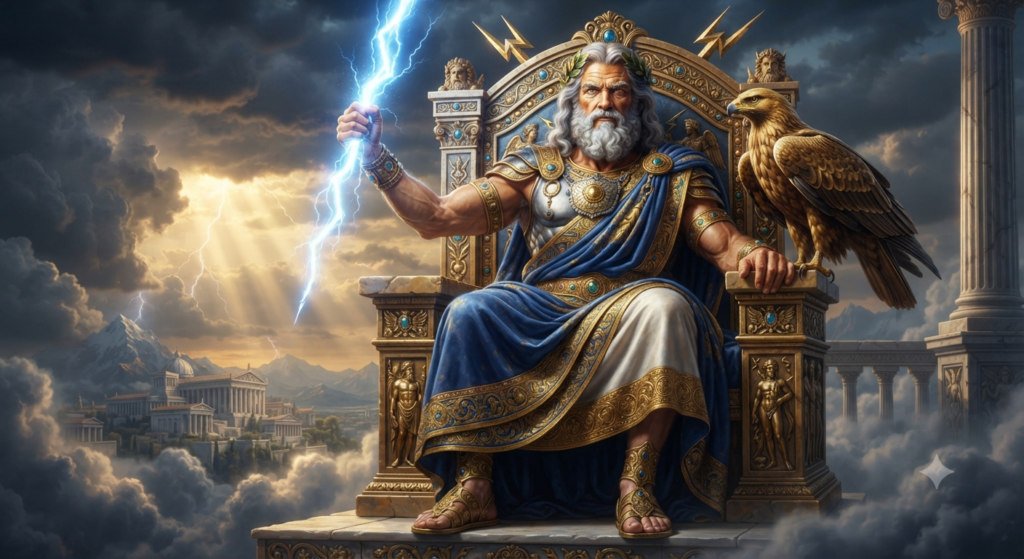
Zeus is the chief god of Greek mythology, ruler of Olympus, bearer of thunder, and a figure whose personality is defined by both majesty and contradiction. In the ancient sources, he is not a simple symbol of power or kindness, but a complex divine king: authoritative, protective of order, quick to punish transgression, capable of restraint, and often driven by desire. Greek myth presents him as the god who holds the cosmos together, yet also as one whose personal impulses can complicate the very order he presides over.
Zeus’s personality in Greek myth and cult
In Greek mythology, Zeus is usually portrayed as the most powerful and most authoritative of the gods, but not as emotionally distant or abstract. He is a deeply personal ruler, one who hears prayers, enforces law, and intervenes in human affairs. In Homer and Hesiod, he appears as the ultimate guarantor of divine hierarchy, yet his decisions often reveal a personality shaped by pride, judgment, and practical rule rather than pure benevolence. He is the father of gods and many heroes, but also a god whose moods can be severe and whose will is difficult to resist.
In cult, Zeus’s personality becomes broader and more communal. Greeks worshipped him under many epithets that emphasize different aspects of his character: Zeus Xenios, protector of guests; Zeus Horkios, guardian of oaths; Zeus Polieus, protector of the city; Zeus Ktesios, giver of household prosperity. These titles show that he was understood not as a single fixed temperament, but as a sovereign presence who could act as judge, protector, punisher, and benefactor. His personality in religion was therefore more than mythic drama; it was the moral and cosmic backbone of Greek life.
King of gods: authority and divine kingship
Zeus’s defining trait is kingship. In Hesiod’s Theogony, after the overthrow of the Titans, Zeus establishes a stable divine order and secures his rule over gods and mortals. This kingship is not merely strength, but governance: he distributes honors, settles ranks, and maintains the balance of the cosmos. Unlike some gods who embody a single force, Zeus personifies rule itself. His authority is solemn and immense, and other gods regularly address him as the one who can finalize divine decisions.
At the same time, his kingship is unmistakably personal and political. Homer often depicts Zeus weighing competing claims, granting favors, and managing divine factions as a king might manage a turbulent court. He is not a neutral law of nature; he is a sovereign who decides, sometimes with patience and sometimes with impatience. His personality reflects the ancient Greek idea that kingship requires both force and intelligence, but also that even the highest ruler remains subject to tension, negotiation, and the burdens of command.
Zeus’s temper, wrath, and punishment of oaths
Zeus is famous for his wrath, especially when oaths are broken or arrogance crosses into impiety. In Greek thought, he is the god who watches over sworn promises, and perjury is one of the clearest ways to provoke his anger. The punishment may fall immediately or only after a delay, but the principle is consistent: Zeus preserves the sanctity of speech. This makes him a stern moral force, especially in societies where oath-taking was foundational to law, treaties, and social trust.
His temper in myth can be devastating. He punishes mortals who overstep divine limits, and his anger often appears in stories of thunderbolts, destruction, or prolonged suffering. Yet this wrath is rarely random. It is usually tied to a breach of order, whether an insult, a lie, or a refusal to honor sacred obligations. Greek myth thus presents Zeus as a god whose anger is part of justice, not mere volatility, even though his punishments can seem severe from a human perspective.
Justice, order, and the defense of hospitality
Zeus is closely associated with justice, especially in the broad Greek sense of order within society and the world. Hesiod links Zeus with dike, the principle of justice, and the moral universe of Greek myth often depends on his oversight. He protects proper relationships between ruler and subject, host and guest, parent and child, and mortal and immortal. His personality, then, is not only regal but judicial. He is a god who notices imbalance and whose presence implies accountability.
Hospitality was one of the most sacred social norms in the Greek world, and Zeus Xenios stood behind it. A guest had to be welcomed and protected, while a host had to show restraint and generosity. Stories involving violations of hospitality often carry divine consequences because they offend Zeus himself. This makes him more than a god of abstract justice; he is a guardian of civilized conduct. In myth, his authority supports the fragile code that holds communities together, and this gives his personality a distinctly civilizing edge.
Zeus as sky god, thunderer, and weather power
Zeus’s personality is inseparable from his role as sky god. He rules from above, sends rain, gathers clouds, and hurls thunder and lightning. These are not merely symbols of power; they express his living force in the world. Greek worshippers understood the weather as one of the most immediate signs of divine presence, and Zeus’s control over storms made him both awe-inspiring and unpredictable. His mood often seems mirrored in the sky itself.
As thunderer, Zeus embodies sudden force and overwhelming visibility. The thunderbolt is the perfect emblem of a god who can appear with instant judgment, yet whose greatness is also life-giving, since rain sustains crops and fertility. This duality is essential to his character. He is not only destructive weather, but also the giver of moisture and seasonal order. In this sense, Zeus’s personality combines menace and nourishment in a way that reflects the ancient experience of nature itself.
Wisdom, planning, and the limits of foresight
Zeus is often described as wise, strategic, and capable of long-range planning. In Hesiod and Homer, he is the god who foresees broad patterns and arranges events to preserve cosmic order. He is not impulsive in the simplest sense; many of his actions reveal calculation, diplomatic caution, and awareness of consequences. His mind is associated with counsel and decision, and other gods may appeal to him as the one who sees the larger design.
Yet Greek myth also places limits on Zeus’s foresight. He is powerful, but not always completely transparent in his intentions, and some traditions show him making choices that later create difficulties. His wisdom is real, but it is the wisdom of rule and strategy rather than omniscience in a modern sense. This ambiguity gives him depth: Zeus is clever enough to outmaneuver rivals, but not so abstractly perfect that myth cannot still present conflict, surprise, or irony around him.
Pride, desire, and the contradictions in his rule
Zeus is one of the most contradictory figures in Greek myth because his rule combines dignity with desire. He is the highest god, yet many stories emphasize his affairs with goddesses and mortal women. These myths are not incidental; they are central to his portrayal. They show a ruler whose authority is immense but whose appetites are equally immense, creating tension between cosmic kingship and personal impulse. His behavior often reflects a divine masculinity that ancient Greeks could admire and criticize at the same time.
This contradiction also appears in the way he governs. Zeus can uphold justice and still act in ways that seem partial or self-interested. He can preserve order while unsettling households through desire, jealousy, or intervention. Greek mythology rarely resolves this tension neatly. Instead, it leaves Zeus as a figure of grandeur mixed with inconsistency, a god whose power is unquestioned but whose personality remains humanly legible in its pride, ambition, and appetite.
Mercy, restraint, and moments of paternal care
Despite his severity, Zeus is not only wrathful. Many myths show him exercising restraint, granting mercy, or acting as a fatherly protector. He may spare a suppliant, answer a prayer, or delay punishment when a broader purpose requires patience. His paternal role is especially important in the myths of heroes, where he can provide legitimacy, protection, or a sign of favor. Even when his care is not tender in a modern sense, it still conveys guardianship.
This paternal aspect helps balance his harsher traits. Zeus can be remote and stern, yet he is often invoked as the god who sustains family, kingship, and social continuity. In some stories, his intervention preserves a lineage or secures a future that would otherwise collapse. The result is a personality that is not simply punitive. He can withhold judgment, show measured favor, and act with a cold but genuine concern for the stability of the world he rules.
Zeus in Homer, Hesiod, and later traditions
Hesiod’s Zeus is the great organizer of the universe, the god who defeats chaos and establishes hierarchy. Homer’s Zeus is more dramatic and political, a ruler balancing competing claims among gods and men. In the Iliad, he is majestic, often detached, yet capable of decisive intervention; in the Odyssey, his authority still frames the moral world, especially where justice and return are concerned. Together, these epics create a portrait of Zeus as both sovereign and judge.
Later traditions broaden him further. Apollodorus, tragedians, and poets of the classical and Roman periods preserve the older kingly image while adding sharper emphasis on his affairs, disguises, and interventions. These later versions do not replace the earlier ones so much as deepen the contradictions already present. Zeus remains the same central figure, but different authors stress different dimensions: statecraft, desire, punishment, or protection. His personality therefore emerges through accumulation rather than consistency.
How Greeks understood Zeus’s character over time
The Greek understanding of Zeus changed according to context, but certain features remained stable: authority, justice, sky power, and the enforcement of divine order. In myth, he is often remote and majestic; in cult, he is immediate and civic. Ordinary worshippers could approach him as protector of households, guarantor of oaths, and lord of weather, while poets shaped him into a figure of epic scale. His personality was never reduced to one trait because Greek religion did not require that kind of simplicity.
Over time, Zeus came to represent not just a god among gods, but the idea of sovereign power itself. His character absorbed the tensions that accompany rule: fairness and force, wisdom and desire, mercy and punishment. That is why he remains so memorable in Greek mythology. Zeus is not admirable because he is perfectly consistent, but because he is large enough to contain contradiction. The Greeks recognized in him a ruler whose personality reflected the world itself, brilliant, ordered, dangerous, and never wholly predictable.
Zeus’s personality in Greek mythology is the personality of a divine king whose power is matched by complexity. He is just and wrathful, wise and prideful, protective and dangerously human in his desires. Across myth and cult, the Greeks imagined him as the ruler who upheld the cosmos while also revealing the tensions that come with authority.
That balance is what makes Zeus endure as a mythic figure. He is not a simple father figure or a simple tyrant, but a god whose character gathers together the grandeur of the sky, the force of law, and the instability of power. To ask what Zeus is like is to meet the Greek imagination at its most lucid and uncompromising.

Orin Vale has spent the better part of two decades tracing the threads that connect the world’s oldest stories — from the halls of Asgard to the banks of the Nile, from Olympus to the jungles of the Maya. What began as a childhood fascination with flood myths and trickster gods grew into years of independent study across comparative mythology and ancient religion, always chasing the same question: what did these stories mean to the people who first told them? Orin writes for readers who want more than trivia — the ones looking for the beliefs, fears, and truths that myths were built to carry.