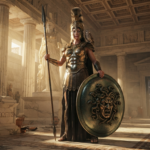
Aletheia is the ancient Greek word most often translated as truth, but its meaning reaches beyond simple correctness. In Greek thought, it could suggest what is revealed, what is not hidden, and what stands in the open before gods and mortals alike. The word appears across poetry, philosophy, and religious language, where it often carries the sense of truthfulness, disclosure, and reality itself.
Aletheia: The Greek Word for Truth
Aletheia (ἀλήθεια) is the standard Greek term associated with truth, especially in the intellectual and philosophical traditions of antiquity. It is usually contrasted with pseudos (falsehood, lie, or deception), though in many early texts the word has a wider and more poetic force than a simple factual claim. Rather than meaning only “correct statement,” it can point to something uncovered, disclosed, or brought into the light.
The word has remained influential because it captures a Greek way of thinking about truth as more than verbal accuracy. In myth, poetry, and philosophy, aletheia often belongs to what is enduring, revealed, and unmistakably real. That gives it a distinct place in Greek culture, where truth was not only spoken but also encountered.
Meaning of Aletheia in Ancient Greece
In ancient Greek usage, aletheia commonly meant truth, sincerity, or reliability, but its deeper sense is tied to the idea of unconcealment. Many scholars have noted that the word appears to be formed from a privative prefix and a root linked to forgetting or hiding, suggesting a state in which something is no longer covered or forgotten. This etymological background helped later thinkers treat truth as a condition of disclosure.
In ordinary and literary Greek, aletheia could describe truthful speech, accurate memory, or the revealed state of a matter. A witness speaking aletheia was speaking honestly; a poet preserving a tradition was presenting what had not been lost to forgetting. The concept was broad enough to serve both practical and philosophical purposes.
Aletheia in Homer and Early Poetry
In Homeric poetry, the exact noun aletheia is not as prominent as it becomes later in philosophy, but the related verbal and adjectival uses already point toward truthfulness and trustworthiness. Homeric language often values what is reliable, proven, and not deceptive, especially in speech, oaths, and recognition scenes. The epic world depends on words that can be believed.
Early Greek poetry, including Hesiod and later lyric traditions, often contrasts truth with misleading appearance, rumor, or forgetfulness. The Muses in Hesiod’s Theogony are famously capable of speaking both falsehoods that seem like truth and truthful things when they wish, a line that shows how closely truth and poetic authority were linked. In that environment, aletheia is not merely information; it is a mark of what can be trusted when language itself is powerful.
Unconcealment, Reality, and True Speech
One of the most important dimensions of aletheia is the sense of unconcealment. A thing in truth is something that stands revealed rather than covered, obscured, or distorted. This idea does not appear only in later philosophy; it is already implied in Greek attitudes toward memory, witness, and divine revelation, where truth emerges when hidden things are made visible.
True speech in Greek culture was therefore not only honest but also revelatory. A speaker of aletheia did not merely avoid lying; they brought forward what was actually the case, sometimes with the authority of a witness, sometimes with the insight of a prophet, and sometimes with the clarity of a philosopher. Reality and truth could become closely joined, so that to speak truly was to let the world appear as it is.
How Greek Philosophers Defined Aletheia
Greek philosophers gave aletheia a more explicit conceptual role than earlier poets did. For the Pre-Socratics, especially Parmenides, truth belonged to what is stable, intelligible, and genuinely real, in contrast to the deceptive world of appearances and opinion. His poem draws a strong line between the path of truth and the path of seeming, making aletheia a central philosophical destination.
Later thinkers refined the term in different ways. For Plato, truth is tied to knowledge of what truly is, beyond shadows and shifting impressions. For the Sophists and other writers, the tension between persuasion and truth also became a major concern, because language can shape belief without necessarily revealing reality. Across these debates, aletheia remained a word for what resists illusion.
Truth and Lies in Mythic Greek Tradition
Greek myth frequently explores the tension between truth and deception. Gods may reveal truth, conceal it, or speak in riddles; mortals may receive visions, warnings, or misleading appearances. Hermes, for instance, is a god of many crossings, and while not a “truth god” in a simple sense, he belongs to communication, messages, and the movement of information between worlds.
Mythic stories also show that falsehood can be powerful but unstable. Characters who deceive often face eventual exposure, while hidden identities are revealed in moments of recognition. In this way, Greek myth treats truth not as an abstract rule but as something that eventually comes to light, whether through divine intervention, suffering, or the unfolding of fate.
Aletheia in Plato, Aristotle, and Beyond
In Plato, aletheia is closely linked with the soul’s ascent toward what is truly real. The visible world may mislead, but philosophical inquiry seeks the stable forms and the knowledge that corresponds to them. Truth is not a mere opinion; it is grounded in the intelligible order that philosophy tries to grasp.
Aristotle gives a more analytical formulation. For him, truth and falsity are found primarily in judgment and proposition: to say of what is that it is, and of what is not that it is not, is to speak truth. This definition became highly influential in later Western thought. Beyond Plato and Aristotle, Hellenistic and later writers continued to use aletheia in religious, ethical, and intellectual contexts, keeping its range broad even as its philosophical precision increased.
Sacred Oaths and the Pursuit of Truth
Truth in Greek society was deeply tied to oaths, witness, and divine sanction. An oath before the gods was not a private promise alone; it invoked a sacred order in which falsehood could bring pollution, punishment, or disgrace. In epic and law alike, to swear truly mattered because speech itself was bound to honor and consequence.
The pursuit of truth could also take a religious form in oracles, cult practice, and consultation of divine signs. Yet oracular truth in Greek tradition was often indirect, symbolic, or difficult to interpret. That complexity reminds us that aletheia was not always simple certainty. In sacred settings, truth might be veiled in language that required discernment, patience, and reverence.
Greek Terms Related to Truth and Falsity
Several Greek words sit near aletheia in meaning. Pseudos refers to falsehood or a lie, and pseudēs describes something false or deceptive. Alēthēs means true or truthful, while related terms can express sincerity, reliability, or frankness depending on context. These words helped Greek writers distinguish between facts, honesty, and deceptive appearance.
Greek also used words for opinion and seeming, especially doxa, which often stands opposite to secure knowledge in philosophical texts. Another important idea is apatē, deception or trickery, a force common in myth and rhetoric alike. Together, these terms show that Greek reflection on truth was never isolated; it developed alongside a rich vocabulary for illusion, belief, and persuasion.
Why Aletheia Still Matters Today
Aletheia still matters because it names a deeper sense of truth than data alone. In an age shaped by information, image, and competing narratives, the Greek idea of truth as unveiling remains strikingly relevant. It asks not only whether a statement is correct, but whether what is hidden has been brought into view.
That older meaning also preserves something essential about myth and culture. Greek traditions did not treat truth as purely mechanical or dry; they understood it as something revealed through speech, memory, and encounter. For modern readers, aletheia offers a powerful reminder that truth can be both factual and luminous, both reliable and transformative.
Aletheia is the Greek word for truth, but in its fullest sense it also means disclosure, clarity, and the lifting of what has been hidden. From Homeric speech and sacred oath to Plato’s philosophy and Aristotle’s logic, the word carried a long history of meaning that shaped how the Greeks understood reality itself. Its legacy endures because it still speaks to a fundamental human desire: to see things as they are, without veil or distortion.

Orin Vale has spent the better part of two decades tracing the threads that connect the world’s oldest stories — from the halls of Asgard to the banks of the Nile, from Olympus to the jungles of the Maya. What began as a childhood fascination with flood myths and trickster gods grew into years of independent study across comparative mythology and ancient religion, always chasing the same question: what did these stories mean to the people who first told them? Orin writes for readers who want more than trivia — the ones looking for the beliefs, fears, and truths that myths were built to carry.