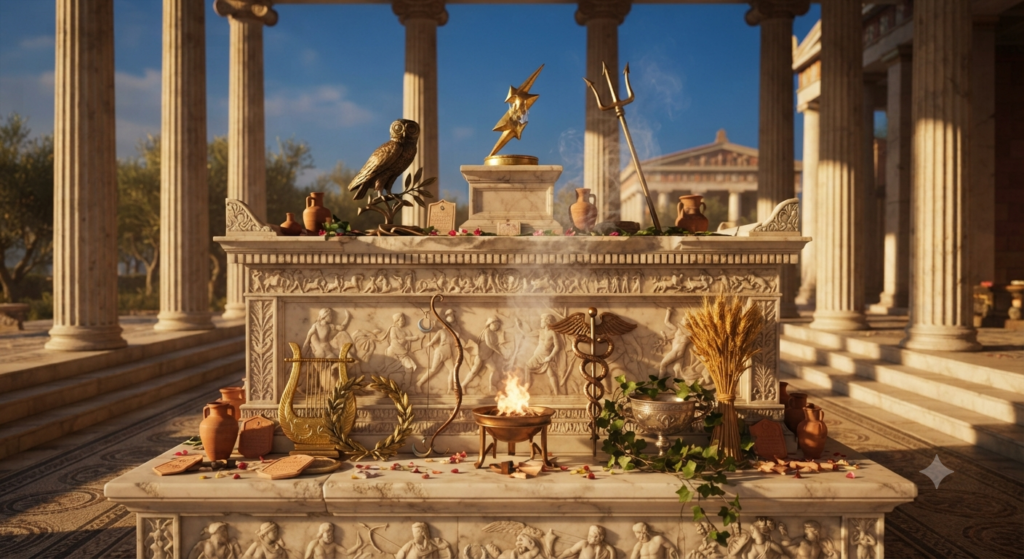
The main religious symbols of ancient Greece were not abstract emblems alone, but living signs that gathered myth, cult practice, and civic identity into one sacred language. In Homer, Hesiod, the Homeric Hymns, and later authors such as Pausanias and Apollodorus, the gods are repeatedly marked by objects, animals, plants, and ritual implements that helped worshippers recognize divine power in visible form. Some symbols belonged to a single deity, while others shifted in meaning from one sanctuary to another, depending on local custom and ritual use.
These symbols were never mere decoration. A thunderbolt, an owl, a branch of laurel, or a sheaf of grain could announce authority, prophecy, protection, passage, sea power, ecstasy, or fertility. In Greek religion, such signs linked the mythic world to everyday worship, appearing on altars, temple sculpture, votive offerings, painted pottery, and coins. Their endurance across the Greek world shows how strongly religious identity depended on image, gesture, and sacred association.
Sacred symbols of the Greek gods and cults
Greek religion was polytheistic and local in character, so symbols often identified both a god and the particular way that god was honored in a city or sanctuary. A single deity might appear under many epithets and in several cult forms, each with its own sacred signs. The same god who ruled in myth could be represented by an animal, a plant, or an implement that reflected a practical aspect of worship: protection, sovereignty, fertility, healing, or guidance.
Classical sources and archaeological evidence agree that these symbols functioned as a kind of visual shorthand. They were understood by worshippers who may never have read a myth in full, but who knew, from festivals and sanctuary life, that an owl belonged to Athena, a thunderbolt to Zeus, and a trident to Poseidon. In this way, Greek religious symbols acted as bridges between narrative and ritual, making divine presence legible in public and domestic settings alike.
Zeus thunderbolt and royal authority in myth
Zeus is most clearly marked by the thunderbolt, a weapon of overwhelming force that appears already in early epic and becomes the most enduring sign of his kingship. In Hesiod’s Theogony, the Cyclopes forge Zeus’s thunder and lightning, and this gift secures his rule over gods and cosmos. Homer also presents Zeus as the wielder of storm and sky, and later art regularly shows him holding the thunderbolt as a token of command. It is a symbol of punishment, but also of lawful supremacy.
The thunderbolt carried political meaning as well as mythic force. Because Zeus was associated with oath-taking, kingship, and the protection of guests and suppliants, the bolt became a sign of sovereign authority rather than sheer violence. Greek rulers and cities sometimes adopted Zeus imagery to express legitimacy, especially on coinage and civic monuments. The god’s royal status was thus made visible through the weapon he alone could bear, a symbol that united heaven, judgment, and order.
Athena owl, aegis, and civic wisdom
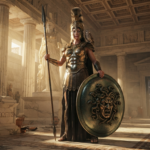
Athena’s best-known symbol is the owl, a creature of sharp sight and nocturnal vigilance. In Athenian culture especially, the owl came to represent practical intelligence, watchfulness, and the city’s patron goddess. It appears frequently in art and on Athenian coinage, where its presence was both religious and civic. Ancient writers and modern scholarship alike recognize the bird as one of the clearest emblems of Athena’s role as a guardian of wisdom and strategic thought.
Another major symbol is the aegis, the protective goatskin or shield-like object associated with Zeus and Athena. In Homer, Athena often bears the aegis into battle, and its appearance can terrify enemies and rally allies. Different sources describe it in slightly different ways, and its exact origin is not entirely fixed, but its function is consistent: it is a sign of divine protection and terrifying power. Together, owl and aegis capture Athena’s double character as a goddess of intellect and defense, equally at home in the council chamber and on the battlefield.
Apollo laurel, lyre, and prophetic light
Apollo is commonly linked with the laurel, a plant sacred to him through the story of Daphne as told by Ovid and reflected in broader Greek tradition. At Delphi and elsewhere, laurel was used in ritual and prophetic settings, including purification and divination. The plant symbolizes Apollo’s connection to victory, consecration, and the enduring power of divine favor. Because the laurel remains green and aromatic, it also suits a god associated with purity, clarity, and renewal.
The lyre is Apollo’s other great symbol, marking him as the patron of music, harmony, and ordered beauty. In Homeric and later hymnic tradition, Apollo is not merely a musician but the divine source of measured sound and civilized form. His association with light, prophecy, and the oracle at Delphi gives the lyre a broader meaning: it is the instrument of proportion and revelation. Apollo’s symbols together suggest a deity whose gifts are both artistic and intellectual, joining inspiration with discipline.
Hermes caduceus and the herald’s staff
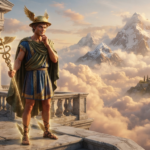
Hermes is identified above all by the caduceus, the herald’s staff often shown as a rod with paired serpents. In Greek tradition, Hermes is the messenger of the gods, guide of travelers, guardian of boundaries, and escort of souls to the underworld. The staff marks him as a figure of mediation, someone who moves between realms and carries authority through speech rather than force. Its presence in myth and art reflects his role as the divine intermediary.
The caduceus also points to Hermes’ association with negotiation, commerce, and exchange. As a god of roads, markets, and transitions, he governs movement in many forms, from trade to travel to communication. The serpents wound around the staff have no single universally agreed origin, but they enhance the symbol’s sense of balance between opposed forces. Hermes’ emblem is therefore less about domination than about passage, skill, and the crossing of thresholds.
Poseidon trident and mastery of the sea
Poseidon’s trident is one of the most recognizable symbols in Greek religion, a three-pronged spear that signifies control over the sea, earthquakes, and watery power more broadly. In Homer, Poseidon is a formidable divine force, often in tension with Zeus and other gods, and the trident expresses both his independence and his capacity to strike the earth and stir the waters. Later artistic tradition makes it his standard attribute, immediately identifying him even without a scene of action.
The symbol also reflects Poseidon’s importance to coastal communities and seafaring culture. For Greeks who depended on maritime trade, fishing, and naval warfare, the sea was both a road and a danger, and Poseidon’s emblem embodied that ambivalence. In sanctuaries and votive offerings, the trident could signal prayer for safe voyages or gratitude after survival at sea. It is a symbol of mastery, but never of complete control, for the sea in Greek thought remains powerful, changeable, and morally indifferent.
Dionysus vine, ivy, and ritual ecstasy
Dionysus is closely associated with the vine and with ivy, two plants that reflect his connection to wine, vitality, and altered consciousness. In the Homeric Hymns and later tragic and poetic traditions, he is the god whose arrival can bring abundance, liberation, and danger in equal measure. Grapevines and wreaths of ivy appear in his rituals and imagery as marks of his sacred presence. They symbolize fertility and growth, but also the power of dissolution, when social boundaries loosen under divine influence.
His cult was especially rich in ritual symbolism, including thyrsus staffs, masks, and ecstatic dance. The vine and ivy do not simply decorate the god; they express the movement between cultivation and wildness that defines Dionysian worship. Ancient sources such as Euripides show that his followers experienced him as both nurturing and disruptive. As symbols, the vine and ivy capture that paradox with unusual clarity: they promise wine, life, and joy, but also frenzy, possession, and the collapse of ordinary restraint.
Demeter sheaf, grain, and fertility rites
Demeter’s symbols are rooted in agriculture, especially grain, sheaves, and the harvested ear of wheat or barley. In the Homeric Hymn to Demeter, her grief and restored honor are tied directly to the fertility of the earth and the cycle of cultivation. She is the goddess who makes crops grow, and her symbols therefore speak to the most basic form of human dependence on divine favor. Grain is not merely a crop in her cult; it is a sacred sign of continuity between human labor and cosmic order.
These symbols were deeply bound to the Eleusinian Mysteries and other fertility rites, where sacred objects and ritual actions conveyed Demeter’s power in ways not fully open to public description. Ancient testimony suggests that the mystery cult centered on loss, return, and the promise of renewal through grain and seasonal change. The sheaf or ear of grain thus becomes a symbol of life sustained through hardship. In Demeter’s case, religious meaning and agricultural reality are almost inseparable.
Ancient Greek altars, votives, and temple signs
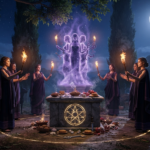
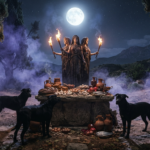
Beyond the symbols of individual gods, ancient Greek religion used altars, votive gifts, and temple markers to make sacred space visible. The altar was central to sacrifice, whether in a household courtyard, a civic sanctuary, or a major panhellenic shrine. It marked the point where offerings crossed from human possession into divine domain. Its form could vary widely, but its function was constant: it established a place of contact between worshipper and god.
Votive offerings extended this symbolic language. Terracotta figurines, bronze tripods, painted plaques, miniature weapons, and carved objects were dedicated in sanctuaries as tokens of gratitude, petition, or fulfillment of vows. Temple signs such as cult statues, inscribed stelae, and sacred emblems helped define the identity of a sanctuary and the deity who dwelt there. Taken together, these objects reveal a religious world in which meaning was built through accumulation, visibility, and repeated ritual use rather than through a single canonical image.
How ritual images shaped Greek religious identity
Greek religious symbols did more than identify gods; they trained communities to see the divine through recurring forms. A bird, a branch, a weapon, or a staff could summon a whole network of myth, prayer, and civic memory. Because these symbols appeared across festivals, coins, sanctuaries, and stories, they created a shared visual grammar that connected local cults to a wider Greek religious imagination. Even when myths differed from one region to another, the symbols could remain stable enough to anchor recognition.
This stability mattered because Greek religion was practiced in public life as much as in narrative tradition. Symbols helped define who a city honored, which power a sanctuary served, and what kind of relationship worshippers expected from a god. They also made divine attributes memorable: Zeus was authority, Athena wisdom and defense, Apollo clarity, Hermes mediation, Poseidon the sea, Dionysus transformation, Demeter fertility. In that sense, the main religious symbols of ancient Greece were not simply signs of belief. They were the visible shape of a civilization’s conversation with its gods.
The sacred symbols of ancient Greece endure because they were both poetic and practical. They condensed myth into a single image while guiding ritual life in temples, homes, and cities. Through thunderbolt, owl, laurel, trident, vine, grain, and countless votive forms, the Greeks gave divine powers a recognizable shape in the world they inhabited.
To study these symbols is to understand how Greek religion worked at ground level: through objects touched, seen, offered, and remembered. They remain among the most eloquent traces of ancient worship, not because they were fixed in one meaning, but because they could hold myth, identity, and ritual together at once.

Orin Vale has spent the better part of two decades tracing the threads that connect the world’s oldest stories — from the halls of Asgard to the banks of the Nile, from Olympus to the jungles of the Maya. What began as a childhood fascination with flood myths and trickster gods grew into years of independent study across comparative mythology and ancient religion, always chasing the same question: what did these stories mean to the people who first told them? Orin writes for readers who want more than trivia — the ones looking for the beliefs, fears, and truths that myths were built to carry.