Zeus, king of the Olympian gods, is not tied to a single fixed color in ancient Greek tradition. Unlike some later artistic symbols that become stable over time, Zeus appears in myth and art through a range of visual associations shaped by his role as sky god, thunderer, ruler, and guarantor of justice. The question of what color is associated with Zeus is therefore less about one official hue than about a network of meaningful colors that recur across classical sources and later artistic conventions.
Among those recurring associations, white, gold, blue, bronze, and the dark colors of storm clouds are the most prominent. Each reflects a different aspect of his divine authority: the brightness of the heavens, the radiance of kingship, the open sky above, the metal of sacred power, and the shadow of thunder. Zeus is best understood through this spectrum rather than through a single emblematic color.
Zeus and the Meaning of Color in Greek Myth
In Greek mythology, color is rarely a fixed theological system. Gods are identified more often by symbols, domains, epithets, and sacred animals than by one official color, and Zeus is no exception. His authority comes from his place as ruler of the gods, master of weather, and dispenser of order, all of which invite visual associations with brightness, height, and storm.
Because ancient Greek culture did not assign standardized divine colors in the modern sense, the colors linked with Zeus arise from poetry, sculpture, ritual objects, and later artistic tradition. The result is a flexible image: Zeus can appear bright and luminous, yet also darkened by storm clouds and bronze weaponry. His color symbolism is inseparable from his function as a god who stands above the world and commands the sky.
The Color Most Often Linked to Zeus
If one color is most commonly associated with Zeus, it is white or bright light. This comes less from a direct ancient label than from his connection to the open heavens, clouds, and lightning. In Greek imagination, Zeus is the shining ruler above the mortal world, and brightness becomes a natural expression of divine presence.
White also fits the broader language of purity, elevation, and sacredness that later traditions often attach to high gods, though Greek sources themselves are more poetic than systematic. Zeus is not a white-robed god in every image, but his radiance is frequently imagined through brightness rather than darkness. When readers ask what color is associated with Zeus, white is often the closest single answer, though it remains only part of the picture.
Thunderclouds, Lightning, and Divine White
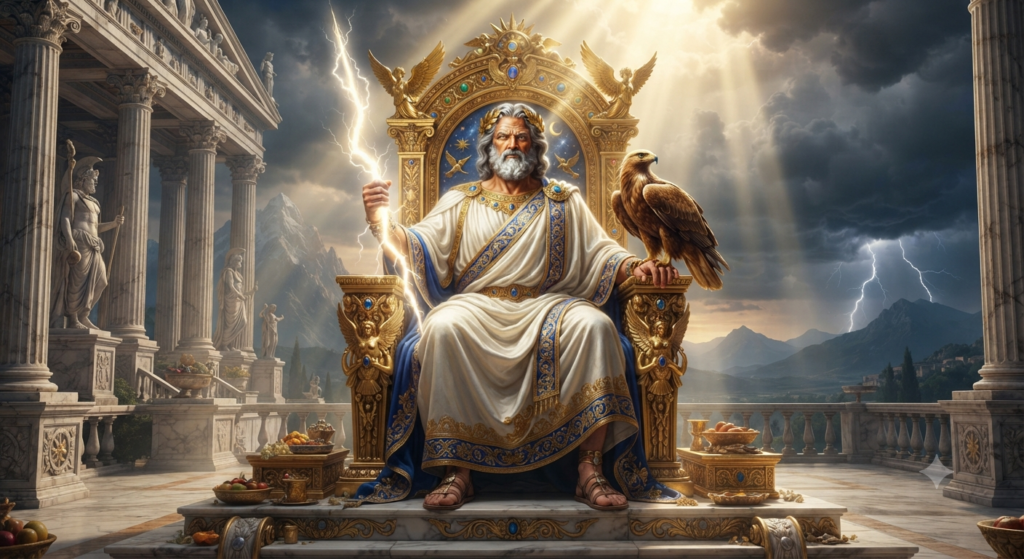
Zeus is the god of thunder and lightning, and this makes cloud imagery central to his visual identity. Storm clouds are dark, but lightning flashes through them in sudden white brilliance. In Homer especially, Zeus is the one who gathers clouds and hurls thunderbolts, so the contrast between black storm and brilliant strike becomes one of his defining color patterns.
This play of shadow and light is important because it reflects both power and revelation. Zeus is not merely the calm sky; he is the force that breaks through it. His divine white is therefore dynamic rather than static, appearing in the flare of lightning, the brightness of the upper air, and the cleansing flash that marks his intervention in the world.
Gold in Depictions of the Olympian King
Gold is another major color associated with Zeus, especially in later artistic and literary traditions. As king of the gods, Zeus is often imagined in ways that emphasize splendor, wealth, and sovereign dignity, and gold naturally becomes the color of kingship. Temples, cult images, and poetic descriptions can all present divine authority through gleaming materials and radiant surfaces.
Gold also suits Zeus because it conveys permanence and grandeur. In Greek and Roman art, the highest deities are often rendered with precious or luminous qualities, and Zeus stands at the top of that hierarchy. While Homer does not give him a simple color label, the visual language of splendor surrounding Zeus makes gold one of the strongest symbolic associations in his later reception.
Blue Skies and Zeus as Sky God
As a sky god, Zeus is strongly linked with blue, though this is more a modern visual intuition than a strict ancient convention. The clear daytime sky is his realm in a broad mythic sense, and blue has become the modern shorthand for that celestial domain. The association is especially natural because the sky is where Zeus’s authority is most visible.
Ancient Greek texts do not consistently describe Zeus as “blue,” yet the color still carries interpretive weight in modern depictions. It captures the vastness and height of his power, as well as the calm upper air that frames the storm. Blue belongs more to the atmosphere of Zeus than to a canonical ancient symbol, but it remains one of the most understandable colors attached to him today.
Sacred Symbols: Eagle, Scepter, and Oak
Zeus’s symbols often matter more than any color alone. The eagle, the scepter, and the sacred oak define him in myth and cult, and each symbol invites color associations of its own. The eagle suggests brown, gold, and white; the scepter suggests bronze or gold; the oak suggests deep green and dark wood, tied to Dodona and oracular worship.
These symbols show how color in Zeus’s imagery is layered rather than singular. His eagle is a creature of the high air, his scepter a token of rule, and his oak a living sign of divine presence. Together they create a palette of earth, metal, sky, and light, all of which reinforce his identity as the sovereign god of heaven and judgment.
Zeus in Vase Painting and Sculpture Traditions
Greek vase painting often presents Zeus with the visual dignity expected of an Olympian ruler, but not through a fixed color code. Black-figure and red-figure pottery rely on technique rather than naturalistic color, so Zeus is recognized through posture, attributes, and context rather than skin tone or clothing color. He is usually shown enthroned, bearing thunderbolts, or standing in commanding stillness.
In sculpture, especially when later surfaces and materials are considered, Zeus’s image becomes even more connected to brightness, stone, and metal. A famous cult statue might have been constructed from ivory and gold, as with the chryselephantine tradition associated with major divine images. Even when the original colors are lost, the impression left is one of luminous sacred majesty rather than a single, simple hue.
Ancient Texts on Zeus’s Radiant Appearance
Ancient poetry often emphasizes Zeus’s radiance indirectly through epithets and imagery. Homer and Hesiod portray him as the cloud-gatherer, thunderer, and all-seeing ruler, which gives him a presence that is atmospheric rather than chromatically fixed. The emphasis falls on brilliance, height, and power, all of which suggest light more than color in the modern sense.
Later authors continue this pattern, describing the god in ways that imply splendor, force, and celestial authority. Even when texts do not name a color outright, they repeatedly present Zeus as radiant or awe-inspiring. That literary radiance has strongly shaped later artistic choices, especially the use of gold, white, and lightning-bright imagery in depictions of the god.
Bronze, Cloud, and Storm Imagery in Worship
In cult and ritual settings, Zeus was often represented through materials that carried their own symbolic colors. Bronze, common in Greek sacred objects and weapon imagery, evokes the metallic sheen of divine power. Thunderbolts, tripods, and votive offerings could all bring a gleam of bronze or gold into the worship of a storm god whose authority descended from the heavens.
Cloud and storm imagery, meanwhile, kept Zeus linked to darker tones as well. The god who sends rain and thunder must also be imagined against a backdrop of grey, black, and shifting sky. Worship did not fix him to one color; instead, it surrounded him with the changing palette of weather, metal, and sacred light.
Why Zeus Has No Single Official Color
Zeus has no single official color because Greek religion did not usually define gods that way. His identity was built through epithets, rituals, symbols, and stories, not through a standardized chromatic code. Different artistic periods and regions emphasized different aspects of his power, so the colors associated with him could shift from brightness to gold to storm-darkness.
For that reason, the best answer is plural rather than singular. Zeus is commonly linked with white or bright light, gold, blue sky imagery, bronze, and the dark colors of thunderclouds. If one color must be chosen, white is the most natural association, but Zeus truly belongs to the whole spectrum of the heavens.
Zeus is a god whose visual identity moves between light and storm, sky and metal, radiance and cloud. Ancient sources do not give him one fixed sacred color, yet they repeatedly place him in a world of brightness, thunder, and royal splendor. That is why white, gold, and blue are often mentioned in connection with him, even as the darker tones of weather remain part of his image.
The color associated with Zeus is therefore best understood as a symbolic field rather than a single shade. He is the shining sovereign above the clouds, the lightning-bright ruler of Olympus, and the divine presence whose power can be imagined in many colors without ever being confined to just one.

Orin Vale has spent the better part of two decades tracing the threads that connect the world’s oldest stories — from the halls of Asgard to the banks of the Nile, from Olympus to the jungles of the Maya. What began as a childhood fascination with flood myths and trickster gods grew into years of independent study across comparative mythology and ancient religion, always chasing the same question: what did these stories mean to the people who first told them? Orin writes for readers who want more than trivia — the ones looking for the beliefs, fears, and truths that myths were built to carry.