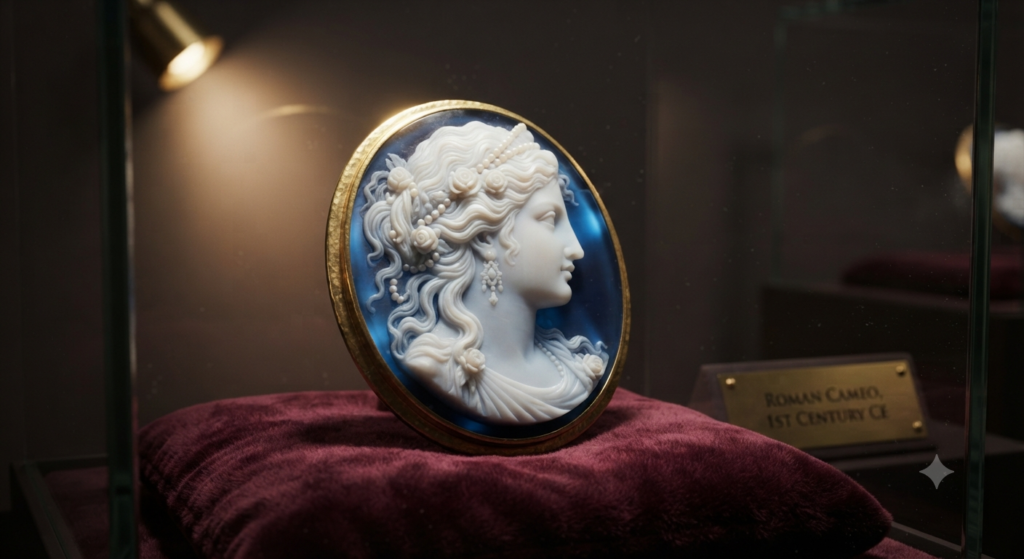
Aphrodite, the Greek goddess of love, beauty, and desire, appears in ancient cameo art as one of the most enduring figures of classical imagination. In carved gems and layered shells, she is not simply a decorative subject but a visual language of grace, fertility, power, and divine allure. Greek and Roman glyptic artists drew on familiar myths and cult images, shaping her in profiles, full figures, and intimate scenes that could fit into a ring, pendant, or imperial display.
Ancient cameo art gave Aphrodite a remarkable range of meanings. She might be presented as a fully idealized goddess, a sea-born figure rising from the waves, a companion of Eros, or the Roman Venus in courtly and domestic settings. The exact image varied by period and material, yet the same core idea remained constant: Aphrodite was rendered as the embodiment of beauty made visible in stone, shell, and light.
Aphrodite in Greek Cameo Iconography and Form
In Greek cameo art, Aphrodite is usually shown through a refined and compact visual vocabulary. Artists favored profiles, three-quarter views, and elegant standing poses that could be adapted to the small surface of a gem. The goddess is often recognized by her youthful face, balanced proportions, and composed bearing rather than by overt narrative action. This restraint suits glyptic art, where clarity and silhouette matter as much as iconographic detail.
The forms used for Aphrodite in Greek gems often echo larger sculptural traditions. She may stand with one hand modestly covering her body, adjust her hair, or lean in a posture that suggests ease and self-possession. Such images do not usually aim at strict portraiture; instead, they present an ideal type of divine beauty, one that Greek viewers would associate with the goddess through pose, attribute, and context.
Shell Cameos and the Goddess of Love
Shell cameos later became especially associated with Aphrodite and Venus because the material itself seemed to suit the goddess of beauty and the sea. The layered structure of shell allowed the carver to create a pale figure against a darker ground, producing a luminous effect that matched her divine radiance. This medium became particularly popular in the Hellenistic and Roman periods, when personal adornment and luxury objects often carried mythological subjects.
The shell also carried a natural symbolic resonance with Aphrodite, since many traditions link her birth to the sea. Hesiod’s Theogony makes her emerge from the foam after Uranus is severed, while later visual culture often connects her with marine imagery more loosely. Shell cameos could therefore suggest both birth and beauty, making them a fitting medium for a goddess whose divine identity was tied to the sea, desire, and radiant emergence.
Venus Portraits in Hellenistic and Roman Glyptics
In Hellenistic and Roman glyptics, Aphrodite is frequently absorbed into the Roman figure of Venus, though the Greek divine character remains visible. Roman elites inherited Greek mythological imagery and adapted it to new social and political uses. On engraved gems and cameo portraits, Venus may appear in serene, courtly form, her presence evoking refinement, fertility, and aristocratic taste rather than a specific episode from myth.
These images sometimes blur the line between goddess and idealized noblewoman. A Roman viewer might read Venus as a symbol of marital harmony, dynastic legitimacy, or cultivated elegance, especially when the gem was worn in rings or set into precious mounts. In this context, the goddess becomes both a mythological figure and a cultural emblem, her image shaped by the Roman appetite for Greek beauty and prestige.
Aphrodite as Nude, Draped, and Idealized Figure
One of the most common ways Aphrodite appears in ancient cameo art is through the nude or partly nude figure. This is not simple erotic display, but a highly controlled classical ideal. The body is typically smooth, balanced, and unmarked, following conventions of proportion that had been established in sculpture and adapted to gem carving. The nude Aphrodite, especially in the tradition of the Aphrodite of Knidos, expresses divine beauty through calm visibility.
Draped versions are equally important. A veil, himation, or slipping garment can suggest modesty, movement, or the moment of self-revelation. In cameo art, drapery helps define contours and gives the figure a soft, flowing rhythm. The tension between concealment and exposure is central to Aphrodite’s image: she is a goddess whose power lies partly in what is shown and partly in what is withheld.
Attributes of the Sea-Born Goddess in Relief
Ancient cameo artists often reinforced Aphrodite’s identity with attributes that hint at her sea-born nature. A shell, a wave-like setting, or marine creatures may accompany her, while the pose itself can suggest emergence or arrival. These details are especially useful in relief carving, where small changes in contour can signal mythic identity with great economy. The goddess may stand on a rocky shore, be carried by attendants, or appear in a shell-like framing device.
Such imagery reflects the older mythic tradition in which Aphrodite is connected to the sea and to birth from primal force. In Hesiod’s account, she is a power that arises from one of the most violent divine acts in early cosmogony, yet visual culture often transforms that origin into serenity. Cameos compress the myth into a quiet emblem: the goddess of overwhelming desire rendered as poised and luminous form.
Shell, Pearl, Dove, and Other Sacred Symbols
Aphrodite’s cameo images are often accompanied by symbols that were widely associated with her in antiquity. The shell is perhaps the most famous, but pearls also belong to her visual world because of their luster and association with the sea. The dove, a bird linked to love and gentleness in later tradition, frequently serves as a companion or emblem in Roman art, reinforcing the goddess’s softer and more affectionate aspects.
Other symbols may appear as well, including mirrors, roses, swans, and garlands. Each of these objects contributes to a broader field of meaning: beauty, sexuality, fertility, and adornment. In cameo art, the symbols are usually not crowded into the composition. Instead, they are placed with care so that a viewer could identify the goddess at a glance, while still appreciating the elegance of the object itself.
Myth Scenes Featuring Aphrodite and Eros
Some cameo works move beyond the isolated figure and show Aphrodite in mythic interaction, especially with Eros. Their relationship is deeply embedded in Greek and Roman imagination, though the details vary by period and source. Eros may appear as a youthful companion, servant, or son, depending on the artistic and literary tradition. In cameo art, the pair often suggests the transmission of desire itself, with Aphrodite guiding or overseeing the force that Eros embodies.
Scenes involving Aphrodite and other mythic figures can also allude to famous narratives such as the Judgment of Paris, the love of Adonis, or the goddess assisting mortals and heroes. Not every cameo can be matched securely to a specific story, and scholars often caution against overidentifying small objects. Even so, the recurring theme is clear: Aphrodite in glyptics is rarely static. She is a goddess whose beauty generates action, relation, and consequence.
Courtly Jewelry and Domestic Devotion to Venus
Cameos of Aphrodite and Venus were not only artistic miniatures but also personal objects. Set into rings, brooches, pendants, and luxury boxes, they moved with the body and entered the rhythms of daily life. In Roman culture especially, such images could signal education, status, and attachment to classical taste. A Venus cameo might be worn as an ornament, but it could also function as a private sign of protection, desire, or refinement.
Domestic devotion to Venus is harder to prove in the strict religious sense than formal temple cult, yet the goddess clearly occupied a place in household life and personal identity. Cameos helped bring her into intimate spaces, where mythological beauty and social aspiration met. A finely carved Venus could transform a personal item into a small monument of inherited culture, making ancient myth feel immediate and near.
Color, Layering, and Stone Choice in Cameos
The visual power of cameo art depends heavily on material. Shell cameos use natural layers of contrasting color, allowing the carver to shape Aphrodite in pale relief against a darker background. Hardstone cameos, by contrast, exploit the colors and bands of sardonyx, agate, and related stones. The choice of material was never accidental; it affected how light fell on the goddess and how sharply she stood out from her ground.
Color and layering also influence the emotional tone of the image. A white figure emerging from a dark field can create a sense of divine appearance, almost like moonlight or sea foam made solid. Translucent stones add depth and richness, while carefully polished surfaces enhance the goddess’s softness. In this way, the material itself becomes part of Aphrodite’s iconography, reinforcing the themes of radiance, delicacy, and controlled luxury.
How Classical Artists Shaped Aphrodite’s Image
Classical artists established the enduring visual grammar of Aphrodite long before cameo art became fashionable in elite circles. Sculptors, vase painters, and relief carvers developed the basic conventions: youthful proportions, serene expression, partial nudity, graceful drapery, and associations with sea, love, and adornment. Cameo artists inherited this tradition and compressed it into a miniature scale without losing its essential character. The result is a figure instantly legible across different media.
At the same time, cameo art helped preserve and circulate Aphrodite’s image across the Greek and Roman worlds. Because gems and shells were portable, the goddess traveled in pockets, jewelry, and private collections, adapting to changing tastes while retaining her core identity. Through these small but exquisitely made objects, Aphrodite remained both ancient and immediate: a classical goddess whose beauty could be held in the hand.
Ancient cameo art shows Aphrodite as more than a subject of decoration. It presents her as an ideal of divine beauty shaped by material skill, mythic memory, and cultural desire. Whether in shell, stone, nude, draped, or accompanied by Eros, she appears as a figure whose power lies in poise, radiance, and symbolic depth.
Across Greek and Roman glyptics, Aphrodite remained one of the most flexible and enduring divine images. Artists adapted her to private jewelry, courtly display, and intimate devotion, yet the same elegant presence persisted beneath every variation. In cameo art, the goddess of love became a small carved mirror of classical imagination itself.

Orin Vale has spent the better part of two decades tracing the threads that connect the world’s oldest stories — from the halls of Asgard to the banks of the Nile, from Olympus to the jungles of the Maya. What began as a childhood fascination with flood myths and trickster gods grew into years of independent study across comparative mythology and ancient religion, always chasing the same question: what did these stories mean to the people who first told them? Orin writes for readers who want more than trivia — the ones looking for the beliefs, fears, and truths that myths were built to carry.