Anyone asking how did Zeus become king of the gods arrives at a single defining event: the Titanomachy, a ten-year war fought between Zeus and his fellow Olympians against Cronus and the ruling Titans, resulting in a complete restructuring of cosmic power. This victory did not come easily or immediately; it followed a hidden childhood, a dangerous rescue of his siblings, and a prolonged, genuinely uncertain war before Zeus finally secured his position as supreme ruler of the cosmos. Understanding how did Zeus become king of the gods requires tracing this entire sequence of events in detail, from his earliest days in hiding through the final division of the universe among the victorious Olympian brothers.
Escaping Cronus — Zeus’s Hidden Childhood
The story of how did Zeus become king of the gods begins well before any war, rooted in a prophecy warning Cronus that one of his own children would eventually overthrow him, just as Cronus himself had previously overthrown his father, Uranus. This prophecy fundamentally shaped Cronus’s behavior toward his children and set the entire subsequent narrative in motion.
To prevent this prophesied overthrow, Cronus swallowed each of his children immediately after birth, consuming Zeus’s siblings, including Poseidon, Hades, Hestia, Demeter, and Hera, one after another as they were born to Cronus and his wife, Rhea, creating a genuinely desperate situation for Rhea as she watched each child disappear.
When Zeus was born, Rhea, determined to save at least one child from this fate, hid him away in secret and tricked Cronus into swallowing a large stone wrapped in cloth instead, successfully deceiving him and allowing Zeus to survive, raised in hiding far from his father’s awareness or control.
This early deception proved absolutely essential to how did Zeus become king of the gods, since without Rhea’s successful intervention, no surviving child would have existed to eventually challenge Cronus’s rule, meaning this single act of maternal protection effectively made everything that followed possible.
Freeing His Siblings
Having grown to adulthood in hiding, Zeus eventually returned to confront his father directly, marking the next essential stage in how did Zeus become king of the gods. Rather than attacking immediately, Zeus first worked to free his previously swallowed siblings, recognizing that he would need allies for any successful challenge to Cronus’s established rule.
Through various accounts, Zeus successfully forced Cronus to regurgitate his swallowed children, freeing Poseidon, Hades, Hestia, Demeter, and Hera, who emerged as fully grown deities ready to join Zeus in his growing opposition to their father’s continued reign over the cosmos.
This act of liberation formed the essential foundation of the alliance that would eventually challenge Cronus directly, transforming Zeus from an isolated, hidden survivor into the leader of a genuine coalition of siblings united by both shared grievance and mutual interest in overthrowing their father’s rule.
This alliance-building phase remains a crucial, sometimes underemphasized element of how did Zeus become king of the gods, demonstrating that his eventual victory depended significantly on cooperation and strategic relationship-building rather than individual strength or power alone.
The Titanomachy — Ten Years of War
With his siblings freed and allied against their father, Zeus and the younger gods established their base on Mount Olympus, while Cronus and the majority of the Titans maintained their position on Mount Othrys, setting the stage for the prolonged conflict central to how did Zeus become king of the gods.
This war, known as the Titanomachy, lasted approximately ten years according to most ancient sources, representing a genuinely extended and uncertain conflict rather than a quick or decisive victory, reflecting the significant power still held by Cronus and the Titans throughout much of this prolonged confrontation.
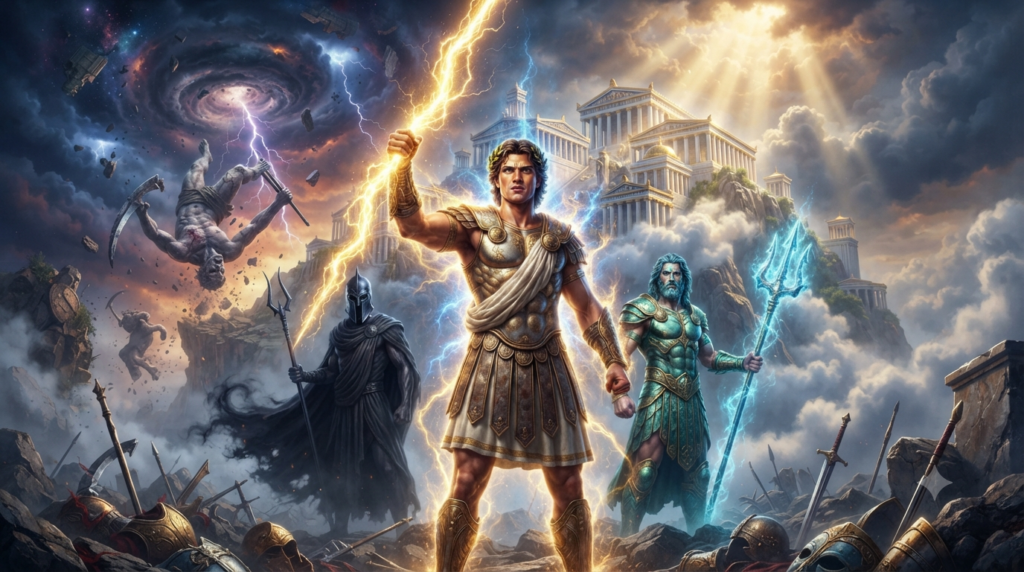
A decisive turning point arrived when Zeus freed the Cyclopes and the Hecatoncheires, powerful beings previously imprisoned by Cronus, who joined Zeus’s side and provided crucial military advantage, including the Cyclopes forging Zeus’s iconic thunderbolt, the weapon that would become permanently associated with his authority and power.
This alliance with the Cyclopes and Hecatoncheires proved essential to how did Zeus become king of the gods, providing the additional strength and weaponry needed to finally overcome Cronus and the Titans after years of otherwise evenly matched conflict between the two opposing divine factions.
Victory and the Division of the Cosmos
Following ten years of sustained conflict, Zeus and his allies ultimately achieved decisive victory over Cronus and the Titans, marking the successful conclusion of the war central to how did Zeus become king of the gods and establishing Zeus and his siblings as the new ruling generation of Greek deities.
Following this victory, Zeus, Poseidon, and Hades divided rule over the cosmos through a drawing of lots, with Zeus receiving dominion over the sky, Poseidon the sea, and Hades the underworld, while the earth itself remained common ground shared among all three brothers rather than exclusively controlled by any single deity.
This division formalized Zeus’s specific position as king of the gods, not simply through military victory alone, but through this additional, mutually agreed division of cosmic authority among the three brothers, reinforcing that his rule rested on both conquest and cooperative agreement with his fellow victorious siblings.
This combination of decisive military victory followed by formal, cooperative division of power represents the essential final stage in how did Zeus become king of the gods, establishing both the practical and symbolic foundation for his subsequent recognized authority throughout the rest of Greek mythology.
Why the Titanomachy Matters Beyond the War Itself
Understanding how did Zeus become king of the gods through this detailed process reveals important symbolic meaning beyond the war itself, demonstrating that Zeus’s authority rested on genuine achievement, strategic alliance, and formal agreement rather than on inherited privilege or unchallenged, automatic succession.
This narrative of earned legitimacy through struggle, cooperation, and eventual formal division of power established the essential structural foundation upon which the entire subsequent Olympian order was built, shaping how later Greek mythology consistently portrayed Zeus’s authority as fundamentally legitimate rather than merely imposed through force alone.
The Titanomachy also established important precedents reflected throughout later Greek mythology, including patterns of divine alliance, strategic cooperation among siblings, and formal agreement regarding divided authority, themes that continued appearing throughout subsequent mythological narratives involving the broader Olympian family.
Recognizing this deeper significance enriches understanding of how did Zeus become king of the gods, demonstrating that this founding narrative established far more than simple political succession, instead providing the essential mythological and symbolic framework underlying the entire subsequent structure of Greek divine authority.
FAQ — Quick Answers About Zeus’s Rise to Power
How did Zeus become king of the gods?
Zeus became king of the gods by leading the Olympians to victory over Cronus and the Titans in the Titanomachy, then dividing rule of the cosmos with his brothers Poseidon and Hades.
How long did the Titanomachy last?
According to most ancient sources, the Titanomachy lasted approximately ten years before Zeus and his allies achieved final victory over Cronus and the Titans.
Who helped Zeus win the war against Cronus?
Zeus’s siblings, along with the freed Cyclopes and Hecatoncheires, helped him defeat Cronus, with the Cyclopes forging his iconic thunderbolt.
How did Zeus and his brothers divide the world?
Zeus, Poseidon, and Hades divided the cosmos through a drawing of lots, with Zeus receiving the sky, Poseidon the sea, and Hades the underworld.
Did Zeus save his siblings before the war?
Yes, Zeus first freed his siblings after they had been swallowed by Cronus, forming the essential alliance needed before the Titanomachy began.
Conclusion
Anyone who sets out to answer how did Zeus become king of the gods finds a story built on far more than simple strength: a hidden childhood, a carefully orchestrated rescue of his siblings, a prolonged ten-year war, and a final, cooperative division of cosmic power among the victorious brothers. Each stage proved essential to his eventual, lasting authority.
This detailed process reveals Zeus’s kingship as fundamentally earned through struggle, alliance, and formal agreement rather than simply inherited or imposed, establishing a model of legitimate authority that shaped the broader structure of Greek mythology for generations of stories that followed.
Ultimately, how did Zeus become king of the gods finds its complete answer not in any single moment of triumph, but in this entire sequence of survival, alliance, war, and division, together forming one of Greek mythology’s most foundational and enduring narratives of earned divine authority.

Orin Vale has spent the better part of two decades tracing the threads that connect the world’s oldest stories — from the halls of Asgard to the banks of the Nile, from Olympus to the jungles of the Maya. What began as a childhood fascination with flood myths and trickster gods grew into years of independent study across comparative mythology and ancient religion, always chasing the same question: what did these stories mean to the people who first told them? Orin writes for readers who want more than trivia — the ones looking for the beliefs, fears, and truths that myths were built to carry.