Anyone asking how many times did Zeus cheat on Hera should first understand that ancient Greek sources never provide a single, definitive number to answer this question precisely. Instead, Greek mythology preserves numerous well-documented affairs involving Zeus and various mortal women and goddesses, each producing significant offspring who went on to become major gods, heroes, or founding figures within Greek mythological tradition. Understanding how many times did Zeus cheat on Hera requires shifting focus away from an impossible exact count and toward examining the specific, significant unions that Greek mythology consistently preserved and referenced across its broader narrative tradition.
Why There’s No Exact Number
Ancient Greek mythology developed as a fragmented, regionally varied oral tradition maintained by numerous different poets across different periods and locations, meaning no single authoritative source ever compiled a definitive, complete list addressing how many times did Zeus cheat on Hera with any precise numerical accuracy.
Many affairs receive only brief genealogical mention within ancient sources, cited primarily to establish a particular hero or deity’s divine parentage, while other unions receive extensive narrative treatment within complete mythological stories, creating significant inconsistency in how thoroughly different affairs were documented across the broader surviving textual tradition.
This inconsistency means that any attempt to answer how many times did Zeus cheat on Hera with a specific number would necessarily involve significant guesswork, since ancient sources simply were not compiled with this kind of precise, comprehensive accounting in mind when originally composed by different ancient Greek poets and storytellers.
Rather than pursuing an ultimately unattainable exact count, a more accurate and genuinely useful approach to how many times did Zeus cheat on Hera involves examining the most significant, well-documented unions specifically, each of which played a substantial role in the broader genealogical structure of Greek mythology.
Notable Affairs and Their Divine or Heroic Offspring
Zeus’s union with Leto produced Apollo and Artemis, two of the most significant deities within the broader Olympian pantheon, representing one of the most consequential affairs relevant to how many times did Zeus cheat on Hera, given the major and lasting mythological significance of these resulting children.
His relationship with the mortal woman Alcmene resulted in the birth of Heracles, arguably the most famous hero within all of Greek mythology, whose extensive later mythology and numerous labors trace directly back to this specific union between Zeus and a mortal woman.
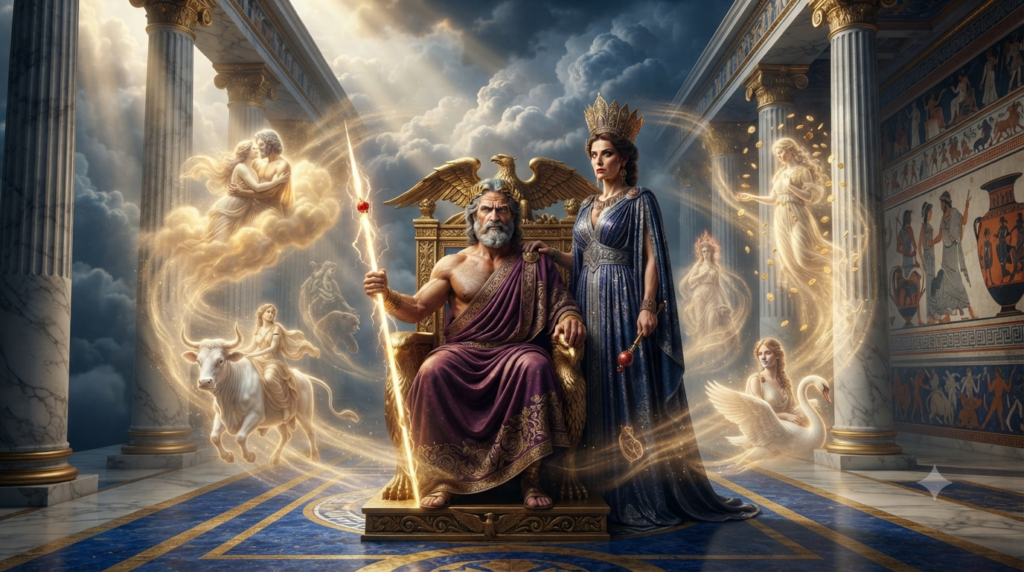
Zeus’s abduction of Europa, accomplished by transforming himself into a bull, resulted in the birth of Minos, who later became the legendary king of Crete, while his union with Danae, achieved through transforming into golden rain, produced Perseus, another significant Greek hero whose mythology remains extensively documented.
Zeus’s union with Leda, achieved through transforming into a swan, produced Helen of Troy among other significant offspring, while his relationship with Io, a mortal priestess whom Zeus transformed into a heifer specifically to help conceal her from Hera, further illustrates the significant lengths involved across these various mythological unions relevant to how many times did Zeus cheat on Hera.
Hera’s Reaction — Jealousy as a Recurring Theme
Hera’s response to Zeus’s various affairs forms a consistent and significant narrative theme throughout Greek mythology, with her jealousy and subsequent anger toward Zeus’s lovers and their resulting children appearing repeatedly across numerous separate mythological stories connected to how many times did Zeus cheat on Hera.
Io’s transformation into a heifer, followed by Hera sending a persistent gadfly to torment her across vast distances, represents one particularly detailed example of Hera’s mythological pursuit of Zeus’s lovers, illustrating the severity and persistence with which she responded to these specific unions within Greek mythological narrative.
Heracles similarly faced significant, ongoing hostility from Hera throughout his life and mythology, reflecting her continued resentment toward this particular product of Zeus’s infidelity, with her hostility toward Heracles becoming a defining and recurring element throughout his broader heroic mythology and various trials.
These recurring patterns of jealousy and retribution serve an important narrative function within Greek mythology, using Hera’s consistent reactions to explore broader themes of power, consequence, and divine emotion, providing genuine dramatic structure to what might otherwise remain simply a list of disconnected mythological unions.
Why These Myths Persisted in Greek Storytelling
Many of Zeus’s affairs served an important genealogical function within ancient Greek culture, allowing various city-states, ruling families, and legendary heroes to claim direct divine descent from Zeus specifically, reinforcing the political and cultural significance behind why how many times did Zeus cheat on Hera generated such extensive mythological documentation.
This genealogical function meant that these myths were not simply narrative entertainment, but carried genuine cultural and political weight within ancient Greek society, providing important legitimizing origin stories for specific families, cities, and heroic lineages throughout the broader Greek world.
These myths also served to connect the more abstract, cosmic Olympian pantheon directly to significant mortal heroes and historical Greek communities, creating a shared mythological framework linking divine authority directly to specific human lineages and civic identities throughout ancient Greece.
Understanding this broader cultural function helps explain why how many times did Zeus cheat on Hera remains such a well-documented aspect of Greek mythology, reflecting genuine cultural significance well beyond simple narrative interest in Zeus’s personal behavior or relationships alone.
FAQ — Quick Answers About Zeus’s Affairs
How many times did Zeus cheat on Hera?
There is no exact number recorded in ancient sources, though Greek mythology documents numerous significant affairs, each producing important gods, heroes, or legendary figures.
Who are some of the most famous children born from Zeus’s affairs?
Notable children include Apollo and Artemis, Heracles, Perseus, Minos, and Helen of Troy, each born from different unions involving Zeus.
How did Zeus often approach these affairs?
Zeus frequently used transformation, appearing as a bull, swan, or golden rain, among other forms, to approach or conceal his various mortal and divine lovers.
How did Hera typically respond to Zeus’s infidelity?
Hera frequently responded with jealousy and retribution, targeting Zeus’s lovers and children directly, as seen in her prolonged pursuit of Io and hostility toward Heracles.
Why were Zeus’s affairs so significant in Greek culture?
These affairs often established important genealogical connections, allowing cities, families, and heroes to claim legitimate divine descent from Zeus specifically.
Conclusion
Anyone who sets out to answer how many times did Zeus cheat on Hera ultimately discovers that ancient Greek mythology never provided a precise, definitive count, instead preserving numerous significant, well-documented unions, each producing major gods, heroes, or legendary founding figures central to broader Greek mythological tradition.
From Apollo and Artemis to Heracles, Perseus, and Helen of Troy, these unions collectively demonstrate how thoroughly Zeus’s mythology intertwined with the broader genealogical and cultural structure of ancient Greek civilization, extending well beyond simple narrative interest into genuine social and political significance.
Ultimately, how many times did Zeus cheat on Hera finds its most meaningful answer not in an impossible exact count, but in recognizing the genuine breadth and lasting mythological significance of these documented unions, each contributing essential figures to the broader landscape of Greek mythology.

Orin Vale has spent the better part of two decades tracing the threads that connect the world’s oldest stories — from the halls of Asgard to the banks of the Nile, from Olympus to the jungles of the Maya. What began as a childhood fascination with flood myths and trickster gods grew into years of independent study across comparative mythology and ancient religion, always chasing the same question: what did these stories mean to the people who first told them? Orin writes for readers who want more than trivia — the ones looking for the beliefs, fears, and truths that myths were built to carry.