According to Greek mythology, the answer to did Poseidon create horses is yes: ancient Greek tradition credits Poseidon, god of the sea, with bringing the first horse into existence. This claim appears across multiple sources and regional variations, consistently tying the god’s identity to one of the most powerful and useful animals in the ancient world. Before examining the specific myths behind this belief, it helps to frame exactly what kind of claim this is and isn’t.
This is a mythological explanation, not a historical or biological account of how the horse actually came to exist as a species. Ancient Greeks, like many cultures before modern science, often explained the origins of natural phenomena, animals, and even entire aspects of civilization through stories involving the gods. The myth of Poseidon creating the horse belongs firmly to this tradition of divine origin stories rather than to any factual claim about zoology or evolution.
Understanding did Poseidon create horses within this mythological framework opens up a rich set of interconnected stories, from the god striking the earth to produce the first horse, to his rivalry with Athena, to the birth of legendary creatures like Arion and Pegasus. Each of these myths reinforces the same underlying idea: that Poseidon’s power extends beyond the sea itself into dominion over one of the ancient world’s most valued animals.
What follows traces these myths in detail, examining how and why the Greeks came to associate Poseidon so closely with horses, and clarifying exactly what this connection meant within their broader mythological worldview.
The Myth of Poseidon Creating the First Horse
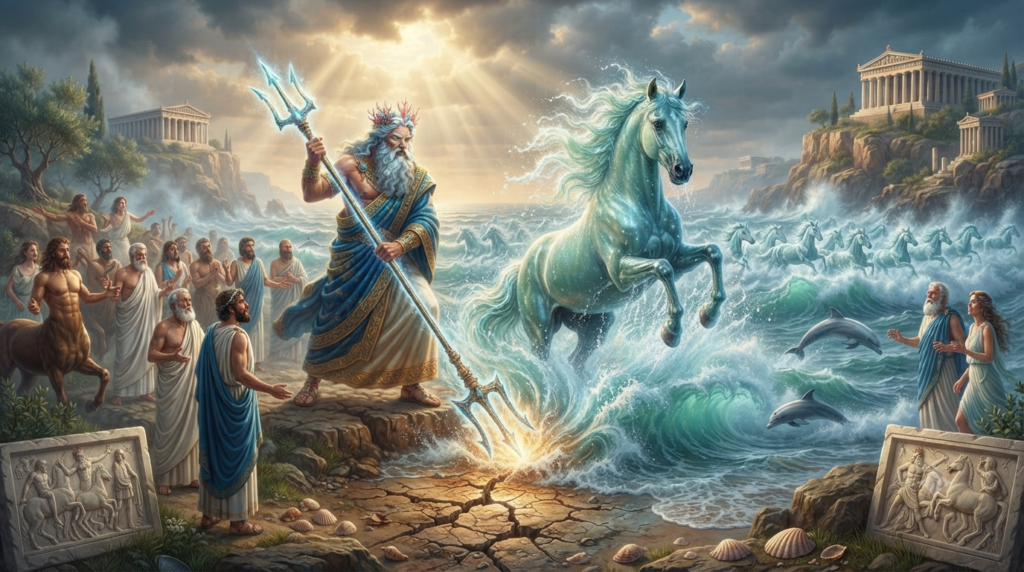
The most widely cited version of this myth describes Poseidon striking the earth or a rock formation with his trident, causing the first horse to emerge directly from the ground as a result. This act of creation mirrors the way Poseidon uses his trident elsewhere in mythology, as a tool capable of producing dramatic natural effects, whether stirring the sea into storms or, in this case, generating an entirely new animal from solid earth.
Different regions within ancient Greece preserved variations of this story, with Thessaly frequently cited as a location closely associated with the myth, likely reflecting that region’s real historical reputation for exceptional horsemanship and cavalry. This connection between myth and geography was common in Greek storytelling, where local traditions often tied divine actions to specific places known for related real-world characteristics.
Some versions of the myth place this act of creation in direct competition with other gods, framing the horse’s emergence not as an isolated event but as part of Poseidon’s broader effort to demonstrate his power and secure influence over particular regions or cities. This competitive framing becomes especially significant when considering Poseidon’s most famous contest involving the horse.
Regardless of which regional variation is considered, the core answer to did Poseidon create horses remains consistent across Greek mythology: the god is credited with bringing the animal into being through a direct, deliberate act tied to his divine authority, establishing the horse as fundamentally connected to his identity from its very first appearance in myth.
Poseidon’s Contest with Athena and the Symbol of the Horse
The horse’s connection to Poseidon becomes even more significant in the famous myth describing his contest with Athena over the patronage of Athens. In this story, both gods offered gifts intended to win favor with the city’s people, with Poseidon presenting either the horse itself or a spring of saltwater, depending on which ancient source is consulted, while Athena offered the olive tree.
In versions where the horse serves as Poseidon’s offering, the animal represents strength, speed, and military power, qualities the god likely believed would appeal to a city weighing its future prosperity and security. This framing positions the horse not merely as a creature Poseidon created, but as a symbol of what he considered his greatest gift to offer humanity, reinforcing the deep connection between the god and the animal.
Athens ultimately chose Athena’s olive tree, a decision reflecting the city’s priorities toward peace and sustenance over raw military strength, leaving Poseidon’s gift rejected despite its impressiveness. This outcome did nothing to diminish the horse’s association with Poseidon in broader Greek belief, even as it marked a notable defeat for the god in this particular contest.
This episode reinforces why did Poseidon create horses remains inseparable from his broader mythological identity, since the animal appears not just as an isolated creation myth, but as a recurring symbol the god actively used to represent his power and influence throughout Greek storytelling.
Poseidon, Demeter, and the Birth of Arion
Beyond creating horses in general, Poseidon also appears in myths explaining the origin of specific, legendary horses, most notably Arion, a creature renowned for extraordinary speed and the rare ability to speak. This myth begins with Poseidon pursuing Demeter, goddess of the harvest, who attempts to escape his advances by transforming herself into a mare and hiding among ordinary horses.
Undeterred, Poseidon transforms himself into a stallion and pursues her in this new form, eventually fathering Arion as a result of their union while both remain in equine shape. This myth stands apart from the general creation story by focusing on Poseidon’s direct paternity over a single, named horse with extraordinary abilities, rather than describing the origin of horses as a species.
Arion goes on to appear in later Greek mythology as a legendary steed associated with various heroes, valued specifically for the divine speed and intelligence inherited from his unusual parentage. This connection further cements Poseidon’s reputation not just as the creator of horses broadly, but as a god whose direct involvement could produce individual animals of exceptional, almost supernatural quality.
This myth adds important nuance to the question of did Poseidon create horses, showing that his relationship with the animal extends beyond a single act of creation into ongoing involvement, personally fathering specific legendary horses whenever the mythology called for a creature of extraordinary power.
Poseidon as Father of Pegasus
Poseidon’s connection to legendary horses extends further still through his paternity of Pegasus, the winged horse who appears throughout Greek mythology as one of its most enduring and recognizable creatures. According to myth, Pegasus was born from the blood of Medusa after the hero Perseus decapitated her, with Poseidon identified as the horse’s father due to his earlier union with Medusa before her transformation into a monster.
This origin story sets Pegasus apart from the general narrative of Poseidon creating horses as a species, since Pegasus represents a unique, singular being rather than an ancestor of ordinary horses found throughout the world. Nonetheless, his paternity reinforces the same underlying pattern seen with Arion: whenever Greek mythology required an extraordinary horse, Poseidon frequently appears as the divine source behind its existence.
Pegasus later becomes closely associated with the hero Bellerophon, who tames and rides the winged horse during various legendary exploits, further embedding Poseidon’s paternal connection into some of Greek mythology’s most celebrated adventure stories. This association helped ensure that Poseidon’s link to horses remained culturally significant well beyond the initial creation myth itself.
Considering Pegasus alongside Arion makes clear that did Poseidon create horses functions as an umbrella question covering multiple distinct myths, each reinforcing the same central idea that extraordinary horses throughout Greek mythology consistently trace their origin back to Poseidon in one form or another.
Why the Horse Became Poseidon’s Sacred Animal
Given this pattern of creation myths and legendary offspring, it is unsurprising that the horse became formally recognized as one of Poseidon’s sacred animals within ancient Greek religious practice. Poseidon received the cult title Hippios, meaning “of the horse,” reflecting dedicated worship practices that specifically honored this aspect of his divine identity across various regions of the Greek world.
Ancient Greek art consistently reinforces this association, frequently depicting Poseidon either alongside horses directly or riding in a chariot pulled by hippocamps, mythical creatures combining the front half of a horse with the tail of a fish. This artistic convention visually merged Poseidon’s two primary domains, the sea and the horse, into a single, unified representation of his power.
Temples and shrines dedicated to Poseidon Hippios existed in several locations throughout ancient Greece, indicating that his connection to horses carried genuine religious significance rather than functioning merely as decorative mythology. Worshippers seeking success in activities like horse racing or warfare involving cavalry would have had particular reason to honor this specific aspect of Poseidon’s divine authority.
This sustained religious and artistic tradition confirms that did Poseidon create horses was not treated as a minor or isolated myth by ancient Greeks, but as a foundational belief significant enough to shape formal worship practices and enduring artistic conventions across centuries of Greek civilization.
Myth Versus the Real Origins of the Horse
It is worth stating clearly that the myth of Poseidon creating horses reflects ancient religious belief rather than any accurate account of the species’ actual biological origins. Modern science traces the horse’s evolutionary history through fossil records spanning millions of years, a process entirely unrelated to the sudden, divine act of creation described in Greek mythology.
This distinction matters because ancient myths like this one served a different cultural purpose than scientific explanation. Rather than functioning as literal historical claims, stories explaining the origins of significant animals or natural phenomena helped ancient Greeks make sense of their world, attributing meaningful, powerful origins to things that mattered deeply to their daily lives, whether the horse’s role in warfare, transportation, or agriculture.
Recognizing this distinction allows modern readers to appreciate the myth of did Poseidon create horses for what it genuinely represents: a window into how ancient Greek culture understood divine power, symbolic meaning, and the relationship between gods and the natural world, rather than a claim requiring reconciliation with modern biological science.
This mythological framing ultimately enriches rather than diminishes the story’s value, since it reveals how central the horse was to Greek civilization, important enough to warrant its own divine origin story credited to one of the most powerful gods in their pantheon.
Frequently Asked Questions
Did Poseidon literally create horses according to Greek myths?
Yes, according to Greek mythology, Poseidon is credited with creating the first horse, though this reflects ancient religious belief rather than an actual account of the species’ biological origins.
What is Arion?
Arion is a legendary, speaking horse born from Poseidon’s union with Demeter while both gods had transformed themselves into horse form.
Is Pegasus Poseidon’s son?
Yes, according to Greek mythology, Pegasus is the son of Poseidon and Medusa, born from her blood after she was decapitated by the hero Perseus.
Conclusion
The answer to did Poseidon create horses lies firmly within Greek mythology’s tradition of divine origin stories, crediting the sea god with bringing the first horse into existence and later fathering legendary creatures like Arion and Pegasus. This enduring connection, reinforced through cult worship, artistic tradition, and recurring myth, cemented the horse as one of Poseidon’s most significant symbols throughout ancient Greek belief.

Orin Vale has spent the better part of two decades tracing the threads that connect the world’s oldest stories — from the halls of Asgard to the banks of the Nile, from Olympus to the jungles of the Maya. What began as a childhood fascination with flood myths and trickster gods grew into years of independent study across comparative mythology and ancient religion, always chasing the same question: what did these stories mean to the people who first told them? Orin writes for readers who want more than trivia — the ones looking for the beliefs, fears, and truths that myths were built to carry.