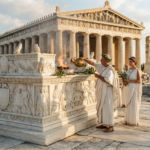
Semele occupies a genuinely rare position within Greek mythology as one of the only mortal women to become the mother of an Olympian god, her brief but consequential life culminating in one of the tradition’s most dramatic and tragic stories. Anyone asking who was Semele, the mortal mother of Dionysus, is uncovering a Theban princess whose fateful encounter with Zeus produced not only a significant new god but also a myth centered on jealousy, divine power, and the fatal danger inherent in mortals confronting the gods too directly.
Semele’s story unfolds against the backdrop of one of ancient Greece’s most prominent royal families, connecting her personal tragedy directly to the broader mythology surrounding the founding of Thebes. Her relationship with Zeus, while ultimately fatal for her mortal existence, set in motion a chain of events that would define much of Dionysus’s own unusual origin story as a god born twice rather than once.
Unlike many of Zeus’s other mortal lovers, whose stories often end simply with the birth of a notable child, Semele’s mythology continues even after her death, eventually granting her a form of divine redemption rarely afforded to mortal women within Greek religious tradition. This extended narrative arc distinguishes her story from many similar myths involving Zeus’s numerous affairs throughout Greek mythology.
What follows traces Semele’s royal lineage, her relationship with Zeus, Hera’s jealous manipulation, the fatal revelation that ended her mortal life, the miraculous rescue of her unborn son, and her eventual transformation into a goddess through Dionysus’s own intervention.
Semele’s Royal Lineage: Daughter of Cadmus and Harmonia
Semele was born into one of Greek mythology’s most significant royal families, the daughter of Cadmus, the legendary founder and king of Thebes, and Harmonia, herself the daughter of Ares, god of war, and Aphrodite, goddess of love. This parentage gave Semele a lineage blending mortal royalty with genuine divine ancestry, positioning her family among the most mythologically significant households in all of ancient Greece.
Cadmus’s own mythology carried substantial weight within Greek tradition, credited not only with founding Thebes but also, according to some accounts, with introducing the alphabet to Greece from Phoenicia. This background situated Semele within a family whose significance extended well beyond typical royal lineage into genuinely foundational cultural mythology affecting Greek civilization more broadly.
Semele shared her royal upbringing with several siblings, including Ino, Agave, Autonoe, and Polydorus, each of whom would go on to play their own roles within various threads of Greek mythology. Autonoe in particular later married Aristaeus, the culture hero credited with teaching humanity beekeeping and cheesemaking, connecting Semele’s family directly into additional significant mythological narratives beyond her own personal story.
This substantial royal and divine lineage provides essential context for who was Semele, the mortal mother of Dionysus, establishing her not as an obscure or minor mortal figure, but as a genuinely significant princess whose family connections made her eventual encounter with Zeus considerably more consequential within the broader landscape of Greek mythology.
Zeus’s Mortal Lover
Zeus’s relationship with Semele followed a familiar pattern established throughout his extensive mythology of affairs with mortal women, though this particular relationship would ultimately produce consequences extending far beyond most of his other similar encounters. Drawn to Semele’s beauty, Zeus pursued a relationship with the Theban princess that soon resulted in her pregnancy.
This pregnancy carried extraordinary significance from its very beginning, since the child Semele now carried was destined to become Dionysus, a god who would eventually take his place among the most significant deities in the Greek pantheon, associated with wine, fertility, theater, and religious ecstasy. Few of Zeus’s other mortal affairs produced offspring who would achieve such lasting divine prominence.
As was common in many of Zeus’s relationships with mortal women throughout Greek mythology, this affair inevitably drew the attention and jealousy of his wife Hera, whose reaction to Semele’s pregnancy would ultimately determine the tragic trajectory of the entire story. Hera’s anger toward Zeus’s infidelities represents one of the most consistent themes running throughout Greek mythology’s treatment of the king of the gods.
This relationship forms the essential foundation for who was Semele, the mortal mother of Dionysus, establishing the circumstances that would soon lead to devastating consequences once Hera discovered the affair and began plotting her characteristic response of jealous revenge.
Hera’s Jealous Trick
Upon learning of Semele’s pregnancy, Hera devised a calculated scheme specifically designed to destroy both mother and unborn child simultaneously, disguising herself as Beroe, Semele’s own elderly nurse, in order to approach the pregnant princess without arousing suspicion. This disguise allowed Hera to manipulate Semele gradually, planting seeds of doubt regarding her mysterious lover’s true identity.
Through this deception, Hera convinced Semele that she should demand proof that her lover truly was Zeus in his full divine majesty, rather than simply taking his identity on faith. Hera specifically instructed Semele to first extract an unbreakable oath from Zeus, promising to grant her any request she might make, before revealing what that request would actually be.
Semele, following this manipulated advice, successfully obtained Zeus’s binding promise before then asking him to appear before her in the same full divine splendor he displayed to Hera herself, unaware that this specific request had been deliberately engineered by Hera to prove fatal to any mortal witness. This oath, sworn upon the sacred river Styx, carried absolute, unbreakable weight even among the gods themselves.
This elaborate deception provides crucial context for who was Semele, the mortal mother of Dionysus, revealing how Hera’s calculated jealousy transformed an ordinary request into an inescapable trap, one that Zeus himself could not avoid fulfilling despite the devastating consequences he surely understood awaited his mortal lover.
The Fatal Revelation
Bound irrevocably by his sacred oath, Zeus found himself unable to refuse Semele’s request without violating a promise even he could not break, forcing him to reveal his true divine form despite fully understanding the fatal consequences this revelation would bring for his mortal lover. This moment represents one of Greek mythology’s clearest illustrations of how binding oaths could trap even the king of the gods himself.
When Zeus finally appeared before Semele in his complete, unfiltered divine glory, manifesting through overwhelming thunder and lightning, the sheer intensity of this direct divine presence proved instantly fatal to her mortal body, consuming her in the resulting blaze of divine radiance. This dramatic death illustrated a broader principle throughout Greek mythology: mortal beings simply could not survive direct, unmediated contact with the gods’ true divine nature.
Semele’s death occurred with tragic swiftness, offering no opportunity for reconsideration or escape once Zeus had begun fulfilling his unbreakable promise. This outcome fulfilled precisely what Hera had calculated from the beginning, using Zeus’s own honor and Semele’s understandable curiosity as the mechanism for achieving her intended revenge against her husband’s mortal lover.
This devastating conclusion to Semele’s mortal life stands as the central tragic event defining who was Semele, the mortal mother of Dionysus, establishing the fatal cost of her fateful request even as it simultaneously set the stage for the miraculous rescue of her unborn son in the moments immediately following her death.
The Rescue of the Unborn Dionysus
In the immediate aftermath of Semele’s death, Zeus acted swiftly to save their unborn child, rescuing the fetus from his dying mother’s body before it could be lost alongside her. Rather than allowing this rescue to end the pregnancy prematurely, Zeus took the extraordinary step of sewing the unborn Dionysus directly into his own thigh, allowing the pregnancy to continue to term within his own divine body.
This unusual arrangement continued for the remaining months of the pregnancy, with Dionysus developing within Zeus himself until he was finally ready for birth, at which point he emerged fully formed from his father’s thigh in a genuinely unique manner unlike any other birth story in Greek mythology. This remarkable process gave rise to Dionysus’s enduring epithet as the “twice-born” god, reflecting his unusual passage through two distinct stages of gestation and birth.
This miraculous rescue transformed what began as an unambiguous tragedy into a story of remarkable divine intervention, ensuring that Semele’s death did not also claim the life of her unborn son despite the overwhelming forces that had destroyed her mortal body. Zeus’s determination to save his child, even under such extraordinary circumstances, underscores the genuine significance ancient Greek mythology attached to Dionysus’s eventual birth.
This dramatic rescue completes an essential chapter in who was Semele, the mortal mother of Dionysus, demonstrating how her tragic death directly enabled one of Greek mythology’s most distinctive origin stories, permanently linking her memory to her son’s unusual and clearly divine method of entering the world.
Dionysus Rescues His Mother from the Underworld
Semele’s story did not conclude with her tragic mortal death, since later Greek mythology describes her son Dionysus eventually undertaking a remarkable journey to rescue his mother’s soul from the underworld once he had matured into his full divine power. This later myth extends Semele’s narrative well beyond the typical fate of mortals who perished through direct contact with divine power.
According to this tradition, Dionysus personally descended into the realm of Hades specifically to retrieve his mother, successfully bringing her soul up from the underworld and securing her a place among the immortal gods on Mount Olympus, an extraordinary honor rarely extended to any mortal figure within Greek religious tradition. This act reflected the genuine devotion Dionysus held toward the mother he had never actually met in mortal life.
Following this rescue, Semele underwent a complete transformation, becoming fully deified under a new name, Thyone, specifically associated with the frenzied, ecstatic worship practices connected to her son’s own religious cult. This new divine identity connected Semele directly into the broader religious traditions surrounding Dionysian worship, giving her ongoing significance within actual ancient Greek religious practice rather than remaining solely a mythological figure of the past.
This eventual redemption provides a crucial final dimension to who was Semele, the mortal mother of Dionysus, revealing a story that ultimately moves beyond simple tragedy into genuine transformation, with her son’s later devotion transforming her fatal mortal death into an unexpected pathway toward lasting divine status.
Why Semele’s Story Matters in Greek Mythology
Semele’s mythology holds particular significance within the broader tradition of Zeus’s numerous affairs with mortal women, since she stands as one of the extremely rare examples of a mortal lover who directly became the parent of a major Olympian god rather than simply a demigod hero. This distinction elevates her story’s importance well beyond many similar myths involving Zeus’s other mortal relationships.
Her story also powerfully illustrates a recurring theme throughout Greek mythology regarding the genuine danger inherent in mortals seeking too much direct proximity to divine power, even when that desire stems from understandable curiosity rather than any malicious intent. Semele’s fatal request, however manipulated by Hera’s deception, ultimately reflects broader Greek cultural anxieties surrounding the appropriate boundaries separating mortal and divine existence.
The eventual resolution of her story, involving genuine redemption through her son’s devoted intervention, further reflects Greek mythology’s occasional willingness to soften otherwise purely tragic narratives through subsequent acts of loyalty and divine mercy. This narrative arc gives Semele’s mythology genuine emotional complexity beyond a straightforward cautionary tale.
Considering these broader themes confirms why who was Semele, the mortal mother of Dionysus, remains a genuinely significant question within Greek mythology, connecting her personal tragedy to some of the tradition’s most important explorations of mortal ambition, divine danger, and the possibility of redemption even after devastating loss.
Frequently Asked Questions
How did Semele die?
Semele died after Zeus, bound by an unbreakable oath, revealed his true divine form to her, and the overwhelming power of his thunder and lightning consumed her mortal body.
Who saved Dionysus after Semele’s death?
Zeus rescued the unborn Dionysus from Semele’s body and sewed him into his own thigh, allowing the pregnancy to continue until the god’s birth.
Did Semele become a goddess?
Yes, after Dionysus rescued her soul from the underworld, Semele was deified as Thyone and taken to live among the gods on Mount Olympus.
Conclusion
Semele’s story stands as one of Greek mythology’s most striking examples of mortal tragedy transformed into lasting divine significance, her fatal encounter with Zeus’s true form giving rise to Dionysus’s unusual twice-born origin before her own eventual rescue and deification as Thyone. As the mortal mother of Dionysus, Semele’s brief life continues to resonate through one of Greek mythology’s most emotionally complete narratives, blending genuine tragedy with an unusually hopeful resolution rarely granted to mortals who dared confront the gods directly.

Orin Vale has spent the better part of two decades tracing the threads that connect the world’s oldest stories — from the halls of Asgard to the banks of the Nile, from Olympus to the jungles of the Maya. What began as a childhood fascination with flood myths and trickster gods grew into years of independent study across comparative mythology and ancient religion, always chasing the same question: what did these stories mean to the people who first told them? Orin writes for readers who want more than trivia — the ones looking for the beliefs, fears, and truths that myths were built to carry.