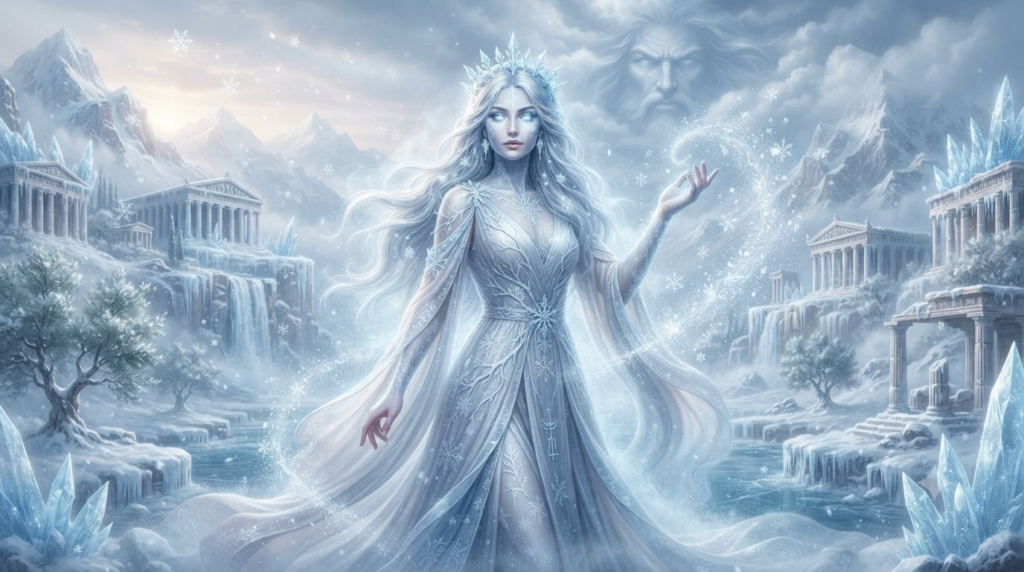
Khione, also spelled Chione, occupies a genuinely modest position within Greek mythology despite governing a natural force experienced across much of the ancient Greek world each winter. Anyone asking who is Khione in Greek mythology is uncovering the goddess of snow, a figure whose name derives directly from the ancient Greek word chion, meaning snow itself, yet whose personal mythology receives comparatively little attention within surviving ancient sources.
It is worth noting immediately that several distinct figures across ancient Greek mythology share this same name, reflecting how frequently Greek storytellers reused meaningful names across entirely separate mythological traditions. While this article focuses primarily on Khione, daughter of Boreas and goddess specifically associated with snow and winter, other notable figures bearing this name include a mortal princess loved by two different gods, whose own dramatic story deserves separate acknowledgment.
Despite her relatively limited documentation compared to more prominent weather deities, Khione’s personal mythology contains a genuinely significant episode connecting her directly to one of ancient Greece’s most important religious institutions, the Eleusinian Mysteries. This connection elevates her importance well beyond what her otherwise sparse mythological record might initially suggest.
What follows traces Khione’s origins as daughter of Boreas and Oreithyia, her specific domain over snow and winter, her fateful relationship with Poseidon and the birth of her son Eumolpus, the other notable figures who share her name, and the broader reasons behind her relative obscurity within Greek mythological tradition.
Khione’s Origins: Daughter of Boreas and Oreithyia
Khione was born to Boreas, the powerful god personifying the cold north wind, and Oreithyia, an Athenian princess whom Boreas had famously abducted and carried away to become his consort. This parentage connected Khione directly to one of Greek mythology’s most dramatic divine abduction stories, situating her within a family defined by raw natural power and forceful, unrestrained action.
Boreas himself traced his own lineage back to Eos, goddess of the dawn, and the Titan Astraeus, positioning Khione within a broader family network of significant weather and celestial deities spanning multiple generations. This connection linked Khione’s own snowy domain to the larger constellation of natural forces her extended family collectively governed across the ancient Greek cosmological framework.
Khione shared her parentage with several notable siblings, including the winged twins Zetes and Calais, both of whom later joined Jason’s crew during the celebrated voyage of the Argonauts, and Cleopatra, who became the wife of Phineus, a Thracian king whose own mythology involves significant conflict with these very brothers. This family connected Khione to some of Greek mythology’s most active heroic narratives, even as her own personal story remained comparatively quieter.
Understanding this family background provides essential context for who is Khione in Greek mythology, establishing her firmly within a lineage of powerful wind and weather deities whose combined mythology shaped much of how ancient Greeks understood the forces governing seasonal change and dramatic natural phenomena.
What Is Khione the Goddess Of?
Khione’s core mythological identity centers directly on her governance over snow, ice, and hail, positioning her as a specific personification of winter’s coldest and most visually striking natural phenomena. This domain connected her directly to the practical, lived experience of ancient Greek communities during the colder months of each year, particularly in mountainous or northern regions where snowfall carried genuine significance.
Despite this seemingly important natural domain, ancient sources treat Khione with notably less attention than many other weather-related deities throughout Greek mythology, with even Homer largely omitting substantial reference to her despite his extensive treatment of other seasonal and atmospheric figures throughout his epic poetry. This relative silence stands out given how thoroughly documented many comparable minor deities remain within surviving classical literature.
This sparse documentation likely reflects broader patterns in how ancient Greek religious and literary tradition prioritized certain natural forces over others, with snow perhaps receiving less sustained mythological attention than more dramatic or economically significant weather phenomena like storms, drought, or the changing of agricultural seasons more broadly associated with figures like Demeter and Persephone.
This combination of clear natural domain and surprisingly limited documentation offers an important early answer to who is Khione in Greek mythology, revealing a goddess whose genuine significance as snow’s personification exists somewhat independently from the level of narrative attention she actually received throughout ancient Greek literary and religious tradition.
Khione and Poseidon: The Birth and Rescue of Eumolpus
Khione’s most significant individual myth involves her relationship with Poseidon, god of the sea, a union that resulted in her becoming pregnant with a son who would eventually achieve considerable mythological importance in his own right. This relationship connected Khione, otherwise associated primarily with cold winter phenomena, directly to one of the Olympian pantheon’s most powerful gods.
Overwhelmed by fear regarding how her father Boreas might react upon discovering this pregnancy, Khione made the desperate decision to cast her newborn son into the sea shortly after his birth, hoping to avoid whatever consequences she anticipated from her father’s notoriously forceful temperament. This act of abandonment reflects the genuine anxiety Khione felt regarding her family’s reaction to circumstances she could not easily conceal.
Poseidon, however, did not allow his son to perish following this abandonment, instead rescuing the infant from the sea and entrusting his care to Benthesikyme, one of his own daughters, who subsequently raised the child in Ethiopia far from any immediate danger posed by Boreas’s potential wrath. This rescue ensured that Khione’s son, named Eumolpus, survived to adulthood despite his mother’s desperate initial actions.
Eumolpus eventually achieved substantial mythological significance as the founding ancestor of the Eumolpidae, a priestly lineage specifically responsible for overseeing the Eleusinian Mysteries, one of ancient Greece’s most important and secretive religious traditions centered on the mythology of Demeter and Persephone. This connection provides perhaps the most historically significant answer to who is Khione in Greek mythology, revealing that despite her own relatively quiet personal mythology, she became the direct ancestral source behind one of ancient Greek religion’s most consequential ongoing institutions.
Other Figures Named Khione in Greek Mythology
Beyond the snow goddess discussed throughout this article, ancient sources preserve several additional, entirely unrelated figures also bearing the name Khione or Chione, reflecting how frequently this particular name recurred across separate Greek mythological traditions. The most notable of these additional figures was a mortal princess, daughter of Daedalion, renowned for exceptional beauty that attracted the romantic attention of both Apollo and Hermes simultaneously.
This mortal Chione bore two significant sons from these divine relationships, Autolycus through Hermes and Philammon through Apollo, before her story took a tragic turn driven by her own growing arrogance regarding her celebrated beauty. Emboldened by having captured the attention of two separate gods, she reportedly boasted that her beauty surpassed even that of the goddess Artemis, a claim of hubris that provoked fatal divine retribution through one of Artemis’s own arrows.
Following his daughter’s death, Chione’s grieving father Daedalion was subsequently transformed into a hawk, a transformation reflecting broader Greek mythological patterns connecting profound grief to dramatic physical metamorphosis. Additional, more obscure figures sharing this name include another Chione connected to the river god Nilus, whose own story ties etymologically to snow’s Greek origins, and yet another figure identified as a separate consort of Boreas himself.
Acknowledging these additional figures ensures a complete and accurate answer to who is Khione in Greek mythology, clarifying that while several distinct mythological women share this evocative name, the goddess of snow discussed throughout this article remains distinct from her mortal namesake’s considerably more dramatic tragic narrative.
Why Khione Remains a Relatively Obscure Goddess
Khione’s comparatively limited presence within major surviving Greek literary works, particularly when contrasted against more thoroughly documented weather and seasonal deities, raises genuine questions about how ancient Greek religious tradition prioritized different natural forces within its broader mythological framework. Her relative obscurity persists despite governing a natural phenomenon that ancient Greek communities certainly experienced and understood firsthand each winter.
This limited documentation may reflect practical realities regarding which natural phenomena ancient Greek storytellers considered most narratively compelling or religiously significant, with snow perhaps registering as less dramatically consequential compared to phenomena directly threatening agricultural survival, such as drought or storm damage to crops and shipping throughout the broader Mediterranean world.
Despite this relative obscurity, Khione’s mythology demonstrates that even lesser-documented deities could carry genuine symbolic weight and lasting consequence, as evidenced clearly through her son Eumolpus’s foundational role within the Eleusinian Mysteries. This connection suggests that ancient Greek religious tradition sometimes granted lasting significance to minor deities through their descendants rather than through extensive personal mythology alone.
This combination of limited documentation and genuine underlying significance completes a full answer to who is Khione in Greek mythology, revealing a goddess whose modest presence within surviving ancient sources belies a mythology whose consequences, through her son’s lasting religious legacy, extended far beyond what her own sparse personal narrative might otherwise suggest.
Frequently Asked Questions
Who are Khione’s parents?
Khione’s parents were Boreas, god of the north wind, and Oreithyia, an Athenian princess whom Boreas had abducted and made his consort.
What did Khione do with her son Eumolpus?
Fearing her father’s anger, Khione cast her infant son Eumolpus into the sea, though Poseidon rescued him and had him raised by his daughter Benthesikyme.
Is Khione the same as the mortal loved by Apollo and Hermes?
No, that figure is a different Chione, the mortal daughter of Daedalion, whose separate tragic story involves both gods and ends in her death at Artemis’s hands.
Conclusion
Khione, goddess of snow and daughter of Boreas, holds a genuinely modest place within Greek mythology’s surviving literary record, yet her personal story connects directly to one of ancient Greece’s most significant religious traditions through her son Eumolpus and his descendants’ role in the Eleusinian Mysteries. Her relative obscurity, despite governing a natural force ancient Greeks experienced firsthand each winter, ultimately reveals how lasting mythological significance could emerge through a deity’s lineage even when her own personal narrative remained comparatively sparse.

Orin Vale has spent the better part of two decades tracing the threads that connect the world’s oldest stories — from the halls of Asgard to the banks of the Nile, from Olympus to the jungles of the Maya. What began as a childhood fascination with flood myths and trickster gods grew into years of independent study across comparative mythology and ancient religion, always chasing the same question: what did these stories mean to the people who first told them? Orin writes for readers who want more than trivia — the ones looking for the beliefs, fears, and truths that myths were built to carry.