King Alcinous occupies a pivotal position within Homer’s Odyssey, serving as the ruler whose generosity finally breaks the cycle of hardship that has defined Odysseus’s decade-long struggle to return home. Anyone asking who is King Alcinous in the Odyssey is uncovering the Phaeacian king whose hospitality toward a shipwrecked stranger ultimately provides the decisive turning point in one of literature’s most celebrated homecoming stories.
Ruling over the island of Scheria, Alcinous presides over a uniquely privileged civilization whose close relationship with the gods sets his kingdom apart from the more familiar mortal realms Odysseus has encountered throughout his long journey. This distinctive setting positions Alcinous not merely as another obstacle in the hero’s path, but as the figure whose kindness genuinely resolves the central conflict driving much of the epic’s narrative tension.
Alcinous’s significance extends well beyond simple hospitality, since his decision to help Odysseus ultimately provokes serious consequences from Poseidon, the sea god who has pursued Odysseus relentlessly throughout his voyage. This connection ties Alcinous directly into the broader mythology surrounding Poseidon’s wrath, making his story essential to understanding how Odysseus’s long conflict with the god finally reaches its conclusion.
What follows examines Alcinous’s divine ancestry, his rule over the Phaeacians, how his daughter Nausicaa first brought Odysseus to his court, the remarkable hospitality he extended to his shipwrecked guest, the ships that finally carried Odysseus home, and the punishment Poseidon subsequently inflicted upon his kingdom.
Alcinous’s Origins: Descendant of Poseidon
Alcinous traces his lineage directly back to Poseidon himself, since his father Nausithous was born to the sea god and Periboea, connecting the Phaeacian royal family to divine ancestry despite the considerable distance separating their island from more prominent centers of Greek mythology. This genealogical connection carries genuine significance given Poseidon’s own central role in pursuing Odysseus throughout the broader epic.
This divine heritage reflects the Phaeacians’ broader, unusually close relationship with the gods more generally, with Homer specifically describing how the gods would openly appear at Phaeacian feasts and sacrifices, a level of direct divine interaction rarely afforded to other mortal communities throughout the poem. This privileged connection positioned Alcinous’s kingdom as existing somewhat outside the normal boundaries separating mortal and divine experience elsewhere in the Odyssey.
This unusual proximity to the gods helps explain why Scheria functions as such a distinctive setting within Odysseus’s broader journey, serving almost as a transitional space between the fantastical, monster-filled world of his earlier adventures and the more grounded, mortal reality awaiting him upon his eventual return to Ithaca. Alcinous’s own divine ancestry reinforces this liminal quality defining his entire kingdom.
Understanding this origin provides essential context for who is King Alcinous in the Odyssey, establishing him as a ruler whose own family history connects meaningfully to the very god whose wrath has driven so much of Odysseus’s suffering throughout his long journey home.
King of the Phaeacians on the Island of Scheria
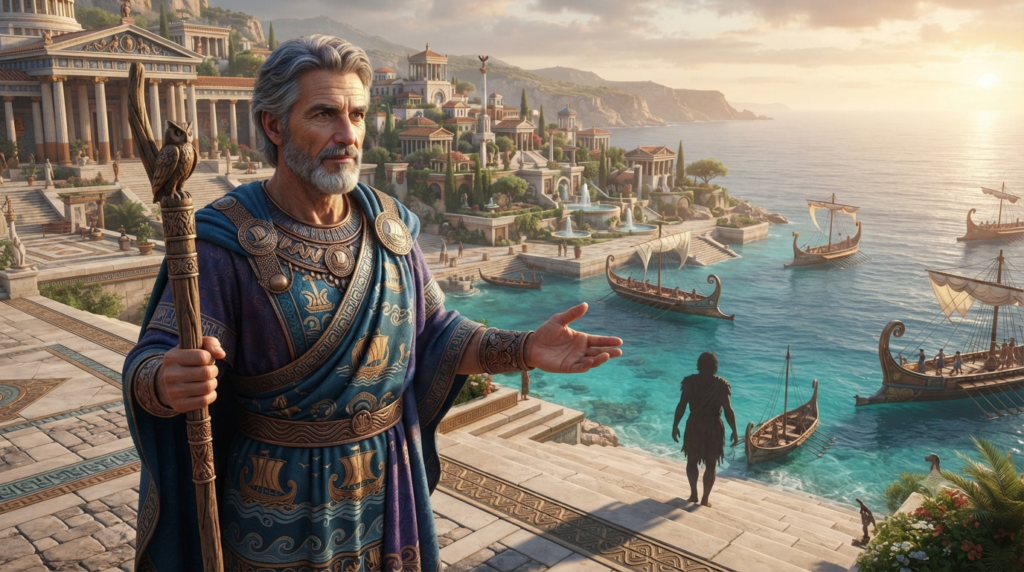
Alcinous governs the Phaeacians, a seafaring civilization inhabiting the island of Scheria, a society Homer depicts as remarkably skilled in maritime navigation and blessed with genuine prosperity and comfort. This nautical expertise proves particularly significant given the crucial role Phaeacian ships will eventually play in finally delivering Odysseus safely home to Ithaca.
Alcinous’s own family structure includes a notably unusual detail regarding his marriage, since his wife Arete is also his own niece, being the daughter of his brother Rhexenor. This close family relationship, while unusual by many standards, reflects patterns occasionally found within ancient Greek royal genealogies, where maintaining bloodline purity or consolidating family authority sometimes took precedence over more typical marriage conventions.
Queen Arete herself holds genuine influence within Alcinous’s court, a detail that becomes particularly relevant when Odysseus first arrives at the Phaeacian palace, since proper protocol requires him to appeal directly to her favor before receiving the king’s full hospitality. This detail suggests that Alcinous’s rule, while formally centered on his own royal authority, genuinely incorporates his wife’s judgment and influence within the kingdom’s broader governance.
This portrait of Phaeacian society provides important context for who is King Alcinous in the Odyssey, establishing him as ruler of a genuinely distinctive kingdom whose combination of maritime skill, divine favor, and unusual royal family structure sets the stage for the pivotal hospitality he will soon extend to his unexpected guest.
Nausicaa’s Father: How Odysseus Reached Alcinous’s Court
Odysseus’s arrival at Alcinous’s court begins not with the king himself, but with his daughter Nausicaa, who discovers the shipwrecked hero washed ashore following the devastating storm Poseidon unleashed against him during his voyage from Calypso’s island. This encounter connects directly to Poseidon’s earlier, nearly fatal assault on Odysseus, positioning Alcinous’s kingdom as the destination that finally interrupts this pattern of divine pursuit.
Nausicaa, encountering Odysseus in his exhausted, disheveled state after his harrowing swim to shore, responds with genuine compassion rather than fear, providing him with clothing and guidance regarding how to properly approach her father’s court. Her specific advice that Odysseus should first appeal to Queen Arete before addressing Alcinous directly reflects the particular protocol governing proper conduct within this unusual royal household.
This guidance proves essential to Odysseus’s successful reception, since Nausicaa’s own status as Alcinous’s daughter lends him a degree of protection and legitimacy he might otherwise lack as an unknown, shipwrecked stranger arriving without any established connection to the Phaeacian royal family. Her role effectively bridges the gap between Odysseus’s desperate circumstances and Alcinous’s eventual formal hospitality.
This sequence of events proves essential for who is King Alcinous in the Odyssey, since his daughter’s compassionate intervention directly sets the stage for the king’s own subsequent generosity, establishing the initial connection that will ultimately lead to Odysseus’s long-awaited return home to Ithaca.
A King’s Hospitality: Feasting, Games, and Odysseus’s Tale
Once properly received at court, Odysseus experiences genuinely lavish hospitality under Alcinous’s direction, including an elaborate feast and a series of athletic competitions organized specifically in his honor as an esteemed, if still unidentified, guest. This generous reception reflects the broader Greek cultural value placed on xenia, the sacred obligation of hospitality toward strangers and travelers throughout ancient Greek society.
During this extended hospitality, the court bard Demodocus performs a song specifically recounting events from the Trojan War, a performance that unexpectedly moves Odysseus to tears given his own direct, personal involvement in these very events. This emotional reaction eventually prompts Alcinous to gently inquire about his guest’s true identity and the sorrow clearly troubling him despite the celebratory occasion.
This inquiry leads directly to one of the Odyssey’s most significant narrative structures, since Odysseus’s subsequent revelation of his true identity prompts him to recount his entire remarkable journey, encompassing the famous adventures involving the Cyclops, Circe, the Sirens, and numerous other trials he has endured throughout his decade-long voyage. These recollections occupy several full books of Homer’s epic, framed entirely as Odysseus’s own account delivered specifically within Alcinous’s court.
This extended hospitality and subsequent storytelling opportunity proves central to who is King Alcinous in the Odyssey, revealing a king whose genuine curiosity and generosity create the specific narrative circumstances allowing readers to finally learn the complete account of Odysseus’s journey directly from the hero himself.
The Phaeacian Ships That Finally Took Odysseus Home
Having heard Odysseus’s complete account of his journey, Alcinous makes the decisive choice that will finally resolve the hero’s decade-long struggle to return home, offering him passage aboard one of the Phaeacians’ remarkable ships, vessels renowned throughout the poem for their unusual ability to navigate safely and swiftly without requiring traditional steering. This offer represents the culmination of Alcinous’s genuine hospitality toward his unexpected guest.
The Phaeacian crew successfully transports Odysseus across the remaining distance separating Scheria from Ithaca, finally delivering him to his home shores after nearly twenty years away, encompassing both his decade fighting at Troy and the additional ten years spent struggling to complete his journey home afterward. This voyage represents the direct fulfillment of everything Odysseus has worked toward throughout the entire epic.
This successful homecoming stands as perhaps the single most consequential outcome connected to Alcinous’s mythology, since his willingness to provide genuine, practical assistance succeeds where countless other encounters throughout Odysseus’s journey had failed to deliver him safely home. The king’s hospitality translates directly into concrete, decisive action rather than remaining merely symbolic or temporary comfort.
This successful voyage provides perhaps the most historically significant answer to who is King Alcinous in the Odyssey, confirming his role as the ruler whose direct, practical generosity finally accomplishes what years of struggle, divine assistance, and personal endurance had not yet achieved on their own.
Poseidon’s Punishment: The Petrified Ship and the Prophecy
Alcinous’s assistance to Odysseus does not pass without serious consequence, since an ancient prophecy, one Alcinous himself recalls hearing from his own father, warned that Poseidon would eventually punish the Phaeacians specifically for their habit of safely escorting travelers home without requiring any hardship or danger during the journey itself. This prophecy directly anticipates the genuine wrath that follows Odysseus’s own successful voyage.
True to this warning, Poseidon transforms the very ship that carried Odysseus safely home into solid stone, striking it within sight of the Phaeacian harbor as the returning crew approaches their own homeland once again. This dramatic punishment serves as unmistakable divine retribution, directly connecting Alcinous’s kindness toward Odysseus to genuine, severe consequences for his own kingdom and people.
Beyond this immediate punishment, Poseidon additionally threatens to bury the entire city of the Phaeacians beneath a massive mountain, a threat significant enough that Alcinous, upon recognizing the prophecy’s fulfillment, immediately calls for sacrifices to Poseidon in hopes of averting this even more catastrophic potential consequence for his people.
This punishment provides a crucial final dimension to who is King Alcinous in the Odyssey, revealing that his generous hospitality toward Odysseus carried genuine risk and real consequence, extending Poseidon’s broader campaign of retribution beyond Odysseus himself into affecting an entirely separate kingdom whose only offense was extending genuine kindness to a stranger in need.
Frequently Asked Questions
Who was Alcinous married to?
Alcinous was married to Arete, who was also his own niece, being the daughter of his brother Rhexenor.
Who was Alcinous’s daughter?
Alcinous’s daughter was Nausicaa, who first discovered the shipwrecked Odysseus on the shore and guided him toward her father’s court.
Why did Poseidon punish the Phaeacians?
Poseidon punished the Phaeacians for helping Odysseus return home safely, fulfilling an ancient prophecy regarding the consequences of their habitual assistance to travelers.
Conclusion
King Alcinous stands as one of the Odyssey’s most consequential figures despite never directly confronting Odysseus in conflict, his genuine hospitality ultimately providing the decisive assistance that finally ends the hero’s decade-long struggle to reach home. Though this kindness provokes serious punishment from Poseidon against his own kingdom, Alcinous’s willingness to help a shipwrecked stranger secures his lasting significance as the ruler whose generosity finally broke the cycle of divine pursuit defining so much of Odysseus’s long and difficult journey.

Orin Vale has spent the better part of two decades tracing the threads that connect the world’s oldest stories — from the halls of Asgard to the banks of the Nile, from Olympus to the jungles of the Maya. What began as a childhood fascination with flood myths and trickster gods grew into years of independent study across comparative mythology and ancient religion, always chasing the same question: what did these stories mean to the people who first told them? Orin writes for readers who want more than trivia — the ones looking for the beliefs, fears, and truths that myths were built to carry.