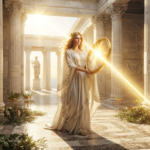
Among the pantheon of ancient Greece, where deities often embodied the forces of chaos, war, and nature’s fury, Eirene stands as a figure of quiet but profound authority. She is the Greek goddess of peace, a divine personification whose very name translates to the state of tranquility and harmony that humanity has always craved. Far from a passive ideal, Eirene represented an active and essential force, one that was believed to bring prosperity, ensure social order, and allow civilization to flourish. Her presence in mythology is a testament to how deeply the ancient Greeks valued peace, not just as a respite from war, but as the foundational condition for a just and thriving society.
As the daughter of Zeus, the supreme ruler of the gods, and Themis, the goddess of divine law, Eirene was born into a position of immense cosmic significance. She was one of the Horae, the goddesses who governed the seasons and the natural order of the world. Her sisters, Eunomia (Good Order) and Dike (Justice), completed a triad that represented the essential pillars of civilization. Together, they maintained the gates of heaven and ensured the cyclical balance of the universe. This article explores the origins, symbolism, and enduring legacy of Eirene, revealing how this ancient goddess of peace continues to offer a powerful ideal for the modern world.
The Divine Lineage and Cosmic Role of Eirene
The origins of Eirene place her at the very heart of the Greek cosmic order. As a member of the Horae, she was more than just a personification of a human ideal; she was a fundamental component of the universe’s structure. Her parents were Zeus, the king of the gods, and Themis, the goddess of law, order, and divine justice. This lineage is highly significant: it establishes peace not as a random or fragile occurrence, but as the natural and inevitable outcome of justice. Peace was the result of Zeus’s supreme will and Themis’s unwavering laws.
Eirene worked in concert with her sisters, Eunomia and Dike, to create a functional society. Where Eunomia ensured the laws were orderly and Dike dispensed fair judgment, Eirene provided the tranquil atmosphere in which these laws could be upheld and life could prosper. As the Horae, they were also keepers of the clouds and the stars, gatekeepers of Olympus, and overseers of the seasons. Eirene’s specific association with spring tied her to renewal, growth, and the return of life, further cementing her as a nurturing and life-giving force.
The Iconography and Symbolism of Eirene
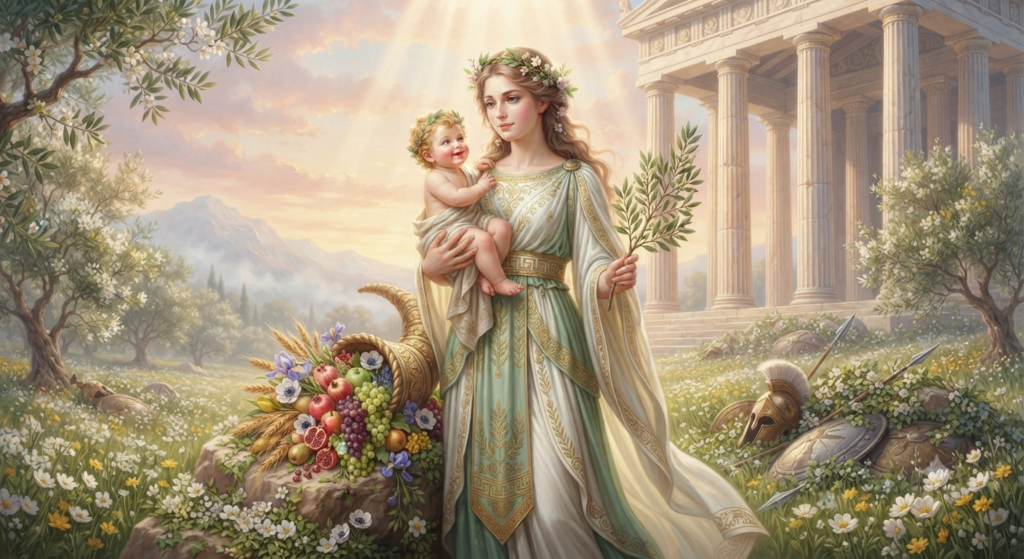
The artistic representations of Eirene are among the most enduring and instructive pieces of ancient Greek iconography. The most celebrated depiction is the lost bronze statue by the sculptor Cephisodotus the Elder, created around 375 BC to commemorate a naval victory. In this renowned work, Eirene is portrayed as a beautiful and matronly young woman, embodying the fertility of the season she represented. However, her most defining attribute is the infant Plutus, the god of wealth, whom she holds tenderly in her left arm.
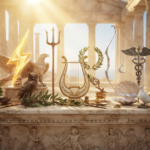
This powerful imagery is a profound political and philosophical statement: it symbolizes that peace is the nurturing mother of prosperity. Plutus looks back at Eirene with trust, illustrating that economic abundance, agricultural bounty, and general well-being (Plutus) can only flourish under the protective care of peace. Other symbols associated with her include the cornucopia (a horn of plenty), a sceptre, and an olive branch, the universal emblem of peace. In some depictions, she is shown burning a pile of arms, personifying the end of conflict. These symbols collectively reinforced her role as the bringer of wealth, agricultural fertility, and a welcome respite from the devastations of war.
The Veneration of Eirene in the Ancient World
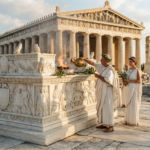
The worship of Eirene, known as Pax in Roman culture, was deeply rooted in the historical context of a world frequently ravaged by war. Her importance reached its zenith in Athens, where the citizenry established a state cult for peace following a naval victory over Sparta in 375 BC. This was not merely a spiritual exercise but a powerful political declaration, a celebration of a longed-for stability after a period of conflict. Altars were dedicated to her at public expense, and an annual state sacrifice was performed in her honor to commemorate the “Common Peace” of 371 BC.
This celebration at the highest civic level underscores her role as a critical political and social ideal. The establishment of her cult transformed peace from a fleeting wish into a tangible and celebrated state of being. Even in the heart of the Roman Empire, her counterpart, the goddess Pax, held a place of immense importance. Emperor Vespasian erected the magnificent Temple of Pax in Rome, solidifying her as a cornerstone of imperial ideology and a symbol of the stability and prosperity brought by Roman rule. For the ancients, Eirene was a vibrant and relevant deity, a critical force for the survival and flourishing of their cities.
The Enduring Legacy of Eirene
Though the marble temples of ancient Greece have crumbled to ruins, the legacy of Eirene is deeply woven into the fabric of modern culture and thought. The very name “Irene,” a common name in many Western countries, is a direct derivative of her name, serving as a constant and personal reminder of her enduring appeal. The concept of peace personified as a goddess has been a powerful trope in art and literature for centuries, continuing to inspire artists and writers to personify abstract virtues.
Moreover, the profound lessons embodied by Eirene remain critically relevant in the modern era. She represents the enduring idea that peace is the essential foundation upon which prosperity, justice, and social order are built. In a world that still grapples with conflict and division, her myth serves as a poignant historical reminder that peace is not merely the absence of war, but an active, nurturing force that allows culture and society to truly thrive. She stands as a timeless testament to the enduring human aspiration for a stable and prosperous world, an ideal that is as powerful and necessary today as it was in antiquity.
Frequently Asked Questions About Eirene, the Greek Goddess of Peace
Who are Eirene’s parents?
Eirene is the daughter of Zeus, the king of the gods, and Themis, the goddess of divine law and order.
What are the names of Eirene’s sisters?
Her sisters are Eunomia (Good Order) and Dike (Justice). Together, they formed the triad of the Horae.
What is the most famous statue of Eirene?
The most famous statue is the lost bronze sculpture by Cephisodotus the Elder, which depicted her holding the infant Plutus, the god of wealth. A Roman marble copy of this statue survives today in the Munich Glyptothek.
What does the child in Eirene’s arms represent?
The child is Plutus, the god of wealth. This is a powerful allegory representing the idea that peace is the nurturing mother of prosperity and economic abundance.
What are Eirene’s main symbols?
Her main symbols are the cornucopia (horn of plenty), a sceptre, and an olive branch. In some depictions, she is also shown burning a pile of arms to symbolize the end of war.
What is the Roman equivalent of Eirene?
Her Roman equivalent is the goddess Pax, who was also highly venerated and had a magnificent temple built in her honor in Rome.
Why was Eirene important to the Athenians?
The Athenians greatly revered her and established a state cult in her honor after a naval victory over Sparta in 375 BC, performing annual sacrifices to commemorate the “Common Peace”.
How is Eirene connected to the seasons?
Eirene is a member of the Horae, the goddesses of the seasons. She is particularly associated with spring, symbolizing renewal, growth, and the return of life.
Conclusion
Eirene, the Greek goddess of peace, represents one of the most profound and cherished ideals of the ancient world. As the daughter of Zeus and Themis, and sister to Eunomia and Dike, her divine lineage established peace as a natural counterpart to order and justice, a fundamental component of a functioning universe. Her iconic representation, especially with the infant Plutus, powerfully symbolized the ancient belief that wealth and prosperity can only blossom in times of peace. Her veneration in Athens and Rome highlights her central role in the political and social life of the ancients, serving as a divine promise for a stable society. Even today, Eirene’s legacy endures as a powerful symbol, reminding us that peace is the true foundation upon which all other human achievements are built.

Orin Vale has spent the better part of two decades tracing the threads that connect the world’s oldest stories — from the halls of Asgard to the banks of the Nile, from Olympus to the jungles of the Maya. What began as a childhood fascination with flood myths and trickster gods grew into years of independent study across comparative mythology and ancient religion, always chasing the same question: what did these stories mean to the people who first told them? Orin writes for readers who want more than trivia — the ones looking for the beliefs, fears, and truths that myths were built to carry.