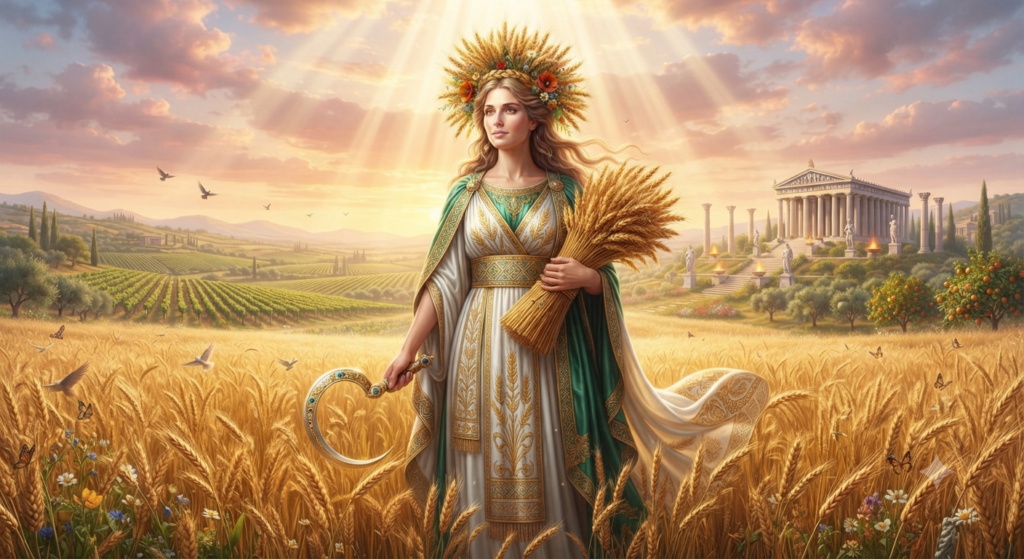
The Greek god of farming and agriculture is Demeter, one of the twelve Olympian deities and a figure of immense importance in the ancient Greek world. Who is the Greek god of farming and agriculture? Demeter is the goddess of grain, bread, and the harvest, and her power over the fertility of the earth made her central to the survival and prosperity of the Greek people. She presided over the cycle of life and death in the natural world, and her favor brought bountiful harvests, while her wrath could bring blight, drought, and famine. Her enduring legacy extends beyond agriculture into religious mystery cults that promised initiates a blessed afterlife, and her influence continues to resonate in our understanding of the natural world and its cycles.
Origins and Divine Lineage
Demeter’s origins are deeply rooted in the pre-Olympian world of the Titans. She was the daughter of the Titans Cronus and Rhea, making her a sister to Zeus, Hades, Poseidon, Hera, and Hestia. This lineage placed her among the most ancient and powerful of the Greek gods. According to myth, like her siblings, Demeter was swallowed by her father Cronus at birth, who feared being overthrown by his offspring. She was later regurgitated by Cronus after Zeus, her youngest brother, forced him to disgorge his children. This origin story establishes her as a powerful, primordial deity whose authority predates even the Olympian order.
Her name itself is a subject of scholarly interpretation, with the most accepted etymology deriving from the ancient Greek words “De” (related to the word for earth) and “Meter” (mother). Thus, Demeter’s name is often translated as “Earth Mother” or “Mother Earth,” though some scholars link the first part of her name to “Dai,” the Cretan word for “barley,” making her the “barley-mother.” This etymology underscores her fundamental connection to the earth and its capacity to nourish life. She was a deity of immense power, embodying the life-giving force of the soil and representing the very sustenance of mankind.
Mythological Role and the Homeric Hymn to Demeter
Demeter’s most significant mythological role is defined by her relationship with her daughter, Persephone, and the cycle of the seasons. The Homeric Hymn to Demeter, a crucial ancient source dating to around the 7th or 6th century BCE, tells the story of Persephone’s abduction by Hades, the god of the Underworld. While Persephone was gathering flowers, the earth opened and Hades seized her, dragging her down to his realm to be his queen. Distraught at the loss of her daughter, Demeter searched the earth for nine days, unable to find her.
On the tenth day, the goddess Hecate told Demeter she had heard Persephone’s cries, and together they approached Helios, the all-seeing sun god, who revealed that Hades had taken her with the permission of Zeus. Enraged and grief-stricken, Demeter withdrew from Olympus and the company of the gods. Disguised as an old woman, she wandered the earth, eventually coming to Eleusis, where she was welcomed by the royal family.
In her despair, Demeter neglected her duties, and the earth grew barren. Crops withered and died, and humanity faced starvation. This was a direct challenge to Zeus, who realized that if he did not intervene, the mortals who worshipped the gods would cease to exist. He sent gods and goddesses to plead with Demeter, but she refused to return to Olympus or restore the earth’s fertility until she saw her daughter again.
In a crucial episode, Demeter, while staying at Eleusis, attempted to make the queen’s infant son, Demophoön, immortal by anointing him with ambrosia and holding him in the fire at night. The queen discovered this ritual and screamed, breaking the spell and causing Demeter to reveal her true divine nature. The goddess then commanded the Eleusinians to build a temple for her. In this temple, she continued to mourn Persephone, and the earth remained barren.
Zeus finally relented, sending Hermes to the Underworld to retrieve Persephone. Hades agreed to release her, but before she left, he tricked her into eating a pomegranate seed, a food of the dead. Because she had consumed this food, she was bound to the Underworld for a portion of each year. A compromise was struck: Persephone would spend two-thirds of the year on earth with her mother and one-third of the year in the Underworld with Hades. In her joy at her daughter’s return, Demeter restored the earth’s fertility, bringing forth flowers and crops. When Persephone descends again for her annual sojourn in the Underworld, Demeter mourns, and the earth becomes barren once more, creating the cycle of the seasons.
This myth explains the agricultural cycle through divine narrative, providing a powerful explanation for the rhythm of the seasons and the connection between agriculture and the mystery of life, death, and rebirth.
Symbols and Attributes
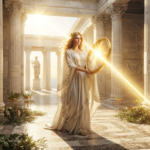
Demeter is typically depicted as a matronly woman of noble bearing and majestic appearance, often crowned with a wreath of wheat ears. Her most common attributes reflect her domain over agriculture and the earth’s bounty:
- Sheaves of Grain or Wheat Ears: These are her most fundamental symbols, representing the harvest, sustenance, and the cycle of agriculture.
- Sickle or Scythe: Tools used for harvesting grain, symbolizing the cutting of the crops and the coming of autumn.
- Cornucopia (Horn of Plenty): A symbol of abundance and the nourishing power of the earth.
- Sceptre: Representing her authority and power as a major Olympian goddess.
- Crown: She is often depicted wearing a crown, sometimes in the shape of a city wall, or a stephane, a type of crown symbolizing her station.
- Poppy: The poppy flower was sacred to Demeter, and its seeds were often scattered in her honor. It is a common motif on statues and coins and appears in the Homeric Hymn to Demeter, where it was a flower picked by Persephone before her abduction.
- Serpent: The serpent was also sacred to Demeter, representing the chthonic (underworld) aspect of her nature and the earth’s fertile power.
- Torus: In some artistic depictions, Demeter sits on a torus, or a decorated throne, emphasizing her role as a queen of the Olympian pantheon.
Family and Relationships
Demeter’s most important relationship was with her daughter, Persephone, who was fathered by Zeus. Persephone was the goddess of spring growth and the queen of the Underworld, acting as a bridge between the world of the living and the dead. This mother-daughter bond was the central focus of Demeter’s mythology.
Demeter also had other divine and mortal children, some of whom were associated with agriculture and the mysteries:
- Plutus: The god of wealth, fathered by the mortal Iasion. This connection links agricultural abundance to material prosperity.
- Despoina: A goddess of mysteries, fathered by Poseidon. Her name means “the Mistress,” and she was worshipped in Arcadia in a mystery cult similar to that of Eleusis.
- Arion: An immortal, divinely inspired horse with the power of speech, also fathered by Poseidon. To escape Poseidon’s advances, Demeter transformed herself into a mare, but he turned himself into a stallion and sired Arion.
- Philomelus: A mortal son of Demeter and Iasion, Philomelus was credited with inventing the wagon, a crucial tool for agriculture.
- Demophoön: While not her son, Demeter attempted to make the Eleusinian prince immortal, creating a bond between her and the city of Eleusis where her mystery cult would flourish.
Through these relationships, Demeter’s influence extended beyond agriculture into the realms of wealth, the mysteries, and even the animal kingdom.
The Eleusinian Mysteries
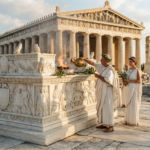
The most significant religious observance dedicated to Demeter was the Eleusinian Mysteries, a set of secret rituals held annually in the city of Eleusis, near Athens. These mysteries were among the most important and revered religious events in the ancient Greek world, drawing initiates from across the Mediterranean.
Based on the myth of Persephone’s abduction and return, the Mysteries were a reenactment of Demeter’s quest and the cycle of death and rebirth. They promised initiates a more blessed afterlife and a deeper understanding of the mysteries of life and death. The rituals were so sacred that participants were sworn to secrecy, and the specific details of the ceremonies remain largely unknown to this day.
The celebration occurred in the fall, consisting of two parts: the “Lesser Mysteries” held in the spring at Agrae, a suburb of Athens, and the “Greater Mysteries” held in the fall in Eleusis. The Greater Mysteries included a procession from Athens to Eleusis along the Sacred Way, fasting, ritual purification, and the consumption of a sacred drink called kykeon. The climax of the Mysteries involved the revelation of sacred objects to the initiates, an experience that was said to transform their understanding of the world and their place within it.
The Eleusinian Mysteries were a cornerstone of Greek religious life and provided a powerful promise of hope and salvation to their participants, cementing Demeter’s role as a goddess of both life and the afterlife.
Worship and Religious Importance
Demeter was a widely worshipped goddess, with numerous shrines, temples, and festivals in her honor throughout the ancient Greek world. She was typically worshipped in conjunction with her daughter, Persephone, with the two often being invoked together as “the Two Goddesses.”
Beyond the Eleusinian Mysteries, which were pan-Hellenic in their reach, local festivals were also held in her honor. The Thesmophoria was a widely celebrated festival for women, held in the autumn to honor Demeter and her role in agriculture. It was a festival of fertility, celebrating the sowing of the seed and the earth’s potential for rebirth. The Haloa, held in December or January, was another agricultural festival involving the harvesting of the vine and the olive. These festivals were often characterized by female-only participation and fertility rites, reflecting Demeter’s role as a mother goddess and her connection to women’s experiences.
The cult of Demeter was deeply integrated into the daily life of the Greek city-states, particularly in Attica, where her worship was a matter of state importance. She was seen as a protector of the community, ensuring the fertility of the land and the survival of its people. Her sanctuaries were often places of sanctuary, where individuals could seek refuge from persecution.
Artistic Representations
In Greek art, Demeter was a frequent subject, appearing on vases, reliefs, and sculptures from the Archaic period onward. Her iconography was remarkably consistent: she was almost always depicted as a dignified, matronly woman, often wearing a crown and carrying a sceptre, with sheaves of wheat or poppies in her hands.
- Vase Painting: The abduction of Persephone by Hades was a particularly popular scene, as was Demeter’s search for her daughter. The gods are often depicted in chariots, and the scene is frequently filled with other figures like Hecate, Helios, and Hermes.
- Sculpture: Large-scale sculptures of Demeter were common in temples and sanctuaries. The statue in the sanctuary at Eleusis was a famous example, and her image also appeared on coins from various Greek city-states.
- Reliefs: Scenes from the Eleusinian Mysteries, such as the procession and the ritual unveiling of sacred objects, were carved onto reliefs and friezes in temples and other sacred spaces.
Through these artistic representations, the Greeks both honored their goddess and made her story and symbolism accessible to all members of their society.
Legacy and Modern Relevance
The legacy of Demeter, as the Greek god of farming and agriculture, is profound and enduring. Her myth and cult were central to the development of Greek culture and religion. She represented the vital importance of agriculture to human civilization, and her story of grief and renewal explained the natural cycle of the seasons that governed ancient life.
Her influence extends into the modern world, where her Roman counterpart, Ceres, gave her name to the word “cereal”. Her association with the cycle of life and death continues to be a powerful symbol in literature and the arts. The Eleusinian Mysteries, though their secrets are lost, are still studied as one of the most fascinating examples of mystery religion in the ancient world.
The figure of Demeter serves as a timeless reminder of humanity’s dependence on the earth and the delicate balance between nature’s ability to provide and to withhold. She is a powerful archetype of the mother goddess, embodying themes of maternal love, loss, and the triumph of life over death.
Frequently Asked Questions About Who is the Greek god of farming and agriculture?
Who is the Greek god of farming and agriculture?
Demeter is the Greek goddess of farming and agriculture, specifically of grain and bread. She is an Olympian deity and one of the most important figures in the Greek pantheon.
What is the Roman name for the Greek god of farming?
Demeter’s Roman equivalent is Ceres. The word “cereal” derives from her Roman name, reflecting her enduring association with grain and agriculture.
What are Demeter’s most common symbols?
Demeter’s symbols include sheaves of grain, a sickle, a cornucopia, a crown, poppies, and a sceptre. These objects represent her domain over agriculture and the earth’s bounty.
What is the story of Demeter and Persephone?
The myth of Demeter and Persephone explains the cycle of the seasons. Persephone was abducted by Hades, and in her grief, Demeter caused the earth to become barren. A compromise was reached: Persephone spends two-thirds of the year with her mother on earth, bringing spring and summer, and one-third in the Underworld with Hades, causing winter.
What were the Eleusinian Mysteries?
The Eleusinian Mysteries were secret religious rituals held annually in Eleusis in honor of Demeter and Persephone. They were among the most important religious events in ancient Greece, promising initiates a more blessed afterlife.
What is Demeter’s role in the seasons?
Demeter’s joy at her daughter Persephone’s return brings spring and summer, while her grief during Persephone’s absence in the Underworld brings autumn and winter. This myth explains the agricultural cycle through divine narrative.
How was Demeter worshipped in ancient Greece?
Demeter was worshipped with numerous local and pan-Hellenic festivals, including the Eleusinian Mysteries and the Thesmophoria. She had shrines and temples throughout the Greek world and was often worshipped alongside her daughter Persephone.
What powers did Demeter have?
As the goddess of agriculture, Demeter had the power to control the fertility of the earth. Her favor brought a bountiful harvest, while her displeasure could cause drought, famine, and crop failure. She also played a role in the mystery cults that promised a blessed afterlife.
Conclusion
In conclusion, Demeter’s identity as the Greek god of farming and agriculture was far more than a simple title. She was the lifeblood of the Greek world, a powerful and complex deity whose influence permeated every aspect of ancient society, from the daily bread on the table to the most profound religious mysteries. Her story, centered on the abduction of her daughter Persephone, was not just a myth but a profound explanation for the cycle of nature and the human condition. Her legacy, enshrined in the Eleusinian Mysteries and immortalized in art and literature, offers a timeless reflection on the relationship between humanity, the earth, and the eternal cycle of life and death. Demeter remains a powerful symbol of the mother goddess, embodying themes of grief, love, and the enduring hope of renewal that continues to resonate today.

Orin Vale has spent the better part of two decades tracing the threads that connect the world’s oldest stories — from the halls of Asgard to the banks of the Nile, from Olympus to the jungles of the Maya. What began as a childhood fascination with flood myths and trickster gods grew into years of independent study across comparative mythology and ancient religion, always chasing the same question: what did these stories mean to the people who first told them? Orin writes for readers who want more than trivia — the ones looking for the beliefs, fears, and truths that myths were built to carry.