In the vast and intricate pantheon of Greek mythology, alongside the well-known Olympian gods, exists a host of personified spirits who embody abstract concepts. Among these, one figure stands out as the very essence of power and might. To answer the question of who is Kratos, the Greek personification of strength? is to delve into the realm of divine abstraction, exploring a being who is not a god of war or heroism, but the literal embodiment of strength, power, and sovereign rule . Kratos (Ancient Greek: Κράτος, lit. ‘power, strength’) is a minor but significant figure, a daimon who serves as the enforcer of Zeus’s will . He is best known for his brutal role in the punishment of the Titan Prometheus, and his name has become, in modern times, synonymous with a very different character from popular culture. This article will serve as a definitive guide to the mythological Kratos, exploring his origins, his family, his role in ancient literature, and his lasting legacy, distinguishing the divine personification from his fictional counterpart.
Origins and Historical Background of Kratos
Kratos belongs to a class of deities known as the daimones, or personified spirits. These are not the fully realized, anthropomorphic gods of Olympus, but rather abstract concepts given divine form and agency . Kratos’s name is derived directly from the ancient Greek word “kratos” (κράτος), which means “might,” “power,” or “strength” . The name itself, therefore, is his definition. He is the action and the force, not merely a being who possesses it.
The earliest and most important source for Kratos is the Theogony of Hesiod, composed in the late 8th or early 7th century BCE . In this foundational work, Hesiod provides a genealogy for Kratos, listing him as one of the “wonderful children” born to the Titan Pallas and the Oceanid Styx . His siblings are Nike (Victory), Bia (Force), and Zelus (Rivalry or Glory) . The mythological history of Kratos is inextricably linked to the Titanomachy, the great war between the Olympian gods led by Zeus and the older generation of Titans. According to Hesiod, when Zeus called upon the gods to join him in his fight, Styx, along with her children, was the first to come to Olympus in support of him . As a reward for their loyalty, Zeus honored them greatly. He made Styx the personification of the great oath of the gods, and her children were given the exalted position of being his constant, winged attendants, dwelling with him forever by his throne . This act of allegiance established Kratos and his siblings as the ultimate enforcers of Zeus’s new regime .
The Mythological Role of Kratos
The primary mythological role of Kratos is to be the embodiment of strength and power as it pertains to the absolute authority of Zeus. He is the divine power of the sovereign, the force that enforces the king’s will without question or mercy . Kratos and his siblings are not merely servants; they are the physical manifestation of the tyrant’s rule, representing the work and the violence required to build and maintain a regime .
Unlike the more complex and charismatic Olympian gods, Kratos is a one-dimensional figure. He does not have a personal backstory, loves, or ambitions. His entire existence is defined by his function as the enforcer. He is characterized as brutal, arrogant, and completely without pity . He is the personification of brute force, a “thug” for whom despotic regimes offer countless job opportunities . His role in the myth is to remind the audience that the rule of Zeus, the king of the gods, is absolute and that defiance comes with a terrible price. This is best exemplified in his most famous appearance in literature, where he carries out the punishment of the Titan Prometheus .
Family and Relationships
Kratos’s relationships are defined not by personal bonds but by their divine roles within the cosmic hierarchy of Zeus’s court.
Parents and Siblings
Kratos’s father is Pallas, a Titan, and his mother is Styx, an Oceanid goddess of the river that bears her name . Styx is a powerful and ancient figure in her own right, as her waters were used for the most binding oaths of the gods . Her decision to side with Zeus at the outset of the Titanomachy, taking her children with her, was a crucial act of loyalty that secured the family’s elevated status .
His siblings are also personifications of aspects of power:
- Nike: The goddess of victory. She represents success and triumph .
- Bia: The goddess of force, might, and compulsion. She is the raw, physical power required to enact violence .
- Zelus: The god of rivalry, zeal, and emulation. He represents the competitive spirit and the drive to achieve glory .
Together, these four siblings form the core of Zeus’s divine retinue, embodying the might and the will that sustain his rule .
Relationship with Zeus
Kratos’s relationship with Zeus is one of pure, unwavering subservience. He is a trusted agent of the king of the gods, tasked with carrying out his harshest punishments . Kratos is fiercely loyal to Zeus, defending his tyranny and advocating for the use of extreme violence in his name . He is the personification of the idea that under a monarch like Zeus, “none is free but Zeus” . His position is one of great honor, but it is an honor derived from his function as a divine enforcer, a weapon in the hands of the king .
Symbols and Meaning
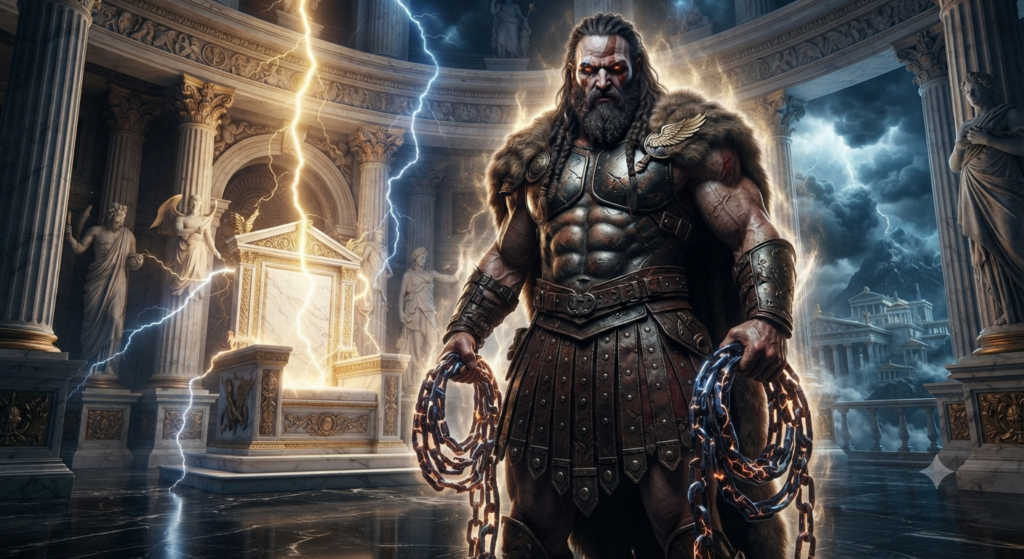
Kratos does not have a specific iconography like a god with a distinct attribute or animal companion. His symbol is the name itself, which is his meaning. He is the abstract concept of strength, might, and power . His attributes are the chains and shackles that he uses to bind his victims . The fetters of Prometheus, which Kratos compelled Hephaestus to forge and apply, are a powerful symbol of his role . They represent the unbreakable, oppressive power of Zeus and the inability of even the gods to resist his will.
His appearance, as described by ancient sources, is perhaps his most telling symbol. In Aeschylus’s Prometheus Bound, Hephaestus, the blacksmith god, criticizes Kratos, telling him that his speech is as ugly as his physical appearance . This suggests that Kratos was visualized as a brutish, perhaps even monstrous, figure, a stark contrast to the beautiful, idealized forms of the major gods. His ugliness is a symbol of the brutality and lack of refinement inherent in pure, unadulterated force.
Powers and Characteristics
Kratos’s “powers” are not magical abilities but rather the divine qualities he personifies. His primary power is his absolute command over strength and power itself. He is the force that compels, the might that enforces . However, his powers are not independent; they are channeled through the will of Zeus.
His characteristics are defined by his personality in Aeschylus’s play:
- Brutality and Pitilessness: Kratos is utterly merciless. He repeatedly orders Hephaestus to use more violence than necessary against Prometheus, advocating for the maximum amount of pain and suffering . He mocks Hephaestus for his pity and declares that “wailing will not ease him” .
- Arrogance: He is supremely arrogant, believing in the absolute right of Zeus’s rule. He responds to Hephaestus’s criticism of his character by telling him to “be soft” and not to reproach him for his “willfulness” and “roughness of temper” .
- Lack of Empathy: Kratos views the world in black and white: obedience to Zeus is good, and defiance is treason. He cannot comprehend or respect the moral qualms of Hephaestus, who is reluctant to bind a fellow god .
- Advocate for Tyranny: He is the most vocal defender of Zeus’s oppressive rule, stating that the rule of law is rule by fear . For him, justice is simply the will of the monarch .
Worship and Religious Importance
As a personified spirit, Kratos did not have a formal cult of worship. There were no temples dedicated to him, no priests who performed rituals in his honor, and no festivals celebrating him. His religious importance was philosophical and mythological rather than ritualistic.
Kratos represented a deeply held belief about the nature of divine power: that it was absolute, unyielding, and enforced by brutal force. He was the reason why even the gods feared Zeus. By including him in their myths and literature, the ancient Greeks were acknowledging the terrifying power at the heart of their pantheon. Kratos was a cautionary figure, a reminder that the cosmic order was maintained not just by wisdom or law, but by the raw, untamed power to punish any who dared to transgress.
Ancient Sources
The mythological figure of Kratos appears in a few key ancient sources, each providing a piece of the puzzle that defines his character.
- Hesiod’s Theogony (c. 8th-7th century BCE): This is the foundational text for Kratos’s genealogy and his place in the cosmos. It introduces him as the son of Pallas and Styx, a sibling of Nike, Bia, and Zelus, and a constant companion of Zeus .
- Aeschylus’s Prometheus Bound (c. 5th century BCE): This is Kratos’s most famous and detailed appearance. In the opening scene, he and his sister Bia bring the captive Titan Prometheus to a desolate cliff . Kratos does all the speaking, compelling the reluctant god Hephaestus to chain Prometheus to the rock, and his dialogue reveals his brutal and arrogant personality .
- Aeschylus’s Libation Bearers (c. 5th century BCE): In this tragedy, Electra calls upon Kratos, along with Dike (Justice) and Zeus, to aid her brother Orestes in avenging the murder of their father .
- Plato’s Protagoras (c. 4th century BCE): The philosopher refers to Kratos and Bia as the “terrible” guards of Zeus, whom Prometheus had to evade to steal fire for humanity .
Artistic Representations
As a relatively minor figure of abstract power, Kratos is not a common subject in surviving ancient Greek art. There are no famous statues or vase paintings that are definitively identified as the personification of strength. However, there is one notable exception.
A late 5th-century BCE Attic red-figure skyphos (a type of drinking cup) depicts the punishment of Ixion, a king who attempted to seduce Hera. In this scene, figures believed to be Kratos and Bia are shown assisting in the binding of Ixion to a fiery wheel . This is a powerful visual parallel to the scene in Prometheus Bound, showing that these divine enforcers were the standard-bearers for Zeus’s punishments.
Cultural Influence and Historical Legacy
The historical legacy of the mythological Kratos is primarily literary and conceptual. He is a key figure in the Greek understanding of divine power, representing the force that maintains the cosmic order. His name, as the Greek word for “power,” is the root of many words in modern languages, such as “democracy” (demos-kratos, “people power”) and “aristocracy” (aristos-kratos, “rule of the best”). This linguistic legacy is perhaps the most profound part of his historical influence, as “kratos” is a foundational term for Western political thought.
However, in contemporary culture, the name Kratos has been almost entirely overshadowed by his video game counterpart. The “God of War” franchise, created by Sony Interactive Entertainment’s Santa Monica Studio, features a protagonist named Kratos . This character, who is a Spartan warrior who becomes the God of War after killing Ares, bears little resemblance to the mythological personification . The creators of the game were initially unaware of the mythological figure and chose the name for its meaning of “strength,” only later realizing the coincidence . This has led to a great deal of confusion, with many people believing the brutal, tragic hero of the video games is the actual figure from Greek mythology .
Legacy
The legacy of Kratos, the Greek personification of strength, is a tale of two figures. In the ancient world, he was the silent, terrifying enforcer, the embodiment of the power of the sovereign whose name was a warning. He was the force behind the king, the violence that made the law absolute. His name lived on not as a god but as a concept, a fundamental building block of words describing systems of power.
In the modern world, his legacy has been divided. The linguistic heritage continues, with “kratos” appearing in words that define our political realities. But the mythological figure has been almost entirely eclipsed by a fictional character who bears his name. The “God of War” Kratos, while drawing on the themes of Greek myth, is a demigod seeking vengeance, a tragic hero who embodies the violence and rage of a very different kind of story . The original Kratos, the divine enforcer of Zeus, is often forgotten, a minor deity whose purpose was to make the king’s power absolute and unquestioned.
Frequently Asked Questions About Who is Kratos, the Greek personification of strength?
What is the difference between the mythological Kratos and the video game Kratos?
The mythological Kratos is the divine personification of strength and power, a minor deity and the brutal enforcer of Zeus . The video game Kratos is a mortal Spartan who becomes the God of War, a tragic antihero who kills gods . They are entirely different characters, though the game’s protagonist was named for the same Greek word.
Who were the siblings of Kratos in Greek mythology?
Kratos had three siblings, all of whom were also personifications of abstract concepts. They were Nike (Victory), Bia (Force), and Zelus (Rivalry). Together, they were the constant winged companions of Zeus .
What is Kratos known for in Greek mythology?
Kratos is best known for his role in the play Prometheus Bound, where he is the enforcer who drags the Titan Prometheus to be chained to a rock as punishment for giving fire to humanity . He is portrayed as cruel, arrogant, and completely loyal to Zeus .
Is Kratos a god?
Yes, Kratos is a god, but he is not an Olympian. He is a daimon, a personified spirit who embodies the abstract concept of strength and power. He is an immortal being who serves Zeus .
Who are the parents of Kratos?
In Hesiod’s Theogony, Kratos’s parents are the Titan Pallas and the Oceanid Styx. This lineage makes him a member of the second generation of divine beings, just like the Titans .
What does the name “Kratos” mean?
The name Kratos is the ancient Greek word for “power,” “strength,” or “might.” It is his defining characteristic and a common noun that appears in many Greek words, such as demokratia (democracy) .
In which ancient sources does Kratos appear?
Kratos appears in Hesiod’s Theogony, which details his birth and role. His most famous appearance is in Aeschylus’s tragedy Prometheus Bound. He is also mentioned in Aeschylus’s Libation Bearers and Plato’s Protagoras .
Why is Kratos associated with chains and shackles?
Kratos is associated with chains because, in Prometheus Bound, he is the one who compels and oversees the binding of Prometheus to a rock . This act of imprisonment is his most famous function, making the chains a symbol of his power as Zeus’s enforcer.
Conclusion
The figure of Kratos, the Greek personification of strength, occupies a unique and fascinating space in ancient mythology. He is not a hero or a god with a grand personality, but rather the embodiment of a concept: the raw, unyielding power that enforces the rule of the divine king. His origins in Hesiod’s Theogony establish him as part of a family of power, the loyal children of Styx who won the right to stand by Zeus’s throne. His terrifying character is most vividly brought to life in Aeschylus’s Prometheus Bound, where his brutality, arrogance, and complete lack of pity serve as a stark warning of the consequences of defying the king of the gods. His historical importance lies in the linguistic legacy of his name, a word that continues to define systems of power to this day. While his modern legacy has been overshadowed by a fictional video game character, the ancient Kratos remains a powerful symbol of the absolute authority that lies at the heart of the Greek pantheon.

Orin Vale has spent the better part of two decades tracing the threads that connect the world’s oldest stories — from the halls of Asgard to the banks of the Nile, from Olympus to the jungles of the Maya. What began as a childhood fascination with flood myths and trickster gods grew into years of independent study across comparative mythology and ancient religion, always chasing the same question: what did these stories mean to the people who first told them? Orin writes for readers who want more than trivia — the ones looking for the beliefs, fears, and truths that myths were built to carry.