The question of who is Lycaon in Greek mythology? leads us to one of the most notorious and fascinating figures of the ancient world, a king whose name has become synonymous with the origins of the werewolf legend. Lycaon (Λυκάων in Greek, meaning “wolf”) was a legendary king of Arcadia, a region in the central Peloponnese, whose story serves as a powerful cautionary tale about the dangers of impiety and the absolute authority of the gods . He is most famous for his attempt to test or trick Zeus, the king of the gods, by serving him human flesh, an act of hubris that earned him a terrible punishment and eternal infamy. This article will serve as a definitive guide to the multifaceted figure of Lycaon, exploring the various versions of his myth, his role as both a culture hero and a monster, his extensive family, and his enduring legacy as the archetypal werewolf.
Origins and Historical Background of Lycaon
The myth of Lycaon is deeply rooted in the ancient Greek world, specifically in the mountainous region of Arcadia. He is consistently described as the son of Pelasgus, the mythical first king of Arcadia, making him a foundational figure in the region’s legendary history . In fact, Lycaon is sometimes presented not as a wicked king but as a great civilizer, the founder of the city Lycosura—believed to be the oldest city in the world—and the introducer of the cult of Zeus Lycaeus and the tradition of the Lycaean Games, which Pausanias considered older than the Panathenaic Games .
This dual nature—as both a founder of civilization and a monstrous tyrant—is central to understanding Lycaon. The story served a dual purpose. Firstly, it explained the origins of a local ritual, the Lycaea, which was held in honor of Zeus Lycaeus on Mount Lycaeus . According to ancient authors like Plato and Pausanias, this ceremony was believed to involve human sacrifice and possibly lycanthropy, a belief that a man could be transformed into a wolf . Lycaon’s myth, therefore, was an etiology, a story that provided a divine and historical explanation for an existing religious practice. Secondly, the myth was a powerful theological statement. It reinforced the idea that the gods were all-knowing and that any attempt to deceive them would be met with swift and terrible retribution. The flood of Deucalion, which was said to have occurred in the reign of Lycaon’s son, was a punishment for the crimes of the Lycaonids .
The Mythological Role of Lycaon
Lycaon’s primary mythological role is that of the impious king who challenges the authority of Zeus. He represents the ultimate transgression: the violation of the sacred laws of hospitality and the fundamental taboo against cannibalism . By serving human flesh, he was not just being cruel; he was attempting to prove that Zeus was not all-seeing and all-knowing, thereby challenging the very foundation of the Olympian order.
In a more positive light, Lycaon also serves as the mythical lawgiver and first civilizer of Arcadia . This dual role is common in Greek mythology, where a figure can be both a transgressor and a cultural hero, reflecting the complex and often contradictory nature of the ancient world’s understanding of its own past.
The Myth of Lycaon: The Various Versions
The story of Lycaon is a myth with many variations, each offering a different detail or emphasis.
Ovid’s Version in the Metamorphoses
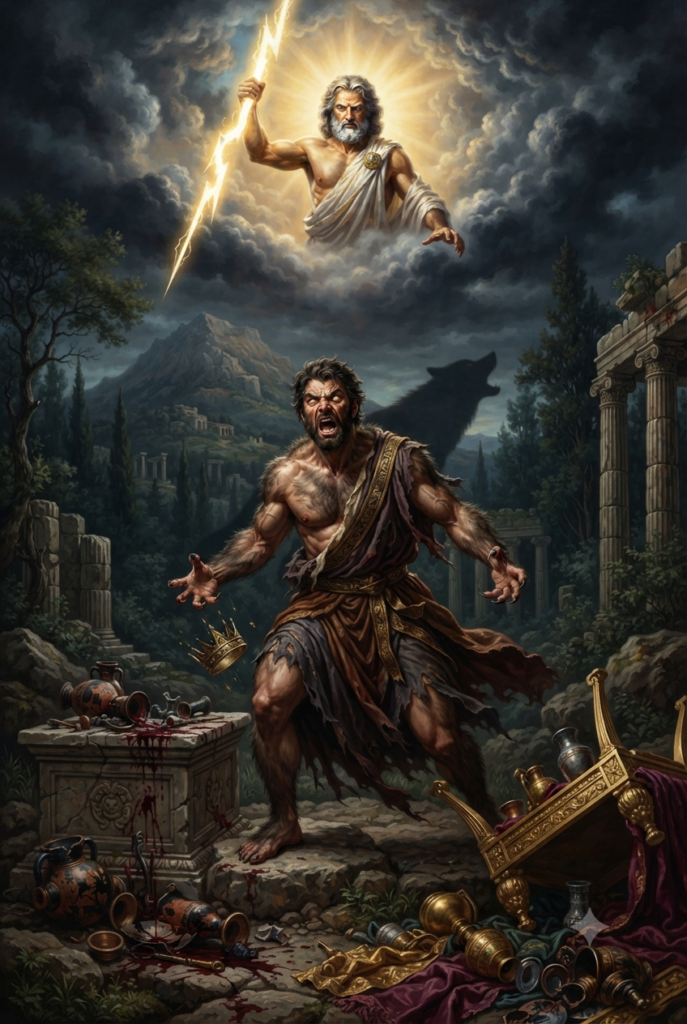
The most famous and influential version is that told by the Roman poet Ovid in his Metamorphoses . According to Ovid, Lycaon was a cruel and impious king. When he learned that Zeus was in his land, he mistrusted and derided the signs of the god’s divine nature. He resolved to test the god by serving him a dish of human flesh. In Ovid’s account, he did not serve his own child but a prisoner: “one taken from the Molossian nation, of his own race . . . whose throat his knife had gash’d”. After serving the meal, Lycaon even attempted to murder Zeus while he slept. Zeus, enraged, brought the roof down and transformed the fleeing Lycaon into a wolf. The transformation signified the stripping away of his human nature: the king was left to wander the fields, howling and bloodthirsty, as a reflection of his true, savage soul.
Apollodorus’s Version
The Bibliotheca of Apollodorus offers a different, but still gruesome, take . In this version, Zeus visits the impious sons of Lycaon disguised as a peasant. The sons, who were notoriously insolent and carefree, served the god the entrails of a child they had murdered. The enraged Zeus threw the meal over a table (explaining the name of the city Trapezus), and killed Lycaon and all his fifty sons with a thunderbolt. Only the youngest son, Nyctimus, was saved due to the intervention of Gaia . Some versions of this account name Nyctimus as the victim sacrificed by his own father.
Pausanias’s Version
The Greek traveler Pausanias gives a version that directly connects the myth to the ritual practices of Arcadia . He states that Lycaon sacrificed a child on the altar of Zeus Lycaeus and sprinkled its blood on the altar. Immediately after this act, Lycaon was transformed into a wolf. This version connects the myth to the ancient belief that a participant in the sacrifice on Mount Lycaeus could be transformed into a wolf for nine years .
Hyginus’s Version
The Roman author Hyginus provides a version where Lycaon sacrifices his grandson Arcas, the son of Zeus and Callisto, to test Zeus . Zeus restored the boy to life, while Lycaon and his fifty sons were killed by lightning.
Family and Relationships
Lycaon is a figure whose family is central to his myth, with his descendants founding the cities and villages of Arcadia .
Parents and Wife
Lycaon was the son of Pelasgus, the first king of Arcadia, and Meliboea, the daughter of the Oceanid . His wife is sometimes said to be the Oread nymph Cyllene, who gave her name to Mount Cyllene, though in other sources, she is his mother .
The Fifty Sons of Lycaon
Lycaon is most famous for his numerous sons, whose number is given as either fifty (most commonly) or twenty-two . These sons were notorious for their insolence and impiety. In the myth, they often share in their father’s punishment. Their names are not consistent across all sources, but they are said to have founded the various towns and villages of Arcadia, giving their names to these settlements . Some of the more famous sons include Nyctimus, Maenalus, and possibly Arcas, who is sometimes his grandson.
Other Children and Descendants
Lycaon also had daughters, the most famous being Callisto, a nymph who was a companion of Artemis and the mother of Arcas by Zeus . This makes the story of Lycaon’s family intimately connected to some of the most famous myths of Greek mythology.
Symbols and Meaning
The symbolism of Lycaon is rich and complex, reflecting his dual nature as both a civilizing hero and a monstrous villain.
- The Name (Lycaon/Lykos): The name itself is a powerful symbol. Its root in the Greek word for wolf (λύκος) is a constant reminder of his fate and the animal nature that lurked beneath his human form .
- The Wolf: Lycaon’s transformation into a wolf is a potent symbol of the loss of humanity. The wolf represents savagery, predation, and the breakdown of the social and moral order. It is the animal that reflects his own inner nature .
- The Table (Trapezus): In the version where Zeus pushes away the table, the act is a powerful symbol of divine disgust. The place was thereafter called Trapezus (“the Table”), a permanent reminder of the king’s transgression and the god’s rejection of human sacrifice .
- The Sacrificial Knife: As a culture hero, Lycaon is associated with the founding of rituals and the civilization of his people. However, his knife also symbolizes the act of human sacrifice, the perversion of ritual that led to his downfall.
Powers and Characteristics
Lycaon, as a mortal king, did not have “powers” in the sense of a god. His characteristics are the defining features of his personality.
- Impiety and Hubris: His defining characteristic is his extreme impiety. He is willing to commit the ultimate sacrilege—human sacrifice and cannibalism—to test the power of the king of the gods .
- Cruelty: He is described as a ruthless and cruel king, and his actions demonstrate a complete lack of respect for human life .
- Cunning (Misplaced): His attempt to trick Zeus shows a kind of cunning, but it is a misplaced and foolish cunning, as it is impossible to deceive an all-knowing god.
- Civilizing Influence: Paradoxically, he is also characterized as the first civilizer of Arcadia, a lawgiver who founded cities and established religious cults . This contradictory nature is a fascinating aspect of the mythological figure.
Worship and Religious Importance
The worship of Lycaon is not as a god, but the myth is deeply connected to the religious practices of Arcadia. The cult of Zeus Lycaeus was of great importance, and the Lycaea festival was a significant event . The figure of Lycaon is central to explaining the origins of this cult.
Furthermore, the myth of Lycaon is the foundational story of the werewolf tradition in Greek culture. It is the classic example of lycanthropy, a term derived from his name . The ancient belief that a man could transform into a wolf was often associated with the sacrifice on Mount Lycaeus . This connection gave the myth a powerful and lasting religious significance.
Ancient Sources
Lycaon is a figure who appears in many of the most important ancient sources.
- Hesiod: Although fragmentary, Hesiod is one of the earliest sources to mention Lycaon and his sons .
- Pseudo-Apollodorus’s Bibliotheca: A comprehensive source that provides a detailed genealogy and the myth of Zeus’s punishment of Lycaon’s sons .
- Ovid’s Metamorphoses: The most famous literary version of the myth, describing Lycaon’s transformation into a wolf .
- Pausanias’s Description of Greece: A vital source for the local traditions and rituals of Arcadia, including the worship of Zeus Lycaeus and the fate of Lycaon .
- Hyginus’s Fabulae and Astronomica: Roman author whose works preserve important alternate versions of the myth .
- Plato’s Republic: The philosopher mentions the ceremonies of Zeus Lycaeus, which he says involved human sacrifice .
- Pliny the Elder’s Natural History: The Roman encyclopedist describes the Arcadian tradition of a man being transformed into a wolf for nine years .
Artistic Representations
Given the gruesome nature of the myth, Lycaon is not a common subject in surviving Greek vase painting, which tended to favor heroic and divine scenes. The transformation itself is a difficult moment to depict in static art. However, the story was a popular subject in later Roman art and Renaissance painting. Depictions of the scene often show the moment of transformation, with Lycaon’s body contorting or the horrified Zeus gesturing at the table. The connection to werewolf lore also led to his inclusion in later bestiaries and works of folklore.
Cultural Influence and Historical Legacy
The legacy of Lycaon is immense. His name is the root of the term “lycanthropy,” the clinical and folkloric term for the transformation of a human into a wolf . The myth is the most famous werewolf story from classical antiquity and has inspired countless tales in literature, film, and popular culture . Furthermore, the myth of Lycaon was a model for the “monster’s bride” or “Beauty and the Beast” style narrative, in which a protagonist must learn to see beyond appearances to find true love. The original Kratos, the divine enforcer of Zeus, is often forgotten, a minor deity whose purpose was to make the king’s power absolute and unquestioned. The Lycaon myth is a stark reminder of the ancient Greek belief in the power of the gods and the terrible consequences of human pride and transgression.
Frequently Asked Questions About Who is Lycaon in Greek mythology?
What is Lycaon most famous for in Greek mythology?
Lycaon is most famous for his attempt to test or trick Zeus by serving him human flesh. As punishment for this act of impiety and cannibalism, Zeus transformed Lycaon into a wolf, making him a central figure in the mythology of werewolves .
Is Lycaon the first werewolf?
While there are earlier stories of human-to-animal transformation in world mythology, Lycaon is the most famous and influential example from classical Greek mythology. His story is the primary mythological origin of the werewolf tradition in Western culture, and his name is the root of the word “lycanthropy” .
Who were the sons of Lycaon?
Lycaon was said to have fifty sons, though some sources say there were only twenty-two. They were notorious for their impiety and were killed by Zeus, either by thunderbolt or by being transformed into wolves, as punishment for their crimes . Nyctimus was often the sole survivor. These sons were said to have founded and given their names to the cities of Arcadia .
Who is Lycaon’s father in Greek mythology?
Lycaon is the son of Pelasgus, the mythical first king of Arcadia. His mother is variously named as Meliboea, an Oceanid nymph, or Cyllene, an Oread nymph .
Was Lycaon a good king or a bad king?
Lycaon has a dual nature in Greek mythology. He is remembered as an impious and cruel king who committed terrible acts to test Zeus . However, he is also credited with being the first civilizer of Arcadia, a lawgiver who founded cities like Lycosura and established the cult of Zeus Lycaeus .
What are the different versions of the Lycaon myth?
There are several versions. In Ovid’s Metamorphoses, Lycaon serves Zeus the flesh of a prisoner. In Apollodorus’s Bibliotheca, his sons serve Zeus the entrails of a murdered child. Pausanias says Lycaon sacrificed his own child on an altar. In all versions, however, the act is punished by Zeus, resulting in the death of Lycaon’s sons and his transformation into a wolf .
What does the name Lycaon mean?
The name “Lycaon” is derived from the ancient Greek word lykos (λύκος), which means “wolf.” His name is, therefore, a direct reference to his transformation and his association with wolves .
Conclusion
Lycaon, the legendary king of Arcadia, stands as one of the most compelling and complex figures in Greek mythology. He is a man of stark contradictions: the noble founder of civilization who introduced the worship of the gods, yet a monster who committed the ultimate crime of cannibalism and sought to defy the king of the gods. The answer to the question of who is Lycaon in Greek mythology? is a story that serves as a powerful moral lesson about the dangers of impiety, the absolute authority of the gods, and the thin line between humanity and savagery. His myth explains the origins of ancient rituals and gave rise to the enduring legend of the werewolf. From ancient Arcadia to modern horror films, Lycaon’s legacy endures as the archetypal figure of one who lost his humanity to his own beastly nature.

Orin Vale has spent the better part of two decades tracing the threads that connect the world’s oldest stories — from the halls of Asgard to the banks of the Nile, from Olympus to the jungles of the Maya. What began as a childhood fascination with flood myths and trickster gods grew into years of independent study across comparative mythology and ancient religion, always chasing the same question: what did these stories mean to the people who first told them? Orin writes for readers who want more than trivia — the ones looking for the beliefs, fears, and truths that myths were built to carry.