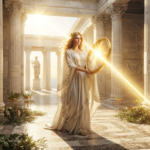
In the vast and shimmering tapestry of Greek mythology, among the elder gods who ruled before the Olympians, there exists a figure of breathtaking beauty and tragic transformation. The answer to the question of who is Asteria, the Titan goddess of falling stars? leads us to a deity who embodies the very essence of the starry night and the fleeting wonder of a shooting star. Asteria was a Titan goddess of the second generation, the daughter of the Titans Coeus and Phoebe, and the sister of Leto . Her name, derived from the ancient Greek word for “star,” speaks to her dominion over the celestial realm, particularly falling stars, nighttime oracles, and the art of divination through dreams and astrology . Yet, her story is not one of power and triumph, but of desperate flight and profound sacrifice. To escape the relentless pursuit of Zeus, she transformed herself into a quail and plunged into the Aegean Sea, becoming the wandering island of Delos, which would later become the sacred birthplace of Apollo and Artemis . This article will serve as a definitive guide to Asteria, exploring her origins, her celestial role, her family, and her enduring legacy as the starry island of the gods.
Origins and Historical Background of Asteria
Asteria belongs to the second generation of Titans, the powerful pre-Olympian deities who ruled the cosmos before the rise of Zeus and his siblings . Her parentage places her at the heart of the divine order. Her father, Coeus, was the Titan of intelligence and the axis of heaven, while her mother, Phoebe, was the goddess of bright intellect and prophecy . This lineage established Asteria as a figure of immense wisdom and cosmic significance, a being who could see the future and understand the movements of the heavens.
Her name, Asteria (Ancient Greek: Ἀστερία), is a direct translation of her divine function. It comes from the Greek word astēr (ἀστήρ), meaning “star” . The name itself is a testament to her role: she was the personification of the starry night, the “starry one,” who was believed to keep the moon and stars in their celestial places, maintaining the balance of the night sky . The historical importance of Asteria lies in her connection to the ancient Greek practice of astrology and nocturnal divination. The Greeks looked to the stars for guidance, and Asteria, as the goddess of falling stars and nighttime oracles, was a key figure in this belief system . Her name and her transformation became an explanation for the origin of the sacred island of Delos, forever linking her to one of the most important religious sites in the ancient Greek world.
The Mythological Role of Asteria
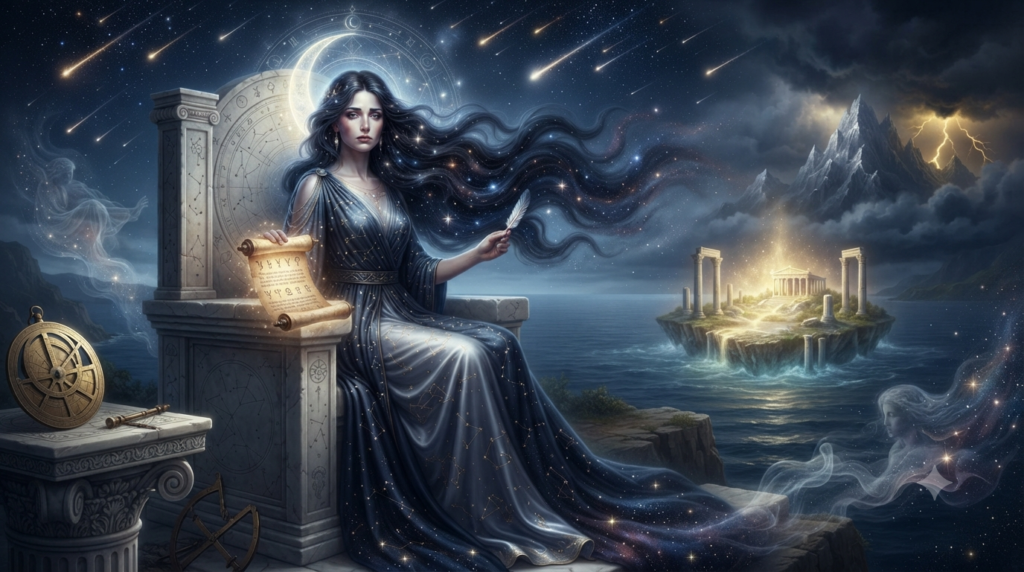
Asteria’s primary mythological role is as the Titan goddess of falling stars and nocturnal divination . She was not simply a goddess who dwelt in the sky; she was the sky itself, the starry firmament that stretched above the earth. She was believed to watch over the stars at night, ensuring they followed their courses . Her role encompassed the mysterious and often frightening phenomenon of a shooting star, which was seen as a sign or an omen from the divine realm.
She was also a goddess of oracles and divination, specifically those conducted at night . This included oneiromancy, the interpretation of dreams, and astrology, the reading of the stars and planets . In this capacity, she was the source of prophetic wisdom that came to mortals in the quiet hours of darkness. In this role, she is closely associated with her daughter, Hecate, who inherited her mother’s affinity for the night, magic, and the unseen world . Some sources also link her to Brizo, an obscure Delian goddess who delivered prophetic dreams, suggesting that the worship of Asteria may have continued in a more localized form on the island that bore her name .
The Myth of the Fleeing Goddess: Zeus and the Creation of Delos
The most famous and defining myth of Asteria is her desperate flight from the amorous advances of Zeus, the king of the gods. According to the tradition, after Zeus had impregnated her sister Leto, his attention turned to Asteria . He pursued her relentlessly, often taking the form of an eagle . Asteria, however, was determined to preserve her virginity and escape the god’s grasp. In a desperate act of transformation, she changed herself into a quail (ortux) and flung herself into the Aegean Sea .
It was there, in the waters, that her transformation was completed. She metamorphosed into a floating island, which was initially called either Asteria (the “starry” island) or Ortygia (the “quail” island) . As a wandering island, she was free from the clutches of Zeus, but she was also rootless, drifting at the mercy of the sea. This act of self-sacrifice was a powerful statement of her autonomy, a rejection of divine will in favor of her own freedom.
The myth of Asteria takes on a new dimension of importance when her sister Leto, pregnant with Zeus’s children, sought a place to give birth. Hera, the jealous wife of Zeus, had decreed that Leto would find no refuge on any solid land . It was only Asteria, the wandering island, who defied Hera’s orders and welcomed her sister. There, on the floating island that had once been a goddess, Leto gave birth to Apollo and Artemis . In gratitude, Apollo fixed the island in place and named it Delos, making it his sacred land and the site of one of the most important sanctuaries in the Greek world .
Family and Relationships
Asteria’s relationships are central to her myth and define her place in the Greek pantheon.
Parents
Asteria was the daughter of the Titans Coeus and Phoebe . This parentage made her a Titanis, a female Titan of the second generation, and a figure of immense power and wisdom.
Siblings
Her sister was Leto, the goddess of motherhood and womanly demure . This close sibling bond is the cornerstone of her most important myth. She also had a brother, Lelantos, the god of the moving unseen .
Husband and Offspring
Asteria was married to the Titan Perses, the god of destruction . Together, they had a single daughter, Hecate, the powerful goddess of witchcraft, magic, and the moon . Hesiod’s Theogony records that Hecate was Zeus’s most honored child, an honor that reflects the might of her Titan parents . In some rare accounts, Asteria is also named as the mother of the fourth Heracles by Zeus .
Relationship with Zeus
Zeus pursued Asteria, but she rejected him and chose transformation over submission. Despite his desire for her, Hera did not punish Asteria for offering refuge to Leto, out of respect for her rejection of Zeus .
Symbols and Meaning
The symbols of Asteria are intrinsically linked to her identity as a celestial goddess and her transformation into an island.
- The Falling Star: The most prominent symbol of Asteria is the falling star (meteor or shooting star). It represents her name, her divine function, and the transient, fleeting nature of her escape from Zeus.
- The Quail: This bird is a powerful symbol of her transformation and her flight . The quail is a ground-dwelling bird that is often hunted, representing vulnerability, but also the ability to take flight and escape. It is a symbol of her desperate but successful flight from the amorous god.
- The Wandering Island: The island of Delos (or Ortygia) is the ultimate symbol of her sacrifice and her legacy. It represents refuge, transformation, and the sacred. It is a place that was both a goddess and a land, a testament to her enduring presence.
- The Starry Night: On a broader level, Asteria symbolizes the beauty and mystery of the night sky, particularly the starry vault that inspired wonder and served as a guide for navigation and prophecy.
Powers and Characteristics
Asteria’s powers reflect her celestial domain and her role as an ancient Titan goddess.
- Celestial Influence: She had dominion over the stars and constellations, believed to keep them in their courses and maintain the balance of the night sky . Her power was the power of the heavens themselves.
- Transformation: Her most dramatic power was her ability to transform her physical form. She could become a quail and then a floating island, demonstrating her immense magical abilities .
- Prophecy and Divination: As a goddess of nocturnal oracles, she could grant prophetic dreams and guide the reading of the stars . She was a source of hidden knowledge that came to mortals in the night.
- Chastity and Independence: While not a “power” in the traditional sense, her fierce determination to preserve her virginity and her autonomy was a defining characteristic that set her apart from many other goddesses. She chose isolation and transformation over submission to Zeus .
Worship and Religious Importance
Asteria did not have a widespread cult or a grand temple in her own name across the Greek world. Her religious importance was instead tied directly to the island of Delos, which was both her physical form and her lasting legacy. The island of Delos was one of the most significant religious sites in the ancient Greek world, serving as the sacred birthplace of Apollo and Artemis.
The worship of Asteria was likely practiced on Delos itself, though it was often subsumed into the veneration of her more famous nephew and niece. However, she was a beloved figure, as the island was the only place willing to defy Hera’s decree and offer sanctuary to the pregnant Leto . In some traditions, she was conflated with Nyx, the goddess of night, and was seen as a starry equivalent of that primordial darkness .
Ancient Sources
Asteria appears in several key ancient literary and mythological sources.
- Hesiod’s Theogony (c. 8th-7th century BCE): This is the primary source for her genealogy, establishing her as the daughter of Coeus and Phoebe and the mother of Hecate by Perses .
- Pseudo-Apollodorus’ Bibliotheca (c. 1st-2nd century CE): A later compendium of myths that provides the most detailed account of her transformation into a quail and then the island of Ortygia to escape Zeus .
- Callimachus’ Hymn to Delos (c. 3rd century BCE): This Hellenistic poem is the key source for the story of Leto’s journey and the role of Delos (Asteria) in providing a place for the birth of Apollo and Artemis.
- Hyginus’ Fabulae (c. 1st century CE): A Roman author who preserves the Greek traditions, including the story of Asteria’s transformation .
- Cicero’s De Natura Deorum (1st century BCE): The Roman philosopher mentions a tradition where Asteria was the mother of Heracles by Zeus .
Artistic Representations
Asteria is a subject in ancient Greek art, though her depictions are tied to her transformation and her role as an island. In Athenian vase painting, she is often represented alongside the other Delian gods—Apollo, Artemis, and Leto—and is typically labelled “Delos” . This depiction shows her as a personification of the sacred island, often as a female figure rising from or associated with the sea.
A notable artistic representation of Asteria is found on the Gigantomachy frieze of the Pergamon Altar, where she is depicted fighting alongside her mother Phoebe against the Giants . This is a powerful and rare image of her as a warrior goddess, participating in the defense of the divine order.
Cultural Influence and Historical Legacy
The legacy of Asteria is profound, primarily through the enduring religious and cultural significance of the island of Delos. The island that was once a goddess became the center of the Delian League, the treasury of the Athenian empire, and a major pilgrimage site for the ancient world. Her story gave birth to the sacred geography of one of the most important places in Greek history.
The story of Asteria also serves as a powerful mythological explanation for the presence of quails on the island, an animal that was considered sacred there . The myth of her transformation was an etiology, a story that explained a local phenomenon. In a broader sense, Asteria’s story of transformation and sacrifice has resonated through the ages. She stands as a symbol of the power of women to choose their own fate, even in the face of overwhelming divine force.
Frequently Asked Questions About Who is Asteria, the Titan goddess of falling stars?
Who were the parents of Asteria?
Asteria was the daughter of the Titans Coeus, the god of intelligence, and Phoebe, the goddess of bright intellect and prophecy . She is a second-generation Titan, belonging to the same generation as her sister Leto and their cousins, the children of the twelve original Titans.
Why did Asteria turn into a quail?
Asteria transformed herself into a quail to escape the relentless pursuit of Zeus, who desired her . She leaped into the Aegean Sea and became the floating island of Ortygia, also known as the “quail island” .
What is the meaning of the name Asteria?
The name Asteria is derived from the ancient Greek word astēr, meaning “star.” Her name translates to “starry one” or “of the stars,” reflecting her role as the goddess of falling stars and the starry night .
Who is the daughter of Asteria?
Asteria’s only child is Hecate, the powerful goddess of witchcraft, magic, and the moon. She was fathered by the Titan Perses . Hecate inherited her mother’s affinity for the night and the unseen realms.
How is Asteria connected to the island of Delos?
After transforming into a bird, Asteria leaped into the sea and became the island of Ortygia. This island later became known as Delos. It was on this island that her sister Leto gave birth to Apollo and Artemis, making Delos one of the most sacred sites in Greek mythology . Thus, Asteria is both the goddess and the physical embodiment of the island.
Did Asteria have any symbols?
Her primary symbols include the falling star, which represents her celestial role, and the quail, which represents her transformation and flight from Zeus . The island of Delos itself is a symbol of her sacrifice and her enduring legacy.
What was Asteria’s relationship with Zeus?
Zeus pursued Asteria, but she rejected his advances and chose to transform herself and leap into the sea to escape him . Later, when her sister Leto was pregnant with Zeus’s children, Asteria (as Delos) provided the only refuge for her to give birth, defying Hera’s orders .
Conclusion
Asteria, the Titan goddess of falling stars, is a figure of profound grace, sacrifice, and enduring power. She is the starry night, the fleeting omen of a shooting star, and the sacred island of Delos. The answer to who is Asteria, the Titan goddess of falling stars? is a story of a goddess who chose her own fate, turning away from the king of the gods to become a wandering island, only to find her ultimate purpose as the birthplace of the new Olympian order. Her legacy is not just in the myths of the ancient past but in the very geography of the Aegean Sea, where the island of Delos stands as a testament to her transformation. She reminds us that even the most powerful forces can be resisted, and that even in transformation, there is the possibility of creating something sacred and enduring. Her name, which means “star,” continues to shine across the millennia, a reminder of the beauty and mystery of the celestial realm she once ruled.

Orin Vale has spent the better part of two decades tracing the threads that connect the world’s oldest stories — from the halls of Asgard to the banks of the Nile, from Olympus to the jungles of the Maya. What began as a childhood fascination with flood myths and trickster gods grew into years of independent study across comparative mythology and ancient religion, always chasing the same question: what did these stories mean to the people who first told them? Orin writes for readers who want more than trivia — the ones looking for the beliefs, fears, and truths that myths were built to carry.