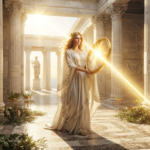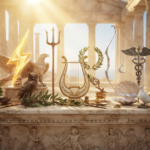
The question of who are the twelve Olympian gods? leads us to the heart of ancient Greek religion and mythology, introducing the powerful deities who ruled the cosmos from their heavenly throne on Mount Olympus. The Twelve Olympians were the principal gods of the Greek pantheon, a divine family that presided over the world and the fate of humanity . They were not merely figures of myth but the central focus of Greek worship, embodying the forces of nature, human emotion, and societal ideals. This article will serve as a definitive guide to these twelve (or perhaps more accurately, thirteen) major deities, exploring their origins, their domains, their symbols, and their enduring legacy.
The Olympian Council: A Divine Family
The Olympians were a family of gods, primarily consisting of a third and fourth generation of immortal beings . They gained their supremacy after a ten-year war, known as the Titanomachy, in which Zeus led his siblings to victory over the previous ruling generation, the Titans . With the Titans defeated, the Olympians established their home on Mount Olympus, the highest mountain in Greece, and from there, they ruled the universe.
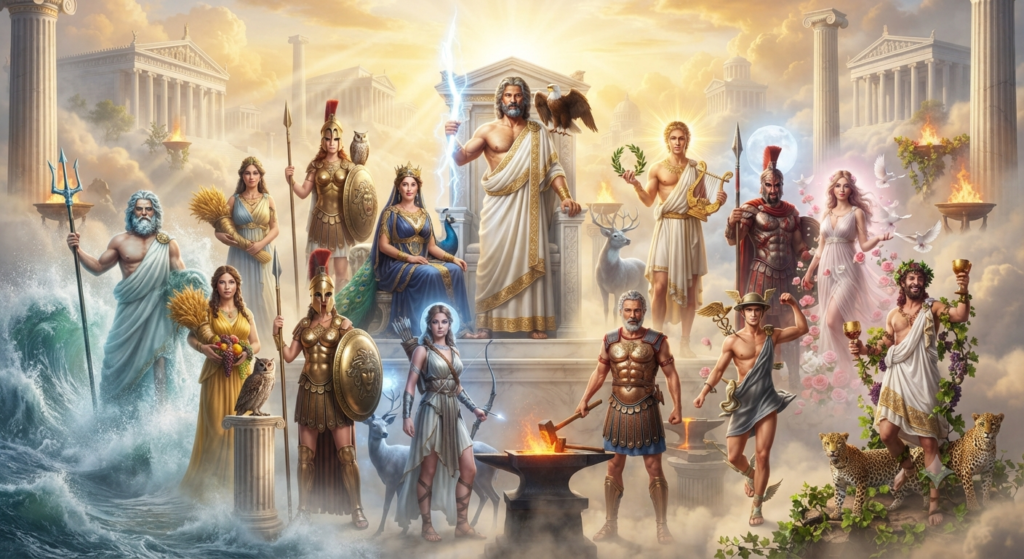
The canonical number of Olympian gods was twelve, but this number was not always fixed . The ancient Greeks, like many cultures, did not have a single, definitive list. Different city-states and time periods included or excluded certain deities . The twelve most universally acknowledged gods include: Zeus, Hera, Poseidon, Demeter, Athena, Apollo, Artemis, Ares, Aphrodite, Hephaestus, Hermes, and either Hestia or Dionysus .
The First Generation: Zeus and His Siblings
The core of the Olympian council consists of the first generation of Olympians, all children of the Titans Cronus and Rhea .
Zeus (Roman: Jupiter)
Zeus is the undisputed king of the gods and the ruler of Mount Olympus. He is the god of the sky, lightning, thunder, law, order, and justice . Zeus is the youngest child of Cronus and Rhea, and he is both the brother and husband of Hera . His symbols include the thunderbolt, eagle, oak tree, and bull . As the most powerful of the gods, he is a central figure in countless myths, known for his many affairs with goddesses and mortals alike .
Hera (Roman: Juno)
Hera is the Queen of the Gods and the goddess of marriage, women, childbirth, and family . She is the sister and wife of Zeus . Hera is often depicted as a majestic figure, and her symbols include the peacock, the cuckoo, and the cow . In myths, she is frequently portrayed as jealous and vengeful towards Zeus’s many lovers and their illegitimate children .
Poseidon (Roman: Neptune)
Poseidon is the god of the sea, water, storms, and earthquakes . He is the brother of Zeus and Hades . He is married to the Nereid Amphitrite . His symbols include the trident, the horse, and the bull . Poseidon was a powerful and often temperamental god, known for causing shipwrecks and earthquakes .
Demeter (Roman: Ceres)
Demeter is the goddess of the harvest, agriculture, fertility, grain, and the seasons . She is the middle daughter of Cronus and Rhea . Her symbols include the poppy, wheat, torch, and cornucopia . Demeter’s most famous myth is the abduction of her daughter Persephone by Hades, an event that she used to explain the cycle of the seasons .
Hestia: The Hearth and Home
Hestia (Roman: Vesta)
Hestia is the goddess of the hearth, fire, domesticity, and the family . She is the first child of Cronus and Rhea and the eldest sister of Zeus, Hades, and Poseidon . She is a virgin goddess and is often depicted as a gentle and modest figure . Her symbol is the hearth itself . Hestia was one of the original twelve Olympians but is sometimes omitted from lists to make room for Dionysus .
The Children of Zeus
The remaining Olympians are primarily the children of Zeus, born from various goddesses and mortals .
Athena (Roman: Minerva)
Athena is the goddess of wisdom, handicraft, and strategic warfare . She is the daughter of Zeus and the Oceanid Metis . According to myth, she was born fully grown and in full battle armor from Zeus’s head . Her symbols include the owl, the aegis, the olive tree, and the spear . Athena is a revered goddess known for her intelligence, strategic prowess, and status as a virgin deity .
Apollo (Roman: Apollo)
Apollo is the god of the sun, light, prophecy, philosophy, archery, truth, inspiration, poetry, music, arts, medicine, and plague . He is the son of Zeus and Leto and the twin brother of Artemis . His symbols include the bow and arrow, the lyre, the laurel wreath, and the raven . Apollo is one of the most complex and important gods, representing the ideal of harmony, moderation, and civilized life .
Artemis (Roman: Diana)
Artemis is the goddess of the hunt, the wilderness, virginity, the Moon, archery, childbirth, and protection of young animals . She is the daughter of Zeus and Leto and the twin sister of Apollo . Her symbols include the Moon, the bow and arrow, the deer, and the cypress tree . Artemis is a fierce and independent goddess, often depicted as a huntress roaming the wilds .
Ares (Roman: Mars)
Ares is the god of war, violence, bloodshed, and manly virtues . He is the son of Zeus and Hera . His symbols include the spear, the shield, the vulture, and the dog . Unlike Athena, who represents the strategic aspects of warfare, Ares embodies the chaotic, brutal, and destructive nature of battle . He was often disliked by the other gods .
Hephaestus (Roman: Vulcan)
Hephaestus is the master craftsman and blacksmith of the gods, the god of the forge, craftsmanship, invention, fire, and volcanoes . He is the son of Hera, either by Zeus or through parthenogenesis . He is married to Aphrodite . His symbols include fire, the anvil, the hammer, and the axe . Hephaestus was often depicted as lame but was highly respected for his skill in crafting divine weapons and armor .
Aphrodite (Roman: Venus)
Aphrodite is the goddess of love, pleasure, passion, procreation, fertility, beauty, and desire . According to one tradition, she was born from the sea foam after Cronus castrated Uranus and threw his genitals into the sea . In another, she is the daughter of Zeus and Dione . She is married to Hephaestus but had a well-known affair with Ares . Her symbols include the dove, the swan, the myrtle, the rose, and the golden apple .
Hermes (Roman: Mercury)
Hermes is the messenger of the gods, the god of travel, commerce, communication, borders, eloquence, diplomacy, thieves, and games . He is also the guide of dead souls to the underworld . He is the son of Zeus and the nymph Maia . His symbols include the caduceus, winged sandals and cap, and the tortoise (whose shell he used to invent the lyre) . Hermes is a clever and resourceful trickster god, known for his speed and eloquence .
Dionysus (Roman: Bacchus)
Dionysus is the god of wine, the grapevine, fertility, festivity, ecstasy, madness, and resurrection . He is also the patron god of the art of theatre . He is the son of Zeus and the mortal Theban princess Semele . His symbols include the grapevine, ivy, the cup, and the thyrsus (a staff topped with a pine cone) . Dionysus is unique among the Olympians as he has a mortal parent, and his worship involved ecstatic rituals and mystery cults .
The Exclusion of Hades
Although Hades is a major deity and the brother of Zeus and Poseidon, he is usually not considered one of the twelve Olympians . His realm, the Underworld, was far removed from Mount Olympus, and he was associated with chthonic (earth) deities rather than the celestial Olympians . However, in some traditions, he was considered a member of the Dodekatheon, which shows that the list was never strictly canonical .
Frequently Asked Questions About Who are the twelve Olympian gods?
Who are the twelve Olympian gods?
The twelve Olympian gods are the principal deities of the Greek pantheon. The most universally accepted list includes: Zeus, Hera, Poseidon, Demeter, Athena, Apollo, Artemis, Ares, Aphrodite, Hephaestus, Hermes, and either Dionysus or Hestia .
Why is Hades not one of the twelve Olympians?
Hades is the brother of Zeus and Poseidon, but he is not considered an Olympian because his domain is the Underworld, which is far removed from Mount Olympus. He also belongs to a different category of deities known as chthonic gods, who were associated with the earth and the dead .
What is the difference between the twelve Olympians and other Greek gods?
The twelve Olympians were the most important and powerful deities in the Greek pantheon. They resided on Mount Olympus and were the principal objects of worship. Other gods, such as Hades, Demeter’s daughter Persephone, and many minor gods, were also worshipped but were not part of this primary group .
Who are the Roman equivalents of the twelve Olympians?
The Romans identified the Greek gods with their own deities. The primary Roman equivalents are: Zeus (Jupiter), Hera (Juno), Poseidon (Neptune), Demeter (Ceres), Athena (Minerva), Apollo (Apollo), Artemis (Diana), Ares (Mars), Aphrodite (Venus), Hephaestus (Vulcan), Hermes (Mercury), and Dionysus (Bacchus) .
Why are there sometimes 13 Olympians?
The list of twelve Olympians was not strictly fixed. Hestia, the goddess of the hearth, was often included as one of the original twelve, but in later traditions, she was sometimes replaced by Dionysus to avoid having an unlucky thirteen deities. This created a total of thirteen distinct gods who have been considered Olympians at different times .
Conclusion
The Twelve Olympian gods represent the foundational figures of ancient Greek religion and mythology. They were not just abstract concepts but a divine family with human-like flaws, emotions, and relationships. They governed the natural world, human endeavor, and the cosmic order. The question of who are the twelve Olympian gods? reveals a complex and ever-so-slightly shifting pantheon that has profoundly influenced Western culture. From the thunder of Zeus to the wisdom of Athena, the love of Aphrodite, and the revelry of Dionysus, these gods continue to inspire art, literature, and thought, a testament to their enduring power.

Orin Vale has spent the better part of two decades tracing the threads that connect the world’s oldest stories — from the halls of Asgard to the banks of the Nile, from Olympus to the jungles of the Maya. What began as a childhood fascination with flood myths and trickster gods grew into years of independent study across comparative mythology and ancient religion, always chasing the same question: what did these stories mean to the people who first told them? Orin writes for readers who want more than trivia — the ones looking for the beliefs, fears, and truths that myths were built to carry.