The question of who are the major goddesses of Greek mythology? opens a door to a world of immense power, complexity, and enduring influence. The goddesses of ancient Greece were not mere supporting characters to the male gods; they were formidable, multifaceted deities who embodied the full spectrum of human experience—from love and wisdom to war, the harvest, and the very cycle of life and death . These divine figures were central to Greek religion, culture, and daily life, presiding over every aspect of existence and reflecting the values, anxieties, and aspirations of the ancient world. This article will serve as a definitive guide to the principal goddesses of the Greek pantheon, exploring their origins, their domains, their roles in myth, and their legacies.
The Twelve Olympians: The Core of the Pantheon
The major goddesses of Greek mythology were the female members of the Twelve Olympians, the principal gods who resided on Mount Olympus . This group represented the most powerful and influential deities of the Greek world, and their ranks included both the first-generation sisters of Zeus and his powerful daughters .
The First Generation: Zeus’s Sisters
The eldest goddesses were the sisters of Zeus, children of the Titans Cronus and Rhea. They were among the most ancient and revered figures in the Greek pantheon.
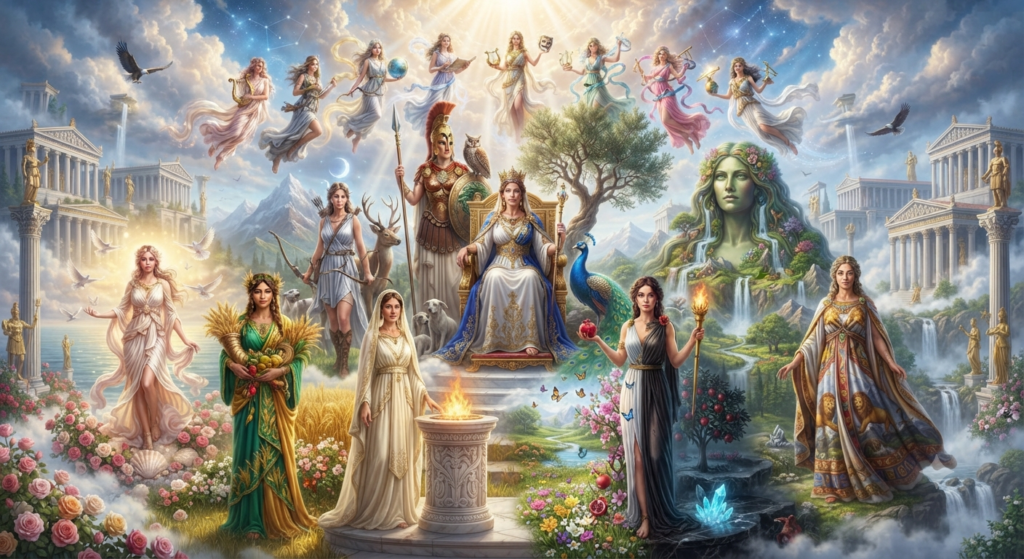
Hera was the Queen of the Gods, the goddess of marriage, women, childbirth, heirs, kings, and empires . As both the sister and wife of Zeus, she occupied a position of immense authority and prestige . Her symbols include the diadem, the lotus-tipped staff, the peacock, the heifer, and the cuckoo . She is often depicted as a regal, majestic woman in the prime of her life, wearing a veil and a high crown . In mythology, Hera is frequently portrayed as the jealous and vengeful wife of Zeus, punishing his many lovers and their illegitimate offspring, a reflection of her domain over marriage and legitimate birth .
Demeter was the goddess of grain, agriculture, harvest, growth, and nourishment . She was one of the central figures of Greek religion, as her power over the crops determined the fate of humanity . Her symbols include the cornucopia, wheat-ears, the winged serpent, and the lotus staff, and her sacred animals include pigs and snakes . She is depicted as a mature woman, often crowned and holding sheafs of wheat and a torch . Her most famous myth is the abduction of her daughter Persephone by Hades, an event that led to the creation of the seasons and the Eleusinian Mysteries, the most important religious rites of ancient Greece .
Hestia was the virgin goddess of the hearth, home, domesticity, and the family . She is the eldest daughter of Cronus and Rhea, a sister of Zeus, and one of the most gentle and revered figures in the pantheon . Her symbol is the hearth itself, and she is depicted as a modestly veiled woman . Hestia was one of the original twelve Olympians, though she was sometimes omitted in later lists to make room for Dionysus . She represents the stability and sanctity of the home, the center of family life .
The Second Generation: Zeus’s Daughters
The younger major goddesses were the daughters of Zeus, born from various unions with goddesses and mortals. They represented more specialized domains, including wisdom, love, the hunt, and the arts.
Athena was the goddess of reason, wisdom, intelligence, skill, peace, warfare (specifically strategy and skill), and handicrafts . She was born from the forehead of Zeus, fully grown and in battle armor, after he swallowed her pregnant mother, Metis . Athena was a special patron of heroes such as Odysseus and Heracles , and she gave her name to the city of Athens . Her symbols include the owl, the aegis, the olive tree, the spear, and the helmet . She is depicted as a beautiful, stern woman crowned with a crested helm, armed with shield and spear, and wearing the aegis . Athena represents strategic thinking, practical wisdom, and the well-ordered society .
Artemis was the virgin goddess of the hunt, wilderness, animals, the Moon, archery, childbirth, and the protection of young children . She was the daughter of Zeus and Leto, and the twin sister of Apollo . Her symbols include the bow and arrow, the deer, the cypress tree, and the moon . She is often depicted as a young woman wearing a short, knee-length chiton, a silver hunting bow and quiver, and accompanied by hunting dogs or deer . Artemis is a fierce and independent goddess, representing the wild, untamed aspects of nature and the inviolate maiden . She also had a powerful function as a goddess who brought sudden death to women with her arrows .
Aphrodite was the goddess of love, pleasure, passion, procreation, fertility, beauty, and desire . According to Hesiod, she was born from the sea foam created when Cronus castrated Uranus and threw his genitals into the sea . In Homer’s tradition, she was a daughter of Zeus and Dione . Her symbols include the magical girdle, myrtle, roses, the scallop shell, doves, and sparrows . She was married to Hephaestus but conducted a famous affair with Ares, with whom she had several children . In art, she is often depicted as a naked or semi-nude woman, especially after the 4th century BCE . Aphrodite represents the power of love, sexual attraction, and the irresistible force of desire, which could be both a blessing and a source of destruction .
Persephone is the goddess of spring and the Queen of the Underworld, the daughter of Demeter and Zeus . She is a central figure in the myth of the seasons and the Eleusinian Mysteries . Her symbols include the pomegranate, grain, torches, wheat, and the asphodelus . In art, she is depicted as a young woman, often in scenes of her abduction or reunion with her mother .
The Mothers and Muses
Beyond the Olympians, several other major goddesses held significant positions of power, influence, and worship.
Gaia was the primordial goddess of the Earth, the mother of all life . She was the ancestor of the Titans and the Olympians and a powerful, active force in the cosmos.
Rhea was the mother of the first generation of Olympians, the wife of Cronus, and a Titaness of motherhood and fertility .
The Muses, the nine daughters of Zeus and Mnemosyne, the goddess of memory, were the goddesses of the arts, literature, science, and inspiration . Their mother was so important that she gave birth to them after nine nights with Zeus .
Frequently Asked Questions About Who are the major goddesses of Greek mythology?
Who are the seven goddesses of Greek mythology?
The seven goddesses often identified as the central female figures are Hera, Athena, Artemis, Aphrodite, Demeter, Hestia, and Persephone. These are the most prominent and powerful goddesses in the Greek pantheon .
What is the most powerful goddess in Greek mythology?
Hera, as the Queen of the Gods, was incredibly powerful. However, “power” can be defined in different ways. In terms of sheer influence and authority, Hera and Athena were among the most powerful. Hera could even challenge Zeus. Athena was the goddess of wisdom and strategic warfare, making her a formidable force .
What do the major Greek goddesses represent?
The major goddesses represent fundamental aspects of life and human experience. Hera is marriage and domestic life; Athena is wisdom and civilization; Artemis is the wilderness and the hunt; Aphrodite is love and desire; Demeter is agriculture and the harvest; and Hestia is the home and family .
Who was the most beautiful Greek goddess?
Aphrodite was universally considered the most beautiful of all the goddesses . Her birth from sea foam established her as the ultimate symbol of beauty and desirability .
Who is the Greek goddess of love?
Aphrodite is the Greek goddess of love, pleasure, and beauty. She is the embodiment of erotic desire and romantic attraction .
Who is the Greek goddess of wisdom?
Athena is the Greek goddess of wisdom, reason, and strategic warfare. She was born from the head of Zeus, fully grown and armed, making her the personification of intelligence and wise counsel .
Who is the Greek goddess of the hunt?
Artemis is the Greek goddess of the hunt, the wilderness, wild animals, and the moon. She is a fierce and independent virgin goddess, often depicted as a huntress roaming the wilds .
Conclusion
The major goddesses of Greek mythology represent the full spectrum of the human experience, from the wisdom of Athena and the love of Aphrodite to the wrath of Hera and the nurturing power of Demeter. They are not merely a collection of stories but a profound reflection of the ancient Greek understanding of the world, society, and the human condition. As women, they were powerful, complex, and often contradictory figures, embodying the ideals and anxieties of a society that both revered and feared their immense power. Their influence has permeated Western culture, from language and literature to art and philosophy, making them an essential part of our shared cultural heritage. The goddesses of Olympus are not just figures of ancient myth; they are eternal symbols of the divine feminine.

Orin Vale has spent the better part of two decades tracing the threads that connect the world’s oldest stories — from the halls of Asgard to the banks of the Nile, from Olympus to the jungles of the Maya. What began as a childhood fascination with flood myths and trickster gods grew into years of independent study across comparative mythology and ancient religion, always chasing the same question: what did these stories mean to the people who first told them? Orin writes for readers who want more than trivia — the ones looking for the beliefs, fears, and truths that myths were built to carry.