In Homer’s Odyssey, the journey to the land of the dead, or Hades, stands as one of the most profound and influential episodes in all of Western literature. How is the land of the dead described in the Odyssey? It is depicted not as a realm of divine punishment or reward, but as a place of profound gloom, shadowy existence, and a pervasive sense of loss, where the spirits of the deceased lead a hollow, diminished existence. Unlike the later, more structured visions of the afterlife, Homer’s underworld is a geographically ambiguous and emotionally complex space. It is a place that Odysseus must visit to gain crucial knowledge from the prophet Teiresias, but it is also a mirror reflecting his deepest anxieties about mortality, heroism, and the very meaning of life . This article will explore the geography, the inhabitants, the key encounters, and the thematic significance of the Homeric Hades, revealing how this ancient vision of the afterlife continues to shape our understanding of death and the human condition.
Geography and the Journey to Hades
The description of the land of the dead in the Odyssey is notable for its practical yet murky geography. It is not a metaphysical realm but a physical location that one can reach by sailing, a detail that emphasizes the concrete, tangible nature of the Homeric world. Circe instructs Odysseus to sail across the river Oceanus, the great river that encircles the world, until he reaches a “desolate coast” . Here, on the shore of this primordial river, lies the grove of Persephone, the queen of the underworld, with its “tall black poplars” and “willows whose fruit dies young” .
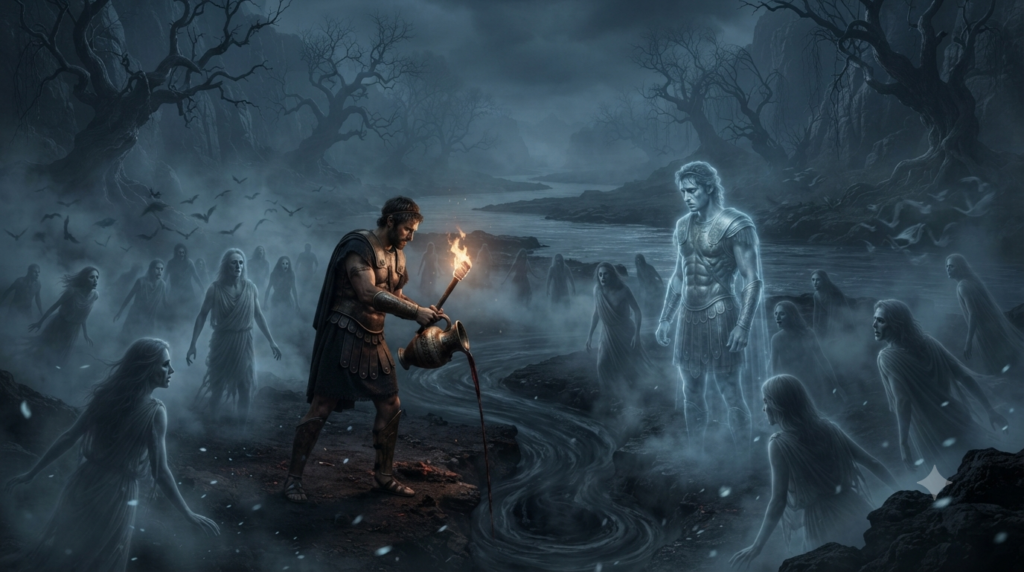
This location is further defined by the confluence of four rivers: Acheron, Pyriphlegethon, Cocytus, and Styx . These rivers are more than just topographical markers; they embody the emotional landscape of death. The Acheron is the “Flood of Grief,” Cocytus the “wailing River of Tears,” Pyriphlegethon the “torrent River of Fire,” and Styx the “Stream of Hate” . The very names evoke suffering and sorrow . Once Odysseus arrives at this desolate shore, he must perform a precise ritual: digging a trench, pouring libations of milk, honey, wine, and water, and sacrificing animals to attract the souls of the dead . The journey to Hades, therefore, is a physical voyage across the boundaries of the known world, culminating in a ritual that bridges the gap between the living and the dead.
The Condition of the Dead
Perhaps the most defining and somber aspect of how the land of the dead is described is the condition of its inhabitants. The dead are referred to as “shades” or “ghosts” (eidola), suggesting that they are mere images or shadows of their former selves . They are described as “drifting, listless spirits” who flit about with a purposeless, mechanical existence . In Book 24, the souls of the slain suitors are memorably compared to bats, “squeaking as bats will in a cavern’s underworld, all flitting, flitting criss-cross in the dark” . This simile perfectly captures their lack of agency and their ghostly, almost sub-human state.
Critically, these shades are incapable of consciousness or communication without a specific stimulus. To speak with them, Odysseus must allow them to drink the blood of his sacrifices . Only after tasting the life-giving blood do the shades regain a semblance of their former identity, recognition, and memory. This detail reinforces the idea that the dead are utterly powerless, their existence a pale echo of the vibrant, sentient life they once knew. The most famous statement on this existence comes from the ghost of Achilles, who famously declares to Odysseus that he would rather be a “poor country farmer who is alive than a glorious lord in the Underworld” . This poignant lament encapsulates the Greek dread of death as an annihilation of self, regardless of the glory one achieved in life.
Key Encounters in the Nekyia
The central episode of the land of the dead, known as the Nekyia (Book 11), is structured as a series of encounters between Odysseus and various shades, each revealing a different facet of the Homeric view of the afterlife.
Teiresias and Odysseus’s Mother
The primary purpose of Odysseus’s journey is to consult the prophet Teiresias, who will give him instructions on how to return home . However, before the prophet speaks, Odysseus is confronted by the ghost of his mother, Anticleia. Her appearance is a powerful emotional moment, as Odysseus was unaware of her death. When he tries to embrace her three times, she slips through his arms like a “shadow or a dream” . This scene demonstrates the finality and the tragic separation of death; no matter how strong the love, the living cannot hold onto the dead. Anticleia provides him with news of his family in Ithaca, grounding the fantastic journey in the reality of his home .
The Heroes of Troy
The meeting with the heroes of the Trojan War forms the dramatic core of the Hades episode. The encounter with Agamemnon, Achilles, and Ajax allows Homer to contrast different ideals of heroism and fate. Agamemnon’s ghost recounts his murder and warns Odysseus against the treachery of women, a pointed contrast to the fidelity of Penelope . The exchange with Achilles is the most famous of all. Despite the great honor he achieved in life, Achilles’s ghost is profoundly miserable, revealing the emptiness of even the most glorious death . He asks about his son, showing that even in death, the ties of family remain a powerful concern . Finally, the encounter with Ajax is one of silence and bitterness, as Ajax refuses to speak to Odysseus, nursing the grudge over the judgment of Achilles’s armor . This episode shows that the dead carry their earthly grievances with them, and there is no reconciliation in the underworld.
The Lack of Moral Judgment
A striking feature of the Homeric underworld is the absence of any system of moral judgment. Unlike the later Christian vision of Heaven and Hell, or even the Greek myths of Tartarus, the land of the dead in the Odyssey is a destination for everyone. There is no explicit punishment or reward based on the deeds of one’s life. As one scholar notes, “the great majority of shades had no ethical recompense; nothing awaited them but a dull, cheerless existence” . This lack of moral geography is a crucial point. It suggests that for Homer, the afterlife was not about justice but about the sheer, unavoidable fact of mortality.
The few exceptions to this rule—figures like Tityos, Tantalos, and Sisyphos, who are subjected to eternal torments—are not condemned for everyday sins but for direct and egregious offenses against the gods . Their punishment is not part of a universal judgment but a unique punishment for a unique transgression. This reinforces the idea that for the average person, death was the great leveler, a fate that stripped away all status and identity, leaving only a hollow shade to drift in the Asphodel Meadows.
The Poetic Function of Hades
Beyond the theological implications, the description of the land of the dead serves a vital poetic function in the Odyssey. The episode is a masterclass in providing an alternative perspective on the epic past . By allowing Odysseus to interview the dead heroes of Troy, Homer gives his audience access to a tradition not governed by the usual constraints of epic narrative. The shades speak from their own personal, subjective viewpoints, offering regret, self-pity, and a focus on intimate, emotional moments rather than objective glorification of the past .
Furthermore, the visit to Hades allows Odysseus to gauge his own standing in the world. The news from his mother grounds him in the reality of Ithaca, while his encounters with the heroes force him to reflect on his own identity and mortality . The episode creates a sense of doubt and anticipation about his return: will his wife be as faithful as he hopes, and will his son be worthy of his name? By confronting these anxieties in the land of the dead, Odysseus is ultimately better prepared to face the challenges of the living world.
Frequently Asked Questions About How is the land of the dead described in the Odyssey?
How did Odysseus reach the land of the dead?
Odysseus sailed to the land of the dead by crossing the river Oceanus. Circe instructed him to reach a “desolate coast” where the grove of Persephone was located, near the confluence of the rivers Acheron, Pyriphlegethon, Cocytus, and Styx .
Who does Odysseus meet in the Underworld?
During his visit, Odysseus meets several significant shades, including the prophet Teiresias, his mother Anticleia, and the Greek heroes Agamemnon, Achilles, and Ajax. He also sees other notable figures like Orion, Sisyphus, and Tantalus .
What is the condition of the dead in the Odyssey?
The dead are described as “shades” or “ghosts” who lead a listless, shadowy existence. They are powerless and lack consciousness unless they drink the blood of a sacrifice, which temporarily restores their memory and ability to speak. They are often depicted flitting aimlessly like bats .
What does Achilles say about being dead in the Odyssey?
Achilles tells Odysseus that he would rather be a poor, living farmer than a glorious king in the land of the dead. This statement powerfully expresses the Greek view that death, even with great honor, is ultimately a hollow and undesirable state .
Why did Odysseus go to the Underworld?
Odysseus visited the Underworld to consult the spirit of the blind prophet Teiresias, who could give him instructions on how to return home safely to Ithaca. He also sought to learn about the fate of his family and confront his own anxieties about death and heroism .
Does the Odyssey describe a “Hell” or place of punishment?
No, the Homeric underworld is not a place of punishment for the average soul. It is a universal destination for all the dead. While a few figures like Tityos and Tantalos are punished for specific offenses against the gods, there is no general system of moral judgment or eternal torment for ordinary people .
How does Odysseus speak to the dead?
To speak with the dead, Odysseus had to perform a specific ritual: he dug a trench and poured libations of milk, honey, wine, and water. He then sacrificed animals, and the shades were able to speak only after they drank the blood from the sacrifice .
What does the description of Hades reveal about Greek values?
The description of Hades reveals a deep Greek anxiety about mortality. The fact that even the greatest heroes become powerless and miserable in death underscores the importance of kleos (glory) in life, as it was the only way to achieve any kind of immortality. It also highlights the deep value placed on life itself, as death was seen as the ultimate loss of identity and self .
Conclusion
In conclusion, the description of the land of the dead in the Odyssey is far more than a simple geographical account of the afterlife. It is a profound poetic construction that explores the deepest fears and values of ancient Greek culture. How is the land of the dead described? It is a realm of mist and shadow, of flitting, powerless shades who yearn for the taste of life that has forever left them. Through the haunting encounters with his mother and the heroes of Troy, Homer constructs a powerful meditation on mortality, heroism, and the enduring bonds of family. The underworld serves as a crucial turning point in Odysseus’s journey, forcing him to confront the past and understand his place in the world, all while reminding the audience that the ultimate fate of even the greatest hero is to become a memory in the darkness. This vision of Hades has resonated for millennia, shaping how we conceive of death and the human struggle for meaning in the face of oblivion.

Orin Vale has spent the better part of two decades tracing the threads that connect the world’s oldest stories — from the halls of Asgard to the banks of the Nile, from Olympus to the jungles of the Maya. What began as a childhood fascination with flood myths and trickster gods grew into years of independent study across comparative mythology and ancient religion, always chasing the same question: what did these stories mean to the people who first told them? Orin writes for readers who want more than trivia — the ones looking for the beliefs, fears, and truths that myths were built to carry.