In Greek mythology, the origin of wine is a story of divine gift, tragic misunderstanding, and cultural transformation. What does Greek mythology say about the origin of wine? It attributes the discovery of the vine and the art of winemaking to Dionysus, the god of wine, fertility, and ecstasy. According to the myths, Dionysus did not merely preside over wine; he was its inventor, the divine figure who first extracted the intoxicating juice from grapes and shared this gift with humanity. This act was not a simple agricultural innovation but a profound cultural event, marking the beginning of viticulture, the establishment of the symposium as a social institution, and the integration of wine into religious ritual . The myths surrounding wine’s origin are deeply tied to the travels of Dionysus, his interactions with mortals, and the establishment of his cult, with the most famous Greek account involving a hospitable Athenian named Icarius, who received the vine from the god and whose tragic fate explains both the stars and a festival of the dead . This article will explore the central myths of wine’s discovery, the figures involved, and the cultural significance of this divine gift in the ancient Greek world.
Dionysus: The God Who Discovered Wine
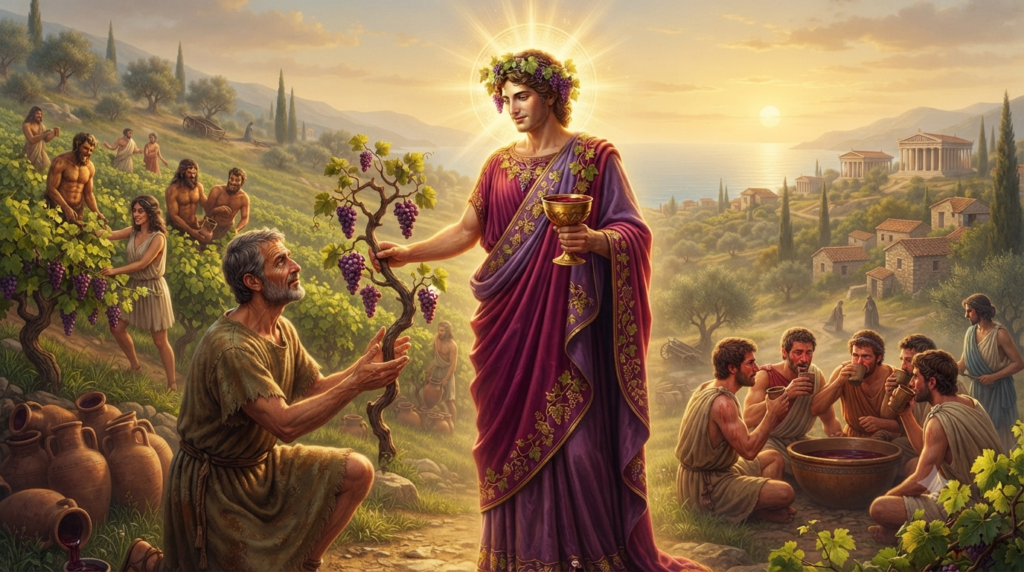
The central figure in the Greek mythological origin of wine is Dionysus himself. He is not merely the god who oversees wine; he is its creator. In the classical literary tradition, Dionysus is the “discoverer of the grapevine” . The fifth-century BCE playwright Euripides succinctly states that while Demeter gave the Greeks grain, it was Dionysos who introduced them to wine .
The myths surrounding Dionysus’s discovery of wine are numerous and vary in detail, but they consistently portray the act as a divine invention. According to one account, the young god, while playing with other children, would strike rocks with a fennel stalk, and from the wounds, “they poured for the god sweet liquor” . In another version, recounted by the Greek historian Diodorus Siculus, after being reared by the nymphs in Nysa, Dionysus “made the discovery of wine and taught mankind how to cultivate the vine” .
The most detailed account of the actual invention comes from the late Greek epic poet Nonnus. In his Dionysiaca, Nonnus describes Dionysus recalling a prophecy from the goddess Rhea. Acting on this prophecy, he dug into a rock, hollowed out a pit, and smoothed its sides to create a winepress, making the first-ever batch of wine . This act of creation established Dionysus’s reputation as the god of wine and made him a benefactor of humanity.
The discovery of wine was also intrinsically linked to Dionysus’s own divine birth. The god was the son of Zeus and the mortal princess Semele. When Semele was destroyed by the sight of Zeus’s divine glory, the god rescued the unborn child and sewed him into his own thigh until the infant was ready to be born, making Dionysus “twice-born” . This miraculous birth, often associated with the motif of “the god who comes,” is reflected in the myths of his arrival in various regions, where he brings the gift of the vine.
The Myth of Icarius: The First Winemaker
The most celebrated and tragic Greek myth concerning the origin of wine is the story of Icarius, also known as Ikarios . This myth, preserved by several ancient sources including the mythographer Apollodorus, the poet Hyginus, and the travel writer Pausanias, explains how wine was first introduced to Athens and the price paid for this divine gift.
According to the legend, Icarius was an Athenian man who lived during the reign of King Pandion. He offered hospitality to Dionysus when the god first arrived in Attica . To show his gratitude, Dionysus taught Icarius the art of viticulture—the cultivation of the vine—and gave him bags filled with the first wine . Icarius was eager to share the god’s boon with his countrymen.
Icarius set out in his chariot to distribute the wine to shepherds. The shepherds, never having tasted wine before, drank it greedily, and without diluting it with water as was the Greek custom. In their ignorance, they became deeply intoxicated and, believing they had been poisoned, they killed Icarius, throwing his body into a well or burying it under a tree .
The tragedy did not end there. Icarius’s daughter, Erigone, accompanied by her faithful dog Maera, searched for her father. When Maera discovered his buried body, Erigone, consumed by grief, hanged herself over his grave . When Dionysus learned of this, he was infuriated and punished Athens with a plague or a mania that caused all the unmarried women of the city to hang themselves as Erigone had done .
Eventually, the Athenians consulted an oracle to learn how to end the plague. The answer was to propitiate Erigone and her father. In their honor, the Athenians instituted a festival called the Aiora (meaning “the swing”) or Aletides. The bodies of Icarius and Erigone were never found, but the festival, in which girls swung on swings, was meant to appease their restless spirits. Fruits were offered as sacrifices to them, and the ritual marked the beginning of a new, more respectful relationship with the gift of wine .
Icarius, Erigone, and Maera were also placed among the stars by Zeus or Dionysus. Icarius became the constellation Boötes (or Arcturus), Erigone became the constellation Virgo, and Maera became the Dog Star, Sirius . This celestial apotheosis serves as a permanent reminder of this foundational myth.
The Spread of the Vine and Other Myths
While the story of Icarius is the most famous Athenian origin myth, other traditions describe Dionysus spreading the vine to other lands. The god’s wanderings, often associated with his madness, took him to Egypt and Syria, where he introduced the cultivation of the vine . The mythographer Apollodorus mentions that Dionysus, after being driven mad by Hera, wandered over Egypt and Syria, discovering the grapevine during his journey .
The myths often emphasize the foreign origins of wine and its introduction to Greece. Dionysus is depicted as arriving from the east or from Thrace, bringing with him the culture of the vine. This narrative reflects historical realities, as viticulture was likely introduced to the Aegean from regions in the Near East and Anatolia . The myth of Dionysus and Icarius, set in the Attic deme of Icaria, served to localize the god’s gift to the city of Athens and to establish a claim to being the birthplace of Greek winemaking.
Another tradition, though less prominent, connects the origin of wine to the figure of Orestes, but through a different cultural lens. In the myth of the Anthesteria, an ancient Athenian festival, the second day was known as Choes, or “Wine Jugs.” According to the myth, when the polluted Orestes arrived in Athens after killing his mother, he was given a separate table and his own individual wine jug to drink from in silence to avoid contaminating others. This custom became the basis for a unique drinking competition held during the festival, where participants raced to drain their jugs of wine . This myth links the ritual consumption of wine not to its origin but to a specific social practice and the concept of pollution and purification.
Wine in Greek Cult and Ritual
The divine origin of wine was celebrated throughout the Greek world in both public and private cult. Dionysus was not just a god of wine; he was, in a sense, present in the wine itself. As Euripides wrote, “Himself a god, he is poured out in libations to the gods, and so it is because of him that men win blessings from them” . Wine was an essential component of almost every sacrifice, and wineless libations were extremely rare .
The festival of the Anthesteria, held in Athens during the month of Anthesterion (February-March), celebrated both the maturing of the wine and the appeasement of the dead. On the first day, Pithoigia (“Jar Opening”), the storage jars of wine were opened and libations were offered to Dionysus . The second day, Choes (“Wine Jugs”), was a day of popular merrymaking and a drinking contest, presided over by the Archon Basileus . The third day, Chytroi (“Pots”), was a festival for the dead, on which pots of seed or food were offered to the spirits of the deceased .
These rituals highlight the dual nature of wine in the Greek imagination. It was a divine gift that brought joy, social cohesion, and a connection to the gods, but it was also a powerful and potentially dangerous substance. The myth of Icarius serves as a cautionary tale, illustrating the consequences of misusing or misunderstanding the divine gift. The connection between the Anthesteria and the dead also reveals a deeper link between wine, the cycle of life and death, and the mystery of fertility.
Frequently Asked Questions About What does Greek mythology say about the origin of wine?
Who invented wine in Greek mythology?
In Greek mythology, wine was invented by Dionysus, the god of wine, fertility, and ecstasy. According to myth, Dionysus discovered the grapevine and was the first to make wine. He then taught this art to mortals, most famously to the Athenian Icarius, who received the vine as a gift from the god .
What is the story of Dionysus and Icarius?
The story of Dionysus and Icarius is the most famous Greek myth about the origin of wine. Icarius, an Athenian, welcomed Dionysus and was rewarded with the vine and the knowledge of winemaking. When he shared the wine with some shepherds, they became intoxicated and, thinking they had been poisoned, killed him. His daughter Erigone died of grief, and their tragic fates were commemorated by the Athenians .
Who was Erigone in the wine myth?
Erigone was the daughter of Icarius. After her father was murdered by drunken shepherds, she searched for him with her dog Maera. Upon finding his body, she was overcome with grief and hanged herself. Zeus or Dionysus placed her among the stars as the constellation Virgo. The Athenians later honored her with a festival to end a plague the god sent in his anger .
What does the myth of Icarius explain?
The myth of Icarius serves as an aetiological (origin) story for several Greek cultural practices. It explains the origin of the constellation Boötes (Icarius), Virgo (Erigone), and Sirius (Maera). It also explains the origin of a festival called the Aiora, during which Athenian girls swung on swings to honor Erigone and end a plague .
How did Dionysus discover wine?
According to Nonnus’s Dionysiaca, Dionysus made the first wine by recalling a prophecy from Rhea. He dug into a rock and hollowed out a pit to create a winepress . Other myths say he simply struck rocks with a fennel stalk, and wine flowed from them, or that he discovered the grapevine during his wanderings in Egypt and Syria .
What is the myth of the Anthesteria festival?
The Anthesteria was an Athenian festival celebrating wine. The second day, Choes, involved a drinking contest where participants drank from individual jugs in silence. This practice was said to commemorate the time when the polluted Orestes was given his own wine jug to drink from in isolation, as the Athenians feared his curse .
Is there a Roman version of the myth of wine’s origin?
The Roman equivalent of Dionysus is Bacchus. While the Romans adopted the Greek myths, they also had their own legends, such as the story of the chaste butler Cato, who got the goddess Venus drunk on wine. In Roman culture, Bacchus was often celebrated as the god who brought the gift of viticulture to Italy .
What was the cultural significance of wine in ancient Greece?
Wine was an essential part of ancient Greek culture. It was used in libations to the gods, central to the symposium (the formal male drinking party), and considered a staple of daily life. The myths surrounding its origin, such as the story of Icarius, served to legitimize its place in Greek society and to caution against the dangers of overindulgence .
Conclusion
In summary, Greek mythology presents the origin of wine as a divine gift from Dionysus, a gift that was both a blessing and a potential curse. The myths, particularly the tragic story of Icarius, weave together the themes of hospitality, divine reward, human ignorance, and cultural memory. Wine was not simply a beverage; it was a sacred substance that connected mortals to the gods, formed the basis of social rituals, and became the lifeblood of the Mediterranean economy. The legacy of these origin myths, from the constellation of the dog star to the echoing shouts of the Bacchic cult, continues to remind us of the profound and enduring power of wine in the human story. The tragedy of Icarius and Erigone, as much as the joyous festivals in Dionysus’s honor, shaped the way the ancient Greeks understood and valued the vine.

Orin Vale has spent the better part of two decades tracing the threads that connect the world’s oldest stories — from the halls of Asgard to the banks of the Nile, from Olympus to the jungles of the Maya. What began as a childhood fascination with flood myths and trickster gods grew into years of independent study across comparative mythology and ancient religion, always chasing the same question: what did these stories mean to the people who first told them? Orin writes for readers who want more than trivia — the ones looking for the beliefs, fears, and truths that myths were built to carry.