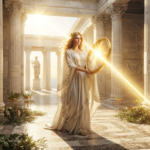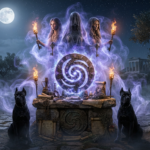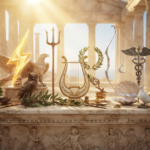
In the intricate cosmology of ancient Greece, the world was not only populated by the great Olympian gods and the chthonic deities of the underworld, but also by a vast and diverse population of lesser divine beings known as daimones. What are the personified spirits (daimones) of Greek mythology? They were a multitude of intermediary spirits, often invisible, who inhabited the air, the earth, the sea, and the underworld . These daimones were the personifications of abstract concepts, human emotions, and the forces of nature, ranging from the benevolent guardians of justice to the malevolent bringers of disease and strife . Unlike the Judeo-Christian concept of a demon as an evil entity, the Greek daimon was a morally ambivalent being, a “supernatural spirit” that could be either good or bad . They were the divine agents that bridged the gap between the immortal gods and mortal humans, interpreting prayers, dispensing fate, and shaping the very fabric of human experience. This article will explore the origins, classifications, and profound cultural significance of these personified spirits, from Hesiod’s Golden Age guardians to the personal guides of philosophers like Socrates.
Origins and Definition of Daimones
The concept of the daimon is deeply rooted in the earliest strata of Greek thought. The word daimon (δαίμων) is thought to derive from the Proto-Indo-European root *da-*, meaning “to divide” or “to distribute,” suggesting a being that apportions destinies or fortunes . In the works of Homer, the terms for gods (theoi) and daimones were used almost interchangeably, though the daimon was often seen as a more ambiguous, unspecified divine power that could bring sudden and inexplicable fortune or misfortune .
It was the poet Hesiod, in the 8th century BCE, who provided the most influential and definitive origin for the daimones. He recounted how the men of the Golden Age, a race of mortals who lived in the time of Cronus, were transformed after their deaths into benevolent spirits. According to Hesiod, these 30,000 daimones were appointed by Zeus to roam the earth, invisible and clothed in mist, to act as “guardians of mortal men,” keeping watch over judgments and rewarding justice with agricultural bounty . These “Pure Spirits” (Daimones Hagnoi) were the original, archetypal daimones, distinct from the later, more specialized personifications .
The Nature and Role of Personified Spirits
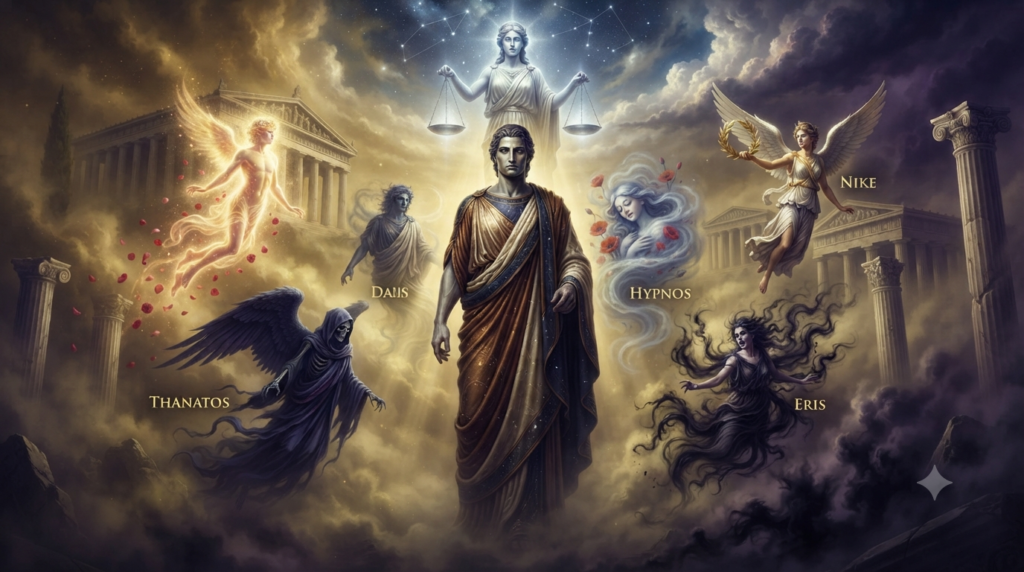
The defining characteristic of the Greek daimones was their role as personifications of abstract ideas . Unlike the complex, anthropomorphic gods of Olympus, the daimones were often one-dimensional, defined solely by the concept they embodied. Their names were simply capitalized nouns: Eros (Love), Thanatos (Death), Hypnos (Sleep), Nike (Victory), and Eris (Strife) . This personification made them direct representations of the forces that shaped human life, from the profound (Love and Death) to the mundane (Toil and Starvation) .
A key aspect of their nature was that they were not bound by a single morality. They were, in the words of Plato, “between divine and mortal,” acting as intermediaries and interpreters . They could be agents of the gods’ will, both good and bad. As such, the Greeks divided them into two broad categories: the agathodaemones (good spirits) and the kakodaemones (evil spirits) . The agathodaemones were seen as bringers of luck, protection, and bounty, while the kakodaemones were sources of misfortune, disease, and strife. This division is perhaps most famously illustrated by Pandora’s jar, from which a host of malevolent daimones like the Nosoi (plagues) and the Algea (pains) escaped to plague mankind .
Classification of Daimones
The personified spirits of Greek mythology can be broadly classified into several categories, reflecting the diverse aspects of the cosmos and human experience they governed .
Emotions and States of Mind
Many daimones were the direct personifications of human emotions and psychological states. Eris was the embodiment of Strife and Discord, and Hesiod describes her as the mother of a host of other malevolent spirits, including Ponos (Toil), Lethe (Forgetfulness), Limos (Starvation), and the Algea (Pains) . Other prominent figures include:
These spirits represented the inner life of mortals, the emotional forces that drove action and shaped destiny.
The Human Condition and Actions
Another major class of daimones represented the universal aspects of human existence. This includes spirits of:
- Birth and Death: Thanatos (Death), the Keres (violent death), and the spirits of Fate .
- Sleep and Dreams: Hypnos (Sleep) and the Oneiroi (Dreams) .
- Labor and Toil: Ponos (Toil) .
- Warfare: The Makhai (Battles), the Phonoi (Murders), and the Androktasiai (Manslaughters) were all spawned by Eris to accompany armies on the battlefield .
Morality and Society
The daimones also served as guardians of social order and morality. They embodied virtues and vices that were essential to Greek civic life . This category includes:
- Dike (Justice) and Themis (Divine Law)
- Eunomia (Good Order)
- Dysnomia (Lawlessness)
- Ate (Ruin and Delusion)
- Horkos (Oath) – the spirit who punished those who broke their oaths .
Specialized and Minor Daimones
Beyond the major personifications, there were countless specialized spirits. The Daimones Khryseoi (Golden Spirits) were the 30,000 celestial guardians from Hesiod’s Golden Age . In contrast, the Daimones Argyreoi (Silver Spirits) were the souls of the men of the Silver Age, who were turned into underground spirits responsible for the earth’s fertility . There were also the Daemones Ceramici, five malevolent spirits who plagued potters, with names like Sýntrips (“the smasher”) and Smaragos (“the crasher”) . Even the crafts had their own daimones, highlighting how deeply these spirits were integrated into every aspect of Greek life.
Daimones in Philosophy and the Personal Spirit
The concept of the daimon evolved significantly in Greek philosophy, particularly in the works of Plato. In his Symposium, Plato describes Eros not as a god, but as a “great daimon,” a mediator that “interprets and transports human things to the gods and divine things to men” . This established the philosophical role of the daimon as an intermediary being.
However, the most famous philosophical concept is Socrates’ “daimonion.” In his Apology, Socrates describes a divine sign—a voice that came to him—that served as a warning, preventing him from making mistakes but never instructing him on what to do . This was not an external god but an internal, personal daimon, a form of spiritual guidance or innate moral compass. This idea was extended to the general concept of a personal, guiding daimon, a spirit that was assigned to each individual at birth and acted as their guardian or genius, a concept the Romans later adopted as their genius .
Frequently Asked Questions About What are the personified spirits (daimones) of Greek mythology?
What is the difference between a daimon and a god?
While Homer often uses the terms interchangeably, later Greek thought distinguished them. Gods were specific, named Olympian deities with complex personalities. Daimones were more general, abstract, and often unnamed supernatural forces or spirits, acting as intermediaries between gods and men . A daimon was often a personification of a concept, such as Love or Death .
Were Greek daimones evil?
Not inherently. The Greek daimon was morally ambivalent. They were divided into the agathodaemones (good spirits) that brought blessings and protection, and the kakodaemones (evil spirits) that brought misfortune, disease, and strife . This is a key difference from the Christian concept of a demon, which is always evil .
Who were the parents of the daimones?
Many of the personified daimones were the offspring of Nyx (Night) or Eris (Strife), with no father, as described in Hesiod’s Theogony . For example, Eris gave birth to Ponos (Toil), Lethe (Forgetfulness), and the Algea (Pains). However, some, like the Golden Spirits of the Golden Age, were transformed from a previous race of mortals .
What is a personal daimon in Greek philosophy?
A personal daimon is a concept where a spirit guides or watches over a specific individual from birth . This idea is most famously associated with Socrates, who spoke of his daimonion, a divine sign that warned him against mistakes. The philosopher Plato also wrote that a daimon was assigned to a person at birth .
What is the connection between Pandora and daimones?
According to the myth, when Pandora opened the jar (or box) containing all the evils of the world, she released a host of malevolent daimones. These included the Nosoi (plagues), the Algea (pains), and other misfortunes that have plagued humanity ever since .
Are nymphs and satyrs considered daimones?
Yes, in the broadest sense. Nymphs and satyrs were nature spirits and are often classified as types of daimones . They were lesser divinities of the natural world, fitting the definition of spirits that inhabited specific places or natural phenomena.
What are the three main categories of daimones?
Theoi.com, a comprehensive encyclopedia of Greek mythology, categorizes the daimones into three main groups: 1) Emotions and states of mind, 2) The human condition, and 3) Qualities and morality .
What does the word “eudaimonia” mean in relation to daimones?
The Greek word eudaimonia literally means “having a good daimon.” It was originally a state of being under the protection of a good spirit. Over time, it evolved to mean well-being, prosperity, and happiness .
Conclusion
In conclusion, the personified spirits of Greek mythology, the daimones, represent a vital and often underappreciated component of the ancient Greek cosmos. They were not the grand, flawed gods of Olympus, nor the distant, moral deities of later religions, but the immediate, tangible forces that shaped the human experience. From the 30,000 guardians of Hesiod’s Golden Age to the internal voice of Socrates and the abstract personifications like Eris and Thanatos, the daimones filled the space between heaven and earth, mediating divine will and human fate. Their legacy is profound, influencing not only the religious and philosophical thought of antiquity but also the very language we use today. The concept of a personal guiding spirit and the moral ambiguity of supernatural forces continue to resonate in literature and philosophy, demonstrating that these ancient spirits, born from the Greek need to explain the world, still hold a place in our cultural memory.

Orin Vale has spent the better part of two decades tracing the threads that connect the world’s oldest stories — from the halls of Asgard to the banks of the Nile, from Olympus to the jungles of the Maya. What began as a childhood fascination with flood myths and trickster gods grew into years of independent study across comparative mythology and ancient religion, always chasing the same question: what did these stories mean to the people who first told them? Orin writes for readers who want more than trivia — the ones looking for the beliefs, fears, and truths that myths were built to carry.