The Orphic Hymn to Hecate is a short but powerful devotional poem from the Orphic Hymns, a collection of Greek hymns likely used in ritual contexts in late antiquity. It addresses Hecate, the goddess of crossroads, night, torches, ghosts, the threshold between worlds, and the hidden powers that move beneath ordinary sight. What the hymn says, in essence, is that Hecate is vast in reach and dangerous in authority, yet also gracious when properly honored. It presents her not as a minor figure at the margins of myth, but as a cosmic presence who can guard, reveal, and transform.
Orphic Hymn to Hecate and its sacred voice
The hymn speaks in the language of reverence rather than narrative. Unlike epic stories that recount an adventure or a birth, it praises Hecate through epithets, divine functions, and requests for favor. This style is typical of Greek hymnic poetry: the god is named, honored through sacred titles, and invited to respond. In the Orphic tradition, such speech was believed to carry ritual force, especially when connected with purification, mystery, and specialized worship.
Hecate’s hymn is sacred precisely because it does not try to domesticate her. It acknowledges her as a goddess who moves between realms and whose power reaches beyond a single sphere. The poem’s tone is solemn and charged, fitting a deity associated with liminal spaces and occult knowledge. In that sense, the hymn does more than praise Hecate; it enacts the kind of careful approach she demands.
What the hymn says about Hecate’s powers
The hymn describes Hecate as a goddess with wide sovereignty, linked to the earth, the sea, and the heavens. It presents her as a being whose influence touches the whole cosmos, not merely one corner of it. This is important, because in many Greek sources Hecate is associated with boundaries and crossings, yet here she is also imagined as universal in reach. The hymn therefore elevates her from a specialized goddess of thresholds to a power with cosmic scope.
It also emphasizes her role as a helper and protector. Hecate can bring blessings, strengthen life, and favor those who honor her correctly. At the same time, her power is formidable; she is not a figure to be treated lightly. Classical religion often held that divine power could be both beneficent and severe, and the hymn reflects that balance clearly.
Torch-bearing Hecate at the crossroads
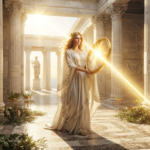
One of Hecate’s best-known images is that of the torch-bearing goddess standing at the crossroads. The Orphic Hymn preserves this identity through its attention to light, guidance, and movement through dark places. Torchlight here is not decoration. It symbolizes direction in uncertainty, especially where paths divide and choices must be made. Hecate is the one who sees where others cannot.
Crossroads were especially significant in Greek religion because they marked places of transition and ambiguity. They were neither fully here nor there, and for that reason they belonged to deities associated with thresholds. Hecate’s presence at such sites made her a guardian of passage and a mediator between spaces. The hymn’s praise of her reflects this deep ritual logic: she is invoked where movement, risk, and transformation meet.
Night, ghosts, and the goddess of threshold
The hymn also places Hecate in the realm of night and spirits. Ancient Greek tradition often connected her with ghosts, restless dead, and uncanny presences, especially in places outside the order of the household and the city. The hymn does not sensationalize this association, but it does acknowledge her authority over the darker and less visible aspects of the world. She belongs to the edges where the living and the dead may come close.
As a threshold goddess, Hecate is not simply a figure of fear. Thresholds are places of passage, and passage can mean protection, initiation, or return as well as danger. The hymn captures this ambiguity. Hecate governs the places where identity is unsettled, where one form gives way to another, and where sacred knowledge may be encountered only through darkness.
Hecate’s rule over earth, sea, and sky
A striking feature of the hymn is its expansive vision of Hecate’s domain. Rather than limiting her to night or the underworld, it describes her influence across earth, sea, and sky. This cosmic range distinguishes the Orphic portrait from narrower local cult images. It suggests a goddess who participates in the structure of the universe itself, moving through all levels of existence.
This wider sovereignty may reflect the theological tendencies of Orphic and later Greek religiosity, where divine figures were often given elevated and more universal roles. Hecate’s reach over the natural world makes her more than a guardian of boundaries; she becomes a power who connects them. The hymn’s language implies that her presence is not confined to one location, because her authority extends wherever divine order touches the world.
Keys, dogs, and the rites of the underworld
Keys are among Hecate’s most enduring symbols, and the Orphic Hymn belongs to the tradition that associates her with opening and closing hidden realms. A key suggests access, permission, and control over what lies behind a boundary. In Hecate’s case, this often includes the gateways between life and death, or between ordinary awareness and secret knowledge. She is the keeper of passage.
Dogs, too, belong to her sacred sphere. In Greek religion, dogs could accompany chthonic powers and were sometimes linked to rituals of purification or warning. Hecate’s association with dogs reinforces her connection to the underworld and to the margins of settled life. The hymn’s imagery gathers these signs together, presenting a goddess whose rites are bound to night paths, concealed doors, and the solemn business of the dead.
The hymn’s prayers for favor and protection
The Orphic Hymn is not only descriptive; it is petitionary. It asks Hecate for goodwill, protection, and favorable influence. This is typical of Greek hymnic prayer, where praise prepares the way for request. The worshipper honors the deity by naming her powers accurately, then seeks a response shaped by reciprocity. The hymn therefore reflects a religious world in which divine favor is earned through correct address and reverent memory.
Protection is especially important in Hecate’s case. A goddess who rules thresholds can also shield those who cross them. The hymn suggests that her power can be turned toward safety, guidance, and relief from danger. Rather than depicting Hecate as merely a source of dread, it recognizes her as a goddess whose blessing is needed precisely because she stands near the forces that can unsettle human life.
Hecate in Orphic worship and mystery cults
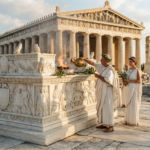
The Orphic Hymns are usually connected with ritual practice rather than public civic worship alone. Their language suggests private or semi-private devotion, perhaps linked to initiatory settings and mystery-oriented religion. In that world, Hecate was especially suited to a role as a guide through hidden or transitional states. Her power over crossings made her a natural figure for rites concerned with purification, the soul, and sacred transformation.
Ancient sources do not give one single, fixed account of Orphic worship, and scholars continue to debate the exact ritual use of the hymns. Still, the overall picture is clear enough: these poems belong to a religious environment that valued symbolic language, divine intermediaries, and careful attention to sacred names. Hecate’s hymn fits that world closely, presenting her as a goddess whose mystery is not accidental but essential.
Reading the hymn beside Greek divine epithets
Greek religion often names gods through epithets that highlight a particular power, place, or function. Hecate’s hymn is full of this style, even when it is translated into English prose. It speaks of her in terms that recall her many roles: torch-bearing, cosmic, night-wandering, guardian, and chthonic. Such language does not reduce her to one identity. Instead, it gathers multiple aspects into a single act of praise.
This is one reason the hymn remains valuable for understanding Greek divine thought. It shows how a goddess could be both local and universal, feared and trusted, dark and protective. The epithets do not contradict one another; they build a fuller image of divinity. To read the hymn beside Greek religious poetry more broadly is to see how carefully the ancient world shaped divine presence through names, functions, and ritual speech.
Why the Orphic Hymn to Hecate endures
The hymn endures because it captures Hecate at her most powerful and most complete. It preserves the ancient sense that she belongs to the places where the world changes shape: roads dividing in the dark, doors opening, souls passing, and hidden things coming into view. Even stripped of its ritual setting, the poem still feels charged with solemnity and movement. It offers not just a portrait of a goddess, but a vision of sacred boundary itself.
For modern readers, the Orphic Hymn to Hecate remains compelling because it reveals how the Greeks could speak of divine power without flattening its mystery. Hecate appears here as a goddess of breadth, depth, and passage, one who stands at the edge of what can be safely known. The hymn’s language is ancient, but its force is immediate: it describes a presence that guards the threshold while belonging to what lies beyond it.
The Orphic Hymn to Hecate says that she is a goddess of wide authority, sacred light, liminal power, and protective favor. It honors her as a ruler of earth, sea, sky, crossroads, ghosts, and the hidden passages between worlds. In doing so, the hymn preserves one of the clearest ancient portraits of Hecate: not merely as a figure of darkness, but as a divine guide through it.

Orin Vale has spent the better part of two decades tracing the threads that connect the world’s oldest stories — from the halls of Asgard to the banks of the Nile, from Olympus to the jungles of the Maya. What began as a childhood fascination with flood myths and trickster gods grew into years of independent study across comparative mythology and ancient religion, always chasing the same question: what did these stories mean to the people who first told them? Orin writes for readers who want more than trivia — the ones looking for the beliefs, fears, and truths that myths were built to carry.