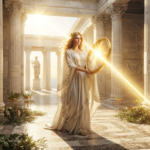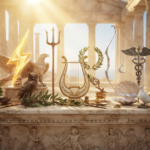
The twelve Olympian gods are the best-known group of deities in Greek mythology, though the number is not fixed with complete consistency in ancient sources. In the broad classical tradition, they are the principal gods associated with Mount Olympus, the divine center of Greek religious imagination, where cosmic authority, family ties, and rivalry were woven together into one enduring pantheon. Their stories appear in epic poetry, hymns, tragedy, and local cult, giving them both a mythic grandeur and a lived religious presence across the Greek world.
The Twelve Olympians in Greek Myth and Cult
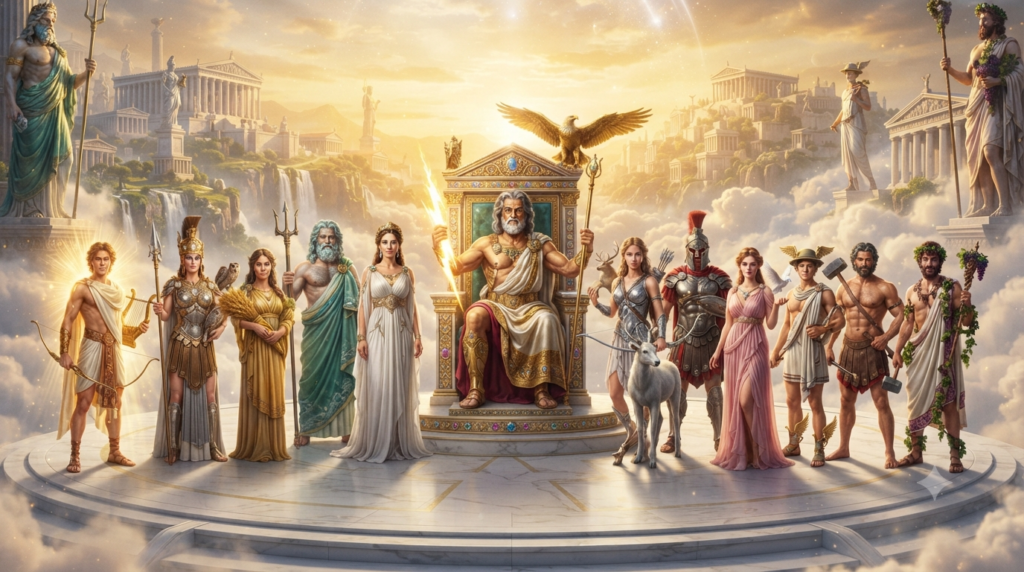
In Greek tradition, the Olympians were not simply twelve gods chosen by a single rulebook. The list varied from author to author and from city to city, though Zeus, Hera, Poseidon, Demeter, Athena, Apollo, Artemis, Ares, Aphrodite, Hephaestus, Hermes, and either Hestia or Dionysus commonly formed the group. Ancient sources such as Homer, Hesiod, and later mythographers preserve this flexibility, which reflects the way Greek religion balanced shared identity with local custom.
As a category, the Twelve Olympians represented the highest tier of divine power in the Greek imagination. They were contrasted with the chthonic gods of the underworld, the old cosmic powers of the earlier generation, and the numerous local deities worshipped in smaller sanctuaries. Yet the Olympians were never distant abstractions alone; they were worshipped through sacrifice, prayer, festivals, and temples, making myth and cult inseparable in Greek life.
Zeus, Hera, and the Rule of Mount Olympus
Zeus stands at the center of the Olympian order as king of the gods, ruler of sky and storm, and enforcer of oaths and hospitality. In Hesiod’s Theogony, he emerges victorious after the war against the Titans and secures his sovereignty over gods and mortals alike. His thunderbolt symbolizes not just force, but legitimate authority, a power that preserves order while remaining deeply personal and often unpredictable in myth.
Hera, his consort, is queen of the gods and goddess of marriage, lawful union, and the household. Homer and later tradition portray her as majestic, proud, and often bitterly opposed to Zeus’s many affairs, a tension that gives their divine marriage much of its dramatic force. Together they represent kingship and queenship on Olympus, but not a simple harmony; their relationship embodies the complexity of authority, kinship, and power in Greek myth.
Poseidon, Demeter, and the Older Divine Order
Poseidon, god of the sea, earthquakes, and horses, belongs to the same high divine generation as Zeus and Hera, yet his domains preserve a sense of an older, wilder order. In Homer, he is a formidable and sometimes resentful deity, ruling the shifting sea with force and dignity. His power touches the foundations of the world, reminding readers that Greek cosmology was never only about the sky and the city, but also about unstable natural forces.
Demeter, goddess of grain and fertility, likewise carries the memory of an older sacred world rooted in cultivation, seasonal loss, and return. Her most famous myth, the abduction of Persephone as preserved in the Homeric Hymn to Demeter, explains the rhythm of growth and barrenness and underlies the Eleusinian Mysteries, one of the most important cults in Greece. In the Olympian company, Demeter stands near the heart of human survival, linking divine power to agriculture and the cycle of life.
Athena, Apollo, and Artemis in the Pantheon
Athena is one of the most distinctive Olympians: a goddess of wisdom, strategy, craft, and just war, born in myth from Zeus himself. In Homer and later literature, she appears as a protective, deliberate, and intellectually commanding deity, especially favored by Athens. Her role shows that Greek religion did not reduce divinity to raw force; intelligence, planning, and civic order were equally sacred forms of power.
Apollo and Artemis, the twin children of Zeus and Leto, form another major axis of the pantheon. Apollo is associated with prophecy, healing, music, purification, and archery, while Artemis governs the wilderness, the hunt, young life, and the transitions of girls and women. Their cults were widespread and ancient, and their myths often place them at the border between civilization and untamed nature, where restraint and sudden divine intervention meet.
Ares, Aphrodite, and the Powers of Passion
Ares embodies the violence of battle, not the disciplined ideals of warfare. In Homer, he is fierce but often less admirable than Athena, representing bloodshed, terror, and the chaotic force of combat rather than strategy or honor. His place among the Olympians shows that Greek myth recognized war as a divine reality, but not necessarily a noble one.
Aphrodite, by contrast, governs desire, attraction, and sexual power, a force that can bring union or disorder. In the Iliad and later tradition, she is born from Zeus and Dione in some versions, while Hesiod gives the famous account of her arising from the sea foam after Uranus’s mutilation. Her affair with Ares, and the consequences that follow in myth, reveal how the Greeks understood desire as potent, beautiful, and never entirely under human control.
Hephaestus and Hermes as Craftsman and Herald
Hephaestus is the divine craftsman, associated with fire, metalworking, and the making of marvelous objects. Ancient poetry presents him as both skilled and physically impaired, a figure whose limping form contrasts with the perfection of his creations. His workshop imagery gives the Olympian world a material dimension: the gods do not only rule; they make, shape, and forge.
Hermes serves as herald, messenger, guide of travelers, patron of exchanges, and liminal god of crossings. He moves between worlds with ease, carrying messages for Zeus and escorting souls in later tradition. In myth, he is clever, mobile, and often improvisational, a deity suited to boundaries, speech, trade, and deception, all of which made him essential to Greek daily life and ritual practice.
Hestia or Dionysus in the Olympian Twelve
Hestia, goddess of the hearth, is sometimes included among the Twelve and sometimes replaced by Dionysus in later enumerations. Her place in the household and civic center made her one of the quietest yet most important deities in Greek religion. Though fewer myths focus on her, her role was fundamental: the hearth was a sacred point of continuity, kinship, and domestic stability.
Dionysus, when included among the Twelve, brings a different kind of divine force: wine, ecstasy, theater, fertility, and altered consciousness. His myths preserve themes of resistance, revelation, and transformation, and his cult grew especially important in the classical and Hellenistic periods. The fact that some traditions place him among the Twelve while others retain Hestia reflects the living nature of Greek religion, where religious rank could shift without erasing older reverence.
Sacred Roles, Cults, and Temple Worship Across Greece
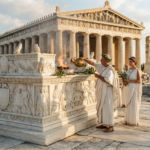
The Olympians were not only characters in stories; they were present in the sacred geography of Greece. Major sanctuaries such as Olympia for Zeus, Delphi for Apollo, and Athens for Athena anchored their worship in specific places, while countless local shrines and altars extended their reach into everyday life. Sacrifice, libation, prayer, and festival formed the practical language of divine relationship.
Greek temple worship did not involve a single unified church or doctrine. Instead, each city-state cultivated its own patterns of devotion, festival calendars, and divine patrons, and the Olympians could take on local epithets that emphasized particular functions or personalities. This is why the Twelve should be understood less as a rigid roster than as the broad summit of a much larger religious landscape.
Myths of Family, Rivalry, and Divine Authority
The Olympian gods are bound together by family ties that are also sources of conflict. Zeus overthrows his father Cronus; Hera resents Zeus’s infidelities; Poseidon and Hades contest the division of the cosmos; Apollo and Artemis defend divine honor; Athena emerges from Zeus in a way that bypasses ordinary birth. These stories reveal a universe ruled by kinship, but one in which power is constantly negotiated.
Ancient myth rarely presents divine authority as peaceful or static. Instead, sovereignty is earned, defended, and sometimes challenged through force, cunning, or alliance. This makes the Olympians deeply human in structure, even when they remain clearly divine: they are immortal powers whose family drama mirrors political life, inheritance, legitimacy, and the burden of rule.
Legacy of the Olympian Gods in Later Tradition
The Olympian gods continued to shape literature, art, and philosophy long after classical worship declined. Roman religion identified them with its own major deities, while later poets, painters, and playwrights drew on their myths as a shared cultural language. Even when the religious world of antiquity changed, the Olympians remained vivid as symbols of authority, beauty, conflict, craft, and desire.
Their legacy also survives in modern scholarship and popular culture, where they are still the most familiar gateway into Greek mythology. Yet their enduring power lies not only in their names, but in the way they preserve the texture of ancient Greek thought: a world in which nature, politics, family, and ritual were never separate from the divine. The twelve Olympian gods are therefore more than a list of figures; they are a map of Greek civilization as the Greeks themselves imagined it.
The Twelve Olympians offer one of the clearest windows into Greek religion and myth, because they unite cosmic history with the ordinary patterns of worship, kinship, and civic life. Their stories do not form a single neat system, but a living tradition shaped by poets, priests, cities, and centuries of retelling.
Seen together, they reveal why Greek mythology remains so enduring: it gives divine form to power, craft, war, love, law, and transformation, while never losing sight of the tensions between them. The Olympians are not merely ancient names preserved in verse; they are the dramatic heart of a religious world that once stood at the center of the Mediterranean imagination.

Orin Vale has spent the better part of two decades tracing the threads that connect the world’s oldest stories — from the halls of Asgard to the banks of the Nile, from Olympus to the jungles of the Maya. What began as a childhood fascination with flood myths and trickster gods grew into years of independent study across comparative mythology and ancient religion, always chasing the same question: what did these stories mean to the people who first told them? Orin writes for readers who want more than trivia — the ones looking for the beliefs, fears, and truths that myths were built to carry.