Hecate’s night is not a single fixed festival in the surviving Greek record, but a phrase that points to the goddess’s dominion over darkness, liminal time, and rites carried out at the threshold between one world and another. Hecate, the Greek goddess of crossroads, torches, ghosts, and magical practice, appears in sources from Hesiod onward as a power respected for what she grants and for what she guards. When later Greek and Roman tradition places her most strongly in the night, it is because night suits her functions: it is the time of roads without clear direction, of household boundaries watched against harm, and of contact with the dead, the restless, and the unseen.
Hecate’s Night in Greek Ritual and Myth
In Greek myth, Hecate is never confined to one simple role. Hesiod’s Theogony presents her as a major divine figure honored by Zeus, one who has power over land, sea, and sky, as well as over victory, eloquence, and the care of youth. Yet later tradition emphasizes another side of her nature: the goddess of darkness, gateways, and the uncertain places where order weakens. “Hecate’s night” therefore signifies the period when her chthonic aspect becomes most visible, especially in private rites, household offerings, and acts of apotropaic protection.
The night was the natural setting for her rituals because it marked a pause in civic life and a widening of sacred danger. Ancient Greeks often associated night with ghostly movement, dreams, and the presence of powers that could not be safely approached in daylight. Hecate’s nocturnal character grew from this atmosphere. She appears not as a goddess of daylight revelation, but as one who governs what is hidden, ambiguous, or in transition.
The Goddess at Crossroads and Thresholds
Hecate is famously linked with crossroads, and that association is central to understanding her night. Crossroads were places of choice, uncertainty, and exposure, where travelers could lose direction and where divine or daimonic forces were thought to gather. In later Greek practice, Hecate was honored at such places as a guardian and as a power that could keep dangerous forces in their proper sphere. Her night belongs to this geography of thresholds, where roads meet and identities blur.
Thresholds mattered just as much as crossroads. Doors, gates, and boundaries were vulnerable points in the ancient imagination, and Hecate’s role extended to these spaces too. She was not merely a goddess of exterior travel; she also stood near the limits of the house, where the human realm meets what is outside it. Her nocturnal significance lies in that protective presence at the edge, keeping the household from what might enter after dark.
Lunar Darkness, Magic, and Protective Rites
Hecate’s night is closely tied to the dark moon and to the broader idea of lunar darkness. Greek religious practice did not treat the moon’s absence as empty. Rather, the invisible or waning moon could be charged with heightened ritual intensity, especially in rites concerned with purification, binding, or protection. Hecate often appears in magical papyri and later ritual tradition as a goddess invoked at such times, when darkness was not simply feared but used ritually.
This is also why her night became associated with magic. Ancient sources and later tradition connect Hecate with spells, herbs, and the special knowledge of those who operate outside ordinary civic worship. That does not mean every reference to her is about sorcery in a narrow sense; rather, she stands at the border between official cult and private practice. Protective rites at night, whether intended to ward off phantoms or to secure a household, reflect her function as a goddess who commands the hidden powers of darkness instead of being overcome by them.
Ancient Sources on Hecate’s Night Meaning
The classical sources do not describe a single ceremony universally called “Hecate’s night,” but they do provide the building blocks of the idea. Hesiod gives her broad divine authority, while later literature and ritual evidence sharpen her nocturnal profile. In the Homeric Hymn to Demeter, Hecate appears with torches, moving through the night as Persephone is sought after her abduction, and this image helped fix her as a goddess who can travel through darkness without being lost in it.
Other sources deepen the picture. Pausanias records local cults and images that show Hecate’s prominence in specific Greek communities, while playwrights and later poets often portray her in relation to ghosts, enchantment, and the underworld. Roman authors such as Ovid also preserve her night-bound identity, especially in scenes involving magic or the dead. Taken together, these sources show that “Hecate’s night” means the ritual and mythic time when her powers are most fully present, even if the phrase itself varies across regions and periods.
Torches, Keys, and the Power of Vigil
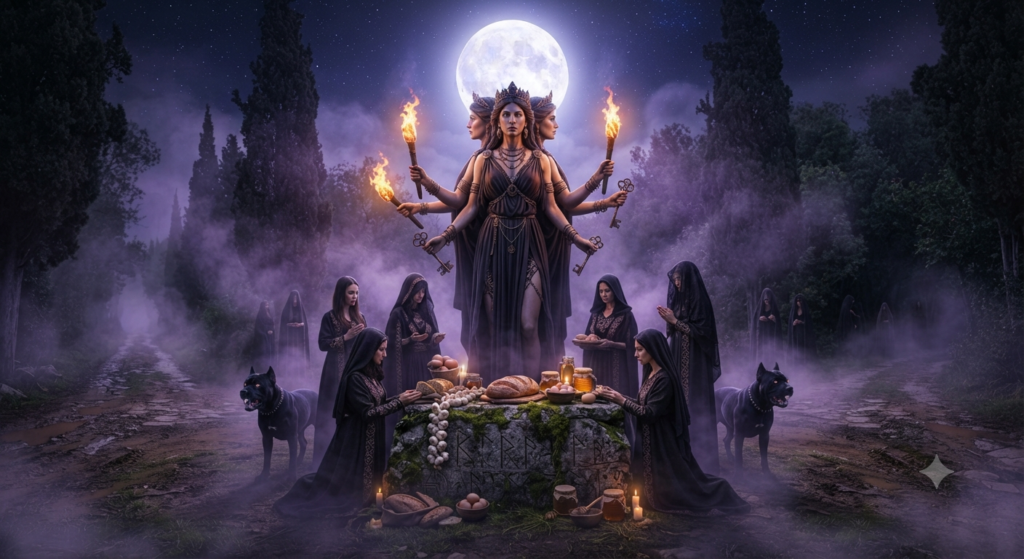
Torches are among Hecate’s best-known attributes, and they explain much about her nocturnal authority. In myth, torches allow her to move through darkness, search hidden places, and illuminate the path between worlds. In the Homeric Hymn to Demeter, her torches are essential to her role as witness and guide during the search for Persephone. The torch does not abolish night; it makes night traversable. That is a revealing image for Hecate’s significance.
Keys are equally important. In later Greek and Roman tradition, Hecate is a key-bearing goddess, one who opens and closes passage between spaces and states of being. A vigil offered to her at night is not passive waiting but watchfulness at a charged boundary. To keep vigil in Hecate’s presence is to stand alert against disorder, to remain awake when others sleep, and to recognize that the night is not empty but governed.
Night Phantoms and Boundaries of the Dead
Hecate is one of the divine figures most strongly associated with ghosts and the dead in Greek tradition. This does not make her a goddess of death in the same way that Hades rules the underworld, but it does place her near the passages by which the dead are imagined to move. Night is the proper time for such contact because it weakens the firm outlines of the living world. As a result, Hecate’s night becomes a time when phantoms are more likely to appear and when ritual protection becomes more urgent.
Boundaries matter here as well. The dead are not simply enemies in Greek thought; they are powers that must be recognized and contained. Hecate’s role is often to help maintain that separation. Offerings placed at crossings or outside the house acknowledge the dead without inviting them inward. In this sense, her night is a disciplined darkness, one shaped by respect for the limits between mortal life and the underworld.
Hecate and the Lunar Cycle in Cult Practice
Hecate’s place in the lunar cycle is especially clear in later cultic and magical contexts. The dark moon and the end of the month were moments of transition, and transitions were Hecate’s domain. Greek households and local cults often observed these times with offerings that reflected caution, purification, or propitiation. The goddess appears most vividly when the moon wanes or disappears, because that loss of light mirrors the liminal character of her power.
Cult practice around the lunar cycle also reveals how flexible Hecate’s worship could be. She was not restricted to a single public temple system in the way some major Olympian gods were. Instead, her honors often appear in domestic or small-scale settings, making her especially present in the lived rhythm of the month. Her night, then, is part of the ancient calendar of thresholds: the old month ending, the new one not yet fully arrived, and the household standing between one measure of time and another.
Offerings to Hecate at the Dark Moon
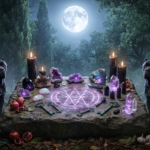
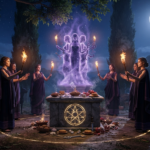
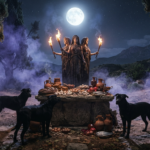
The dark moon was a common time for offerings to Hecate, especially in later Greek practice. These offerings could include food placed at crossroads or at the edge of the household, sometimes left for the goddess and the spirits associated with her. The best-known later form is the deipnon, or “dinner,” offered at the end of the month, which appears in the evidence from classical Athens and beyond. It was linked to cleansing, appeasement, and the careful management of dangerous spiritual presence.
Such offerings matter because they show Hecate’s night as practical religion, not abstract symbolism. People made space for her in ordinary life through food, fire, and boundary rites. The act of giving at the dark moon recognized both vulnerability and protection: vulnerability because the household stood at the mercy of unseen forces, protection because those forces could be honored, negotiated with, and turned toward order rather than harm.
Why Night Strengthened Her Chthonic Role
Night strengthened Hecate’s chthonic role because it placed her in the same symbolic field as the underworld, the dead, and hidden knowledge. Chthonic divinities are not always dark in a moral sense, but they are rooted in the earth, in burial, and in the unseen forces beneath ordinary life. Hecate’s association with night makes her one of the clearest examples of a goddess who mediates these realms without being absorbed by them.
The darkness of night also amplified her authority over uncertainty. In daylight, roads, houses, and ritual spaces are easy to distinguish. At night, those distinctions become less secure. Hecate thrives in precisely that condition. Her night is not merely the absence of solar light; it is the condition under which the world’s edges are most visible, and under which divine protection, magical action, and contact with the dead acquire their full force.
Legacy of Hecate’s Night in Later Tradition
Hecate’s night endured well beyond the classical period because it spoke to lasting human concerns: fear of darkness, the need for protection, and the mystery of boundaries that cannot be fully controlled. Late antique, medieval, and modern occult traditions often reshaped her image, sometimes emphasizing witchcraft more strongly than the ancient evidence warrants. Even so, those later developments drew on real features of her Greek identity: her torches, her keys, her crossings, and her presence in the night.
In modern reception, Hecate often stands as a symbol of the liminal and the hidden, a figure whose night is both threatening and protective. That legacy comes from the ancient sources, even when it is transformed by later imagination. Her significance lies in the fact that night in Greek religion was not simply absence or fear. In Hecate’s domain, it was a sacred interval of power, vigilance, and passage between worlds.
Hecate’s night signifies the meeting point of darkness and protection, fear and ritual, the living house and the dead beyond it. In Greek myth and worship, she emerged most fully where roads diverged, moonlight faded, and human beings sought safety in the unseen. Her night was never mere emptiness. It was a charged time in which boundaries could be defended, crossings could be made, and hidden powers could be addressed with caution and respect.

Orin Vale has spent the better part of two decades tracing the threads that connect the world’s oldest stories — from the halls of Asgard to the banks of the Nile, from Olympus to the jungles of the Maya. What began as a childhood fascination with flood myths and trickster gods grew into years of independent study across comparative mythology and ancient religion, always chasing the same question: what did these stories mean to the people who first told them? Orin writes for readers who want more than trivia — the ones looking for the beliefs, fears, and truths that myths were built to carry.