In the Bible, Hades refers to the realm of the dead, not to a horned ruler of the underworld and not to the devil himself. The word enters the biblical tradition through Greek-speaking Jews and early Christians, where it often translates the Hebrew Sheol, the shadowy place associated with the dead. Depending on the text and translation, it can suggest the grave, the underworld, or the unseen state of those who have died.
Because the Bible was written across different languages and literary worlds, Hades does not carry only one fixed meaning. In some passages it is a neutral term for the abode of the dead; in others it becomes a place of awaiting judgment; and in later Christian reading it is sometimes contrasted with paradise or the final destiny of the wicked. Its sense is shaped by Hebrew scripture, Greek usage, and apocalyptic imagination alike.
Hades in the Bible: the Greek term’s meaning
In classical Greek, Hades is first of all the name of the god who rules the underworld and, by extension, the underworld itself. When the Greek Bible uses the word, however, it usually points to the place of the dead rather than to a personal deity. The New Testament writers employ the term in this broader sense, and most English translations either keep “Hades” or render it as “the realm of the dead” or “the grave,” depending on context.
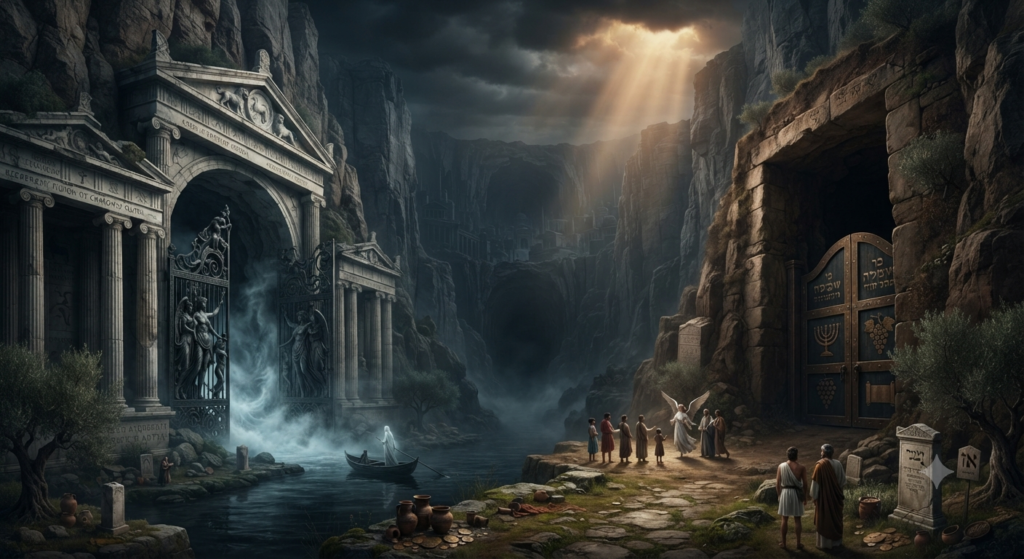
This matters because biblical Hades is not identical to the later Christian image of hell as a place of endless punishment. It is a temporary or intermediate realm in many passages, associated with death and concealment. In that sense, the word belongs to the Bible’s ancient cosmology: the dead are gathered in a hidden region below, awaiting God’s final action.
Sheol and Hades in Hebrew scripture
The Hebrew Bible most often uses Sheol, a term that describes the world of the dead. Sheol is not usually depicted with the sharp moral division of later afterlife thought. It is the place where both righteous and unrighteous descend, a silent and diminished existence far from the living. Psalms, Job, and prophetic writings repeatedly treat it as the destination of mortality itself.
When Greek-speaking Jews translated Hebrew scripture, Hades became the natural equivalent for Sheol. The pairing is not perfect, but it is close enough to preserve the basic idea of the underworld or grave. This is why many biblical passages that speak of Sheol in Hebrew appear as Hades in Greek, and why the two words are often discussed together by scholars and translators.
How the Septuagint uses Hades for the dead
The Septuagint, the ancient Greek translation of the Hebrew Bible, is central to understanding biblical Hades. Its translators regularly chose Hades for Sheol, making the Greek term the standard biblical way of speaking about the place of the dead. This was not an attempt to import pagan mythology wholesale, but a practical translation choice within the Greek-speaking Jewish world.
As a result, readers of the Septuagint encountered familiar Hebrew ideas in Greek dress. Hades could mean the depths, the grave, or the unseen abode where the dead reside. That usage then shaped the language of the New Testament, which was written in Greek and inherited much of its vocabulary from the Scriptures that early Christians read.
Hades as the underworld, not the devil
A common misunderstanding is that Hades in the Bible refers to Satan or to a demonized ruler of hell. In the biblical texts, this is not the case. Hades is a place or condition, not the devil. The devil appears under other names and roles in biblical literature, while Hades functions as the domain of death.
This distinction is important because later Christian tradition and popular imagination often blended different images together. The Greek mythological Hades, the biblical Hades, and the medieval hell of punishment are related in language but not identical in meaning. In the Bible, Hades is more often the shadowed place where the dead are held than a person who torments them.
Abraham’s bosom, paradise, and Hades
The New Testament uses other terms alongside Hades to describe the destiny of the dead, especially in Luke’s Gospel. Abraham’s bosom is a vivid image for comfort and rest after death, while paradise suggests blessedness in God’s presence. These expressions help distinguish the fate of the righteous from the condition associated with Hades.
The contrast is significant because Hades can be pictured as a place of deprivation, while Abraham’s bosom or paradise suggests peace and honor. The texts do not present a single, fully systematized geography of the afterlife; rather, they draw on Jewish and Greco-Roman imagery to communicate divine justice, consolation, and reversal.
The rich man and Lazarus in Hades
The story of the rich man and Lazarus in Luke 16 is one of the best-known New Testament passages featuring Hades. In the parable, the rich man, after death, is described as being in Hades and in torment, while Lazarus is comforted in Abraham’s bosom. A great chasm separates the two conditions, making reversal impossible after death.
This passage is often read as a moral lesson about wealth, mercy, and accountability, but it also shows how flexible the term Hades had become in Christian preaching. Here Hades is not merely the neutral grave; it is the place where the unrepentant dead experience distress before final judgment. The image is dramatic, yet it remains distinct from the later fully developed notion of hell.
Hades in Revelation and apocalyptic judgment
In Revelation, Hades appears in a more cosmic and final register. Death and Hades are portrayed as powers that will be overcome, and eventually Hades itself is cast into the lake of fire. This is a striking image of divine victory over mortality and the temporary realm that holds the dead. The language is apocalyptic, not philosophical.
Such passages show that biblical Hades is not ultimate. It is part of the old order that will pass away when God brings final judgment and renewal. Revelation’s imagery draws on Jewish apocalyptic tradition, where death is not the last word and even the underworld is subject to divine authority.
Grave, realm of the dead, and translation choices
English translations handle Hades in different ways because the term can overlap with several concepts. Sometimes “grave” fits the context best; at other times “realm of the dead” or simply “Hades” preserves the historical flavor. No single English word captures every biblical usage perfectly, because the original term itself carries a range of meanings.
Translation choices also shape theology. If Hades is rendered as “hell” too readily, readers may assume eternal punishment where the source text may mean only the abode of the dead. If it is rendered as “grave” in every case, the richer mythic and apocalyptic dimensions can disappear. Careful translation tries to keep both the historical setting and the literary force of the word in view.
Ancient Greek background behind the biblical word
Behind the biblical term stands the older Greek tradition of Hades as both deity and underworld. In Homeric epic, the dead descend beneath the earth to a dim existence, and Hades is the ruler of that domain. By the classical period, the word could name the god, the place, or the broader unseen region of the dead.
The biblical writers did not simply copy Greek myth, but they worked in a world where Greek language already carried these associations. That background helped make Hades an effective translation for Sheol and a useful term for discussing death, concealment, and postmortem destiny. The biblical usage is therefore best understood as a meeting point between Hebrew thought and Greek expression.
What Hades means for Christian and Jewish readers
For Jewish readers of Scripture, the idea behind Hades is closely tied to Sheol: the realm where the dead go, a place of silence and incompletion rather than a fully mapped afterlife system. For Christians, the term has often been read in light of resurrection, judgment, and Christ’s triumph over death. In both traditions, it remains a word about mortality and what lies beyond it.
That is why Hades in the Bible should be read with care. It is not a simple synonym for hell, and it is not the devil’s throne. It is the ancient biblical name for the hidden place of the dead, a concept inherited from Hebrew scripture, expressed in Greek, and reinterpreted through later theological reflection.
Hades in the Bible is a window into how ancient people spoke about death before modern categories hardened the language. It carries the atmosphere of the underworld, the grave, and the unseen realm, while also standing at the crossroads of Hebrew Sheol and Greek translation. In biblical literature, it is a temporary and mortal domain, always under the authority of God.

Orin Vale has spent the better part of two decades tracing the threads that connect the world’s oldest stories — from the halls of Asgard to the banks of the Nile, from Olympus to the jungles of the Maya. What began as a childhood fascination with flood myths and trickster gods grew into years of independent study across comparative mythology and ancient religion, always chasing the same question: what did these stories mean to the people who first told them? Orin writes for readers who want more than trivia — the ones looking for the beliefs, fears, and truths that myths were built to carry.