Ancient mosaics preserve Greek mythology in colorless yet vivid fragments of stone, glass, and shell. Across the Roman world, mythological scenes appeared underfoot in villas, bathhouses, dining rooms, and sanctuaries, where patrons encountered the gods and heroes through images assembled from thousands of tiny tesserae. These mosaics do not merely decorate; they translate epic, cult, and literary tradition into domestic and public art, drawing from Homer, Hesiod, tragedians, and later mythographers while also reflecting local taste and Roman patronage.
Greek myth scenes in Roman floor mosaics
Greek mythology appears most often in Roman floor mosaics because Roman elites admired Greek stories as markers of education and refinement. Artists adapted myths from poetry and drama into scenes suited to pavements: a single dramatic moment, a recognizable god, or a narrative sequence that could be read at a glance. The same story might be shown differently from one province to another, depending on workshop style, available models, and the preferences of the owner.
These mosaics usually come from the imperial period, especially from the second to fourth centuries CE, when mosaic production flourished around the Mediterranean. They often combine Greek subject matter with Roman domestic spaces, creating a cultural bridge between myth and daily life. In this setting, Greek heroes and gods became part of the atmosphere of leisure, learning, and status.
Dionysus and the vine in ancient mosaics
Dionysus is among the most frequently depicted Greek divinities in ancient mosaics. His presence makes sense in dining contexts, where the god of wine, fertility, ecstasy, and theatrical transformation suited the setting. Mosaic artists often show him crowned with ivy or vine leaves, accompanied by satyrs, maenads, panthers, or scenes of revelry, and these images could allude to abundance as well as to the civilizing power of wine.
The Dionysian cycle also appears in processional scenes, triumphal chariots, and the god’s mythical voyages. Some mosaics depict his Indian triumph, a theme known from later literary tradition and visual art, while others focus on the vine itself, with tendrils, grapes, and harvest imagery framing the god’s figure. In Roman houses, Dionysus was not only a mythic deity but also a fitting emblem of luxury, pleasure, and seasonal renewal.
Hercules, labors, and heroic mosaic cycles
Hercules, known in Greek as Heracles, is another favored figure in mosaic art because his myths combine strength, suffering, and eventual apotheosis. Mosaics often depict individual labors—slaying the Nemean lion, capturing the Ceryneian hind, subduing the Erymanthian boar, or wrestling the Hydra—each instantly recognizable to viewers familiar with heroic tradition. These scenes could stand alone or appear as a full cycle, presenting the hero as a model of endurance and conquest.
Classical sources preserve multiple versions of Heracles’ exploits, but the canonical sequence of twelve labors was established in later tradition and became a standard visual framework. In mosaics, the hero may also appear with the club, lion skin, or beside scenes from his later life, such as his conflict with centaurs or his marriage to Hebe. The enduring appeal of Hercules in pavements lies in his dual nature: a man of toil and violence, yet also a figure who crosses into divine status.
Zeus, Europa, and divine abduction images
One of the most widely depicted mythic narratives in mosaic art is Zeus and Europa. According to the familiar version preserved by later mythographers and alluded to in literary tradition, Zeus transformed himself into a bull to carry Europa across the sea to Crete. Mosaics typically capture the central image of the maiden riding the bull, sometimes with attendants on the shore, the sea beneath them, and divine or marine figures around the scene.
These images belong to a broader visual tradition of divine pursuit and abduction in Greek myth, though ancient artists treated the subject with formal elegance rather than narrative commentary. The same theme could also appear in other stories of Zeus’s transformations and unions, reflecting the god’s role as a powerful and often disruptive force in mythic genealogy. In domestic art, the Europa scene offered beauty, movement, and a clear emblem of divine authority operating beyond human control.
Perseus, Medusa, and monsters in tesserae
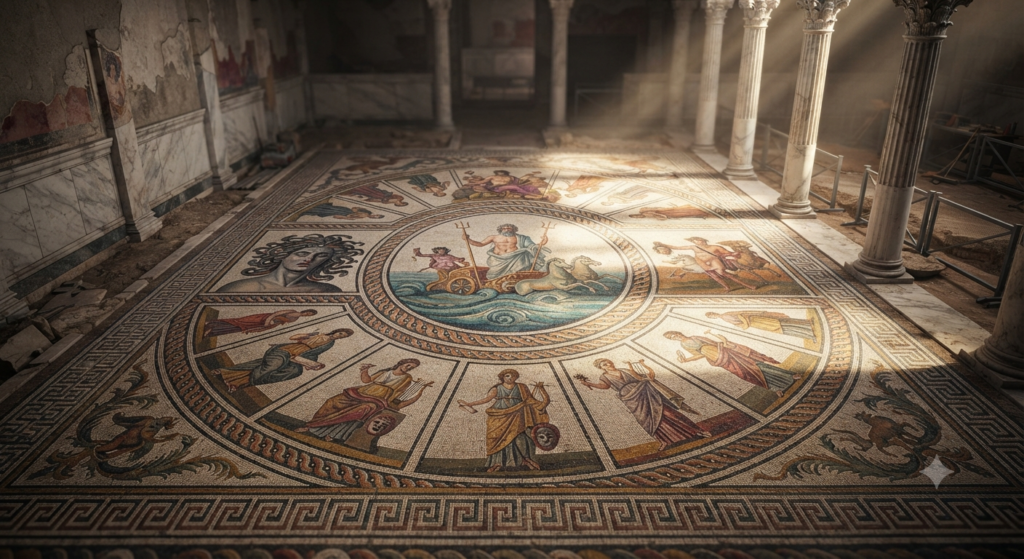
Perseus and Medusa provided mosaic artists with a dramatic contest between heroism and monstrosity. In the myth, Perseus receives help from the gods—especially Athena and Hermes in later tradition—before decapitating Medusa, one of the Gorgons whose gaze turned viewers to stone. Mosaics often emphasize the moment of victory or the aftermath, with the severed head, winged sandals, and a tense confrontation that condenses the tale into a single arresting image.
Such scenes could be paired with other monster-slaying images, reflecting a broader interest in the triumph of order over chaos. The Gorgon head itself also functioned as an apotropaic symbol, believed to ward off harm, and it appears in many contexts beyond the Perseus story. In mosaics, the myth becomes both narrative and protective emblem, uniting literary memory with visual power.
Poseidon, nereids, and sea-born mythology
Sea mythology appears frequently in mosaics from coastal regions and bath complexes, where Poseidon and his retinue fit the setting naturally. Poseidon, ruler of the sea in Greek tradition, may appear in a chariot drawn by hippocamps, alongside tritons, nereids, dolphins, and sea creatures. These scenes evoke the movement and abundance of the marine world, and they often serve as decorative centerpieces in floors designed to suggest freshness, flow, and maritime wealth.
Nereids, the sea nymphs associated with Poseidon’s realm, are commonly shown riding marine beasts or accompanying divine processions. Their presence links mosaic art to Homeric and later mythic imagery, where the sea is both beautiful and dangerous, a domain of travel, trade, and divine power. Such mosaics would have resonated especially in port cities and villas facing the coast, where myth and environment reinforced one another.
Achilles and Trojan War scenes in pavements
The Trojan War entered mosaic art through a series of hero scenes, with Achilles often at the center. Artists drew on Homeric tradition and later retellings to depict moments such as Achilles in battle, his quarrel with Agamemnon, his confrontation with Hector, or the discovery of his vulnerability through the famous heel motif in later myth. These mosaics usually select a climactic episode rather than attempting a full narrative from the Iliad.
Trojan War imagery also includes the education of Achilles by Chiron, his concealment among the daughters of Lycomedes, or scenes involving Odysseus and other heroes from the same cycle. The war was a foundational myth of Greek heroic memory, and its presence in pavements gave elite spaces an epic horizon. A dining room or reception hall could thus become a stage for the world of Homer, where honor, fate, and mortal cost were constantly visible.
Orpheus, music, and underworld symbolism
Orpheus is one of the most beloved figures in mosaic art because his story unites music, enchantment, and descent into the realm of death. In the myth known from Greek literary tradition, Orpheus softens beasts and nature with his song, and in the most famous version he later journeys to the underworld in an attempt to recover Eurydice. Mosaics often show him seated or standing with a lyre, surrounded by animals drawn into harmony by his music.
The figure of Orpheus also carried symbolic weight beyond the specific tale. In funerary and domestic contexts, he could signify the civilizing power of art, the fragility of human hope, or the possibility of passage between worlds. Some mosaics place him in an idyllic setting of trees and animals, making the scene both mythic and contemplative, while others hint at the underworld through more somber composition and iconography.
The Olympian gods in domestic mosaic art
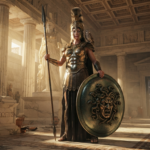
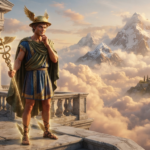
The Olympian gods appear throughout domestic mosaics as individual figures and as assembled divine company. Athena may be shown in armor, Apollo with lyre or radiance, Artemis with bow and hunting companions, Aphrodite with beauty and sea-born imagery, and Hermes with travel and mediation. These portraits often rely on established attributes rather than elaborate narrative, allowing viewers to identify the deity at once.
In private houses, such images were more than ornament. They expressed education, piety in a cultural sense, and participation in the visual language of the classical past. Some mosaics even pair gods with seasonal personifications, moral allegories, or cosmological motifs, creating a layered display in which mythology, status, and learned taste reinforce one another.
Mythological themes in baths, villas, and shrines
The settings of mosaic installation matter as much as the myths themselves. Baths favored marine, athletic, and Dionysian imagery; villas often displayed grand myth cycles in reception rooms, corridors, and peristyles; shrines and sanctuaries could integrate divine scenes into a more overtly sacred environment. The choice of subject was rarely random, since each space invited a different relation between viewer, image, and story.
Ancient mosaics depicting Greek mythology therefore reveal a world where myth remained active in art, not as isolated relic but as a living visual language. They show how Roman patrons inherited Greek stories and remade them for new uses, shaping pavements into scenes of power, transformation, danger, and divine presence. Through tesserae, the myths of Greece were carried into the rooms of empire and made part of everyday sight.
Ancient mosaics depicting Greek mythology endure because they join narrative clarity with material splendor. A hunter, a god, a monster, or a sea procession could be fixed into stone and glass, turning familiar tales into permanent ground beneath the feet of later generations. In villas, baths, and shrines, these images preserved not only the stories of Homer and the mythographers, but also the tastes, ambitions, and religious imagination of the world that made them.

Orin Vale has spent the better part of two decades tracing the threads that connect the world’s oldest stories — from the halls of Asgard to the banks of the Nile, from Olympus to the jungles of the Maya. What began as a childhood fascination with flood myths and trickster gods grew into years of independent study across comparative mythology and ancient religion, always chasing the same question: what did these stories mean to the people who first told them? Orin writes for readers who want more than trivia — the ones looking for the beliefs, fears, and truths that myths were built to carry.