Apollo in the Odyssey is a god of decisive moments rather than constant presence. Unlike Athena, who moves through the epic with sustained attention to Odysseus’ fate, Apollo appears only sparingly in Homer’s poem. Yet his influence is important: he stands behind plague, sacrificial order, prophecy, and the terrible logic of divine punishment. In the Odyssey, Apollo is not the central divine patron of the hero, but a remote and authoritative power whose acts and symbols remind readers that gods govern life through signs, song, and death as much as through direct intervention.
Apollo in the Odyssey: divine presence and limits
Apollo’s presence in the Odyssey is real but restrained. Homer does not make him a constant companion to Odysseus in the way Athena is, nor does he give him many direct scenes of action. Instead, Apollo functions as a god whose authority is felt in specific moments, especially where purity, healing, prophecy, or destruction are involved. This limited role fits the poem’s broader divine economy: each god has a sphere, and Apollo’s sphere remains distinct even when he is not physically “on stage.”
That restraint matters. The Odyssey is largely about return, household order, and survival by intelligence, while Apollo belongs to a different cluster of divine powers: archery, plague, song, and prophetic clarity. He therefore appears more as a principle than as a character with a long dramatic arc. Homer uses him selectively, and that selectiveness gives his appearances weight.
The archer god and the language of plague
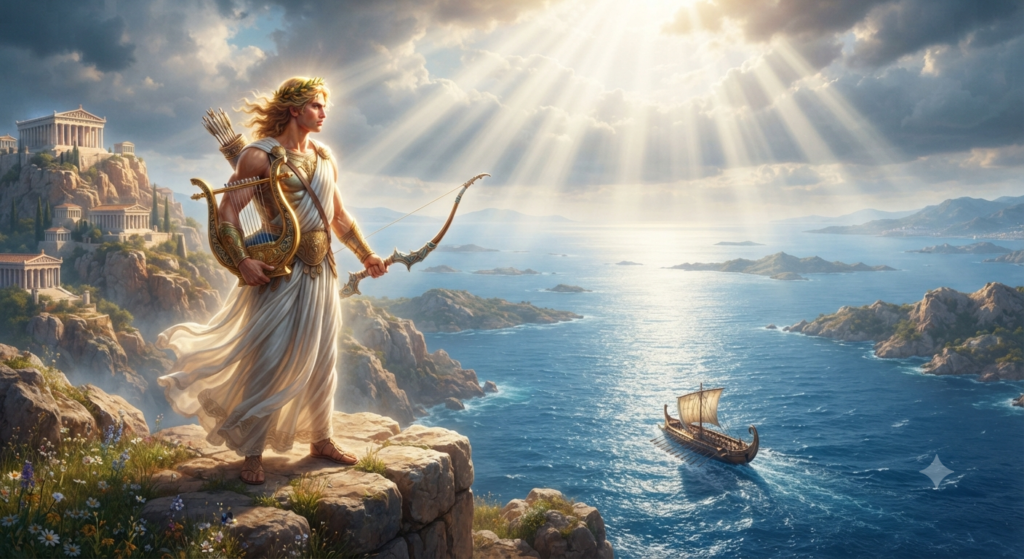
In Homer, Apollo is famously the god who sends plague with his arrows. This is clearest in the Iliad, where he strikes the Achaeans with disease after Agamemnon offends his priest Chryses. The Odyssey preserves that same divine profile in the background, and its audience would have recognized Apollo’s arrows as a language of sudden, invisible punishment. His bow is not merely a weapon of war; it is a sign of divine judgment delivered at distance.
That association gives Apollo a darker presence even when he is not active in the plot. The god can wound without appearing, and the effects of his anger are often collective rather than individual. In the world of Homer, plague is not random misfortune but a sign that sacred order has been violated. Apollo stands at the center of that idea, enforcing the boundary between human conduct and divine law.
Apollo’s role in the opening of the epic
Apollo is not a major participant in the opening books of the Odyssey, but he already belongs to the poem’s religious background. The opening movement of the epic focuses on Odysseus’ absence, the suitors’ disorder, and the gods’ decision-making, especially Zeus and Athena. Apollo does not dominate those debates, yet his authority as an Olympian remains implicit in the world Homer describes: the gods are not abstract forces but rulers with particular jurisdictions.
His later importance is prepared by the poem’s concern with rightful action and ritual balance. Apollo governs the kinds of acts that restore or disrupt that balance—sacrifice performed correctly, prophecy spoken truly, and punishment falling where it should. Even when he is absent from the early councils of the gods, the standards he represents remain active in the poem’s moral architecture.
Prophecy, signs, and divine guidance in Homer
Apollo is closely associated with prophecy across Greek tradition, and that association matters for the Odyssey. Although Athena and Zeus are more prominent in guiding Odysseus’ return, Apollo belongs to the same larger system of divine signs. Homeric prophecy is rarely a simple message from one god to one hero; it appears through seers, omens, birds, dreams, and inspired speech. Apollo’s domain overlaps with all of this because he is the god who makes hidden truth legible.
The Odyssey is full of interpretive moments in which characters must read signs correctly or fail to do so. Apollo’s presence is felt in that atmosphere of meaning. The poem repeatedly suggests that human beings live among signals they do not fully control. Apollo is one of the gods who authorize those signals, especially when religious or fateful truth must be spoken by a seer such as Teiresias.
Why Apollo is absent from most Odyssean scenes
Apollo’s relative absence from the bulk of the Odyssey is not a sign of insignificance. It reflects Homeric specialization among the gods. Athena is the divine patron of practical intelligence, disguise, and counsel, which makes her especially suited to Odysseus’ long homecoming. Apollo, by contrast, is more associated with fixed powers: plague, purification, prophecy, and archery. These do not require him to accompany the hero step by step.
His distance also suits the poem’s atmosphere. The Odyssey often presents divine action indirectly, through outcomes rather than constant intervention. Apollo fits this mode well, since his power is often experienced as a sudden result: a death, an oracle, a ritual response, a warning sign. His rarity in the narrative makes his name resonate when it does appear.
The sun god and the confusion of later tradition
Later tradition often blends Apollo with the sun, but Homer does not fully identify him as the sun god. In the Odyssey, the sun is usually personified through Helios, not Apollo. This distinction is important because the epic preserves an older and more careful divine map than some later interpretations. Apollo may be radiant, far-shooting, and associated with clarity, but he is not simply the sun in Homeric poetry.
Confusion between Apollo and Helios became more common in later Greek and Roman literature, where divine attributes were increasingly merged. In the Odyssey, however, the distinction remains meaningful. Helios owns the sacred cattle whose slaughter brings catastrophe in Book 12, while Apollo retains his own separate powers. Homer’s audience would have understood that these are different gods with different spheres.
Apollo in relation to Zeus and the other gods
Apollo occupies a subordinate but honored position within the Olympian hierarchy. Zeus remains supreme, deciding the broad direction of events, while Apollo acts within the limits of his domain. The Odyssey repeatedly shows this structure: divine will is shared, but not evenly. Some gods advise, some protect, some punish, and Apollo’s role belongs to a specific set of religious functions rather than overarching governance.
His relation to the other gods is also shaped by contrast. Athena is active, tactical, and intimate with Odysseus’ plight; Hermes appears as a messenger and boundary-crossing guide; Poseidon is the great antagonist who delays the hero’s return. Apollo is more distant than all of them, yet his authority is unquestioned. He belongs to the orderly side of divine power, though that order can be severe.
Bow, lyre, and the god’s wider Homeric image
Apollo is not only an archer. In Greek culture and Homeric tradition, he is also linked with the lyre, song, and the disciplined beauty of music. While the Odyssey does not spotlight this side of him as often as later literature does, the association still matters. Apollo’s identity unites precision in sound with precision in action: the bow and the lyre are both instruments of measured force, one deadly, the other harmonizing.
That broader image helps explain why Apollo belongs so naturally in epic poetry. He is a god of controlled power, whether that power comes as a sung form or a lethal arrow. In the Odyssey, which itself moves through songs within songs, singers, and remembered tales, Apollo’s relation to order and performance sits just beneath the surface.
Sacrifice, ritual order, and Apollo’s favor
Apollo is deeply connected to correct ritual, especially sacrifice and purification. Homeric religion assumes that the gods respond to proper offerings, and Apollo is among the deities most closely tied to this exchange between humans and the divine. When sacrifice is performed well, it restores order; when sacred boundaries are crossed, Apollo can become a force of punishment. His worship therefore rests on precision and respect.
This is part of why Apollo matters in the Odyssey even without many personal scenes. The epic is full of meals, offerings, vows, and prayers, and these are not merely decorative details. They are the grammar of civilization itself. Apollo stands behind that grammar as one of the gods who ensures ritual acts have consequences.
What Apollo reveals about fate in the Odyssey
Apollo’s role in the Odyssey ultimately reveals how fate works in Homer: not as a simple fixed script, but as a structure in which divine powers reveal and enforce what mortals must face. He does not dominate Odysseus’ journey, yet his presence reminds readers that human intelligence cannot master everything. Some truths arrive as prophecy, some as punishment, and some as the visible result of invisible divine will.
In that sense, Apollo contributes to the epic’s larger vision of order under pressure. Odysseus survives by cunning, endurance, and timely help from Athena, but the world he moves through is still governed by gods whose powers exceed human understanding. Apollo embodies the clarity and severity of that world. He is not everywhere in the Odyssey, but where he appears, the poem’s religious seriousness becomes unmistakable.
Apollo’s place in the Odyssey is brief yet significant. Homer gives him less narrative space than some other gods, but he remains essential to the poem’s religious logic as the god of plague, prophecy, ritual order, and decisive divine force. His relative silence only sharpens his meaning: Apollo is one of the powers that reminds mortals that fate is not negotiated on human terms alone, and that the gods of Homeric epic govern through signs as much as through intervention.

Orin Vale has spent the better part of two decades tracing the threads that connect the world’s oldest stories — from the halls of Asgard to the banks of the Nile, from Olympus to the jungles of the Maya. What began as a childhood fascination with flood myths and trickster gods grew into years of independent study across comparative mythology and ancient religion, always chasing the same question: what did these stories mean to the people who first told them? Orin writes for readers who want more than trivia — the ones looking for the beliefs, fears, and truths that myths were built to carry.