Apollo was one of the most widely honored gods in the Greek world, invoked as healer, purifier, archer, patron of music, and giver of prophecy. To pray to Apollo was not simply to speak a request into the air; it was to enter a relationship shaped by ritual precision, offerings, purity, song, and sometimes the difficult patience of waiting for an oracle’s answer. Across Homer, the Homeric Hymns, Hesiod, Pausanias, and later writers, Apollo appears as a deity approached through both formal cult and intimate petition, especially at sanctuaries such as Delos and Delphi.
Apollo’s role in Greek prayer and worship
Apollo occupied a distinctive place in Greek religion because he was invoked in so many different circumstances. In Homer, he can send plague with his arrows, yet also lift disease away; in later cult he is the god of healing, boundary-marking, music, and divination. This made prayer to Apollo practical as well as solemn. A Greek asking for relief from illness, success in travel, protection from harm, or guidance about an uncertain future might appeal to him with confidence that his sphere of power touched all these concerns.
His worship also carried a strong sense of order and measure. Apollo was not approached in the same way as every god, and his sanctuaries often emphasized discipline, correct procedure, and purity. The Greeks did not usually think of prayer as private, invisible belief, but as an act embedded in ritual life. To pray to Apollo meant to acknowledge his power with the right words, the right gifts, and the right conduct, whether at a temple altar, during a festival, or before an oracle.
Offerings made at temples and altars
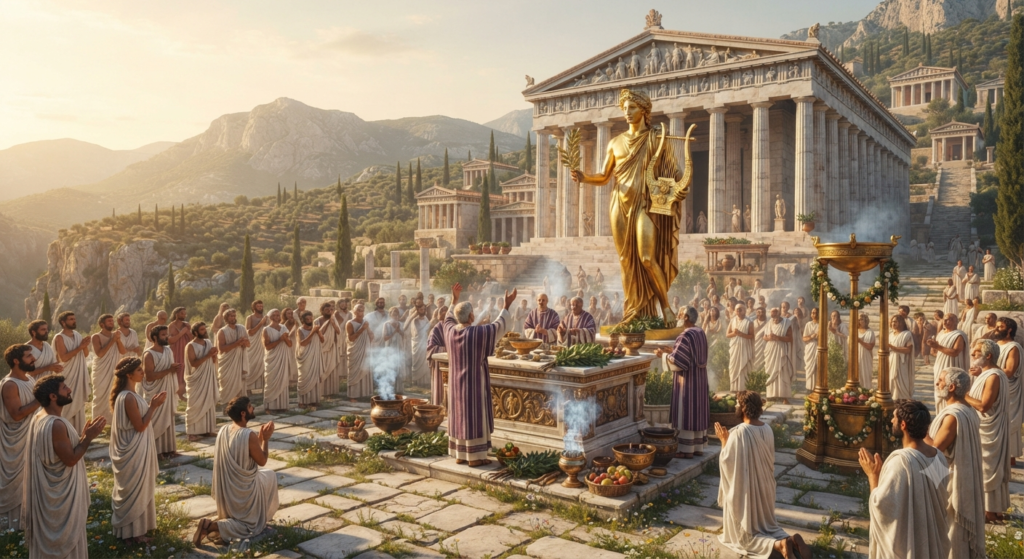
Offerings were central to prayer, and Apollo’s altars received a wide range of gifts. The most common were agricultural products, cakes, first-fruits, and animals, depending on the occasion and the means of the worshipper. A private petitioner might bring a modest offering, while a city or sanctuary could dedicate larger sacrifices at public expense. The altar, more than the enclosed temple itself, was the place where prayer became action.
Greek sources show that the act of giving was inseparable from asking. A worshipper did not merely request Apollo’s favor but established a relationship through reciprocity, the exchange of honor for divine help. Temples of Apollo, from local shrines to major panhellenic sanctuaries, were therefore filled with evidence of devotion. Offerings expressed gratitude, dependence, and reverence at once, and the variety of gifts reflected the many roles Apollo held in Greek life.
Libations, incense, and sacrificial rites
Libation was one of the simplest and most widespread ways to pray to Apollo. Wine, water, honey, milk, or a mixture of these could be poured onto the ground or altar while the supplicant spoke. In epic and ritual practice, the pouring itself marked a transition from ordinary speech to sacred address. The liquid, offered to the god, carried the prayer with it in symbolic form.
Incense and sacrifice deepened the act. Fragrant smoke was thought to rise toward the divine realm, while the slaughter of an animal, when performed, created a formal bond between human and god. The Homeric Hymns and later ritual evidence suggest that Apollo was honored with burnt offerings and hymnic worship, though particular rites varied by region and sanctuary. In some settings the prayer accompanied the sacrifice; in others, the sacrifice itself was the prayer made visible.
Hymns, paean chants, and spoken petitions
Song mattered greatly in Apollo’s worship, since he was the god of the lyre and of ordered harmony. The paean, a choral hymn of praise and petition, was especially associated with him. In Homer and later tradition, paean singing could mark healing, thanksgiving, or victory, and it often began with invocation and moved into collective response. The chant was both religious and communal, giving voice to the group as a whole.
Spoken petition remained equally important. Greek prayer commonly named the god, recalled some aspect of his power or past favor, and then stated the request. A worshipper might remind Apollo of titles such as Phoebus, Far-Shooter, or Paean before asking for health, protection, or truth. The language was formal but not mechanical; Greek prayers often combined praise, memory, and request in a compact, forceful utterance.
Purification before approaching the god
Purity was essential before approaching Apollo, especially in sanctuaries connected with prophecy and healing. Washing hands, bathing, and avoiding pollution were common preparatory acts. A person stained by death, bloodshed, or other ritual impurity could not approach a sacred space casually. Greek religion treated such conditions not as moral guilt in the modern sense, but as states that required cleansing.
Apollo’s association with purification is itself ancient. In myth and cult he could cleanse communities, and in some traditions he oversaw the removal of pollution after crime or calamity. That role shaped the behavior of those who came to pray. The worshipper sought to stand in a state fit for divine hearing, because the efficacy of prayer depended not only on words but on ritual readiness.
Delos and Delphi as sacred centers
Delos and Delphi were the two great names most closely associated with Apollo’s worship. Delos, in the Homeric Hymn to Delian Apollo, is the island of his birth, a place of radiant cult memory and festival celebration. Delphi, by contrast, became the supreme center of his oracle, where Greeks from across the world came to seek divine counsel. Both sanctuaries embodied Apollo’s identity, but in different ways: Delos as birth and communal festival, Delphi as revelation and authority.
At these sacred centers, prayer took on public and pan-Hellenic significance. Cities sent delegations, rulers dedicated gifts, and individuals made journeys because Apollo’s voice there mattered beyond local boundaries. Delphi in particular gave prayer a dramatic form, since petitioners came not only to ask but to hear. Delos, with its festivals and hymns, emphasized collective honor, while Delphi transformed request into consultation with a god understood to speak through inspired mediation.
Priests, seers, and ritual specialists
Although a Greek could pray directly to Apollo, ritual specialists often shaped the process. Priests maintained sanctuaries, supervised sacrifices, and guarded correct observance. In oracular settings, attendants and officials controlled access, interpreted procedure, and preserved the authority of the shrine. Their role did not replace prayer; it organized the conditions under which prayer could properly be made.
Seers and inspired figures also belonged to Apollo’s religious world. Because Apollo was the god of prophecy, those who interpreted signs, flights of birds, sacrificial omens, or inspired speech were linked to him in both myth and practice. The presence of such specialists reminds us that Greek prayer was rarely solitary in the modern sense. Even when one person spoke, the religious system surrounding that speech included trained intermediaries, inherited custom, and the sanctity of place.
Omens, oracle consultation, and responses
When Greeks sought Apollo’s guidance, they often expected some form of response beyond a simple yes or no. Omens, signs from sacrifice, and oracular utterances were all ways the god might answer. At Delphi, this response was famously mediated through the Pythia, whose words required interpretation. Ancient reports, including those of Herodotus and later writers, show that the oracle’s replies could be direct, ambiguous, or couched in language that demanded reflection.
This uncertainty was part of the power of Apollo’s speech. A petitioner did not control the answer, only the question and the ritual approach. The god’s response might validate a plan, warn against it, or reveal that more sacrifice or restraint was needed. Prayer to Apollo thus included listening as much as speaking, and the consultation process made divine guidance a matter of interpretation, not mere confirmation.
Votive gifts after answered prayers
When prayers were answered, thanks were often expressed through votive dedication. A worshipper might leave a statue, a tablet, a weapon, a piece of clothing, or a smaller token appropriate to the sanctuary and the occasion. Such gifts testified that Apollo had heard and responded. In archaeological sites across the Greek world, votives preserve the memory of petitions long vanished from speech.
These dedications also extended the relationship between human and god beyond the moment of prayer. A gift remained in the sanctuary as a public witness to favor received. In some cases, inscriptions recorded the names of the dedicants and the nature of the divine help, turning personal gratitude into communal memory. Apollo’s sanctuaries became archives of answered prayer, filled with objects that spoke silently of illness relieved, danger escaped, or counsel granted.
Praying to Apollo in home and festival rites
Not every prayer to Apollo required a great sanctuary. Greeks could invoke him in the home, at meals, before journeys, or during moments of need. A small libation, a spoken request, or a household rite could bring his presence into daily life. Because Apollo governed healing and protection as well as prophecy, he belonged not only to grand civic religion but to the rhythm of ordinary existence.
Festival worship, however, gave these domestic gestures a larger frame. During processions, choral songs, and public sacrifices, whole communities prayed to Apollo together. The paean, the altar flame, and the gathered crowd created a shared experience of divine nearness. In that setting, prayer was not only personal appeal but civic devotion, a way for a city to present itself before the god who could bless, warn, or illuminate the path ahead.
The ancient Greeks prayed to Apollo through a rich blend of speech, song, purification, sacrifice, and offering. Whether at Delos, Delphi, or a small household altar, they approached him as a god who could heal, guide, and reveal, and they did so with careful attention to ritual form. Prayer was never only inward feeling in the Greek world; it was a practiced encounter with divine power, made concrete through libation, hymn, incense, and votive gift.

Orin Vale has spent the better part of two decades tracing the threads that connect the world’s oldest stories — from the halls of Asgard to the banks of the Nile, from Olympus to the jungles of the Maya. What began as a childhood fascination with flood myths and trickster gods grew into years of independent study across comparative mythology and ancient religion, always chasing the same question: what did these stories mean to the people who first told them? Orin writes for readers who want more than trivia — the ones looking for the beliefs, fears, and truths that myths were built to carry.