The Python of Delphi is the great serpent of Greek myth associated with the sanctuary of Apollo at Delphi, the most famous oracle in the ancient Greek world. In the traditional story, Apollo kills this serpent and takes possession of the shrine, turning a place once linked to older earth powers into the radiant center of his own prophetic authority. The myth is not a single fixed tale but a cluster of versions preserved in poets, mythographers, and travelers, each reflecting different layers of Greek religion.
At its core, the myth explains both the holiness and the authority of Delphi. It preserves memory of a sacred landscape older than Apollo, while also celebrating the god’s victory over a chthonic creature tied to the earth. Because of that, the story is more than a monster-slaying episode: it is a myth of succession, sacred legitimacy, and the transformation of an ancient sanctuary into the home of the Delphic oracle.
The Python of Delphi and Apollo’s sacred victory
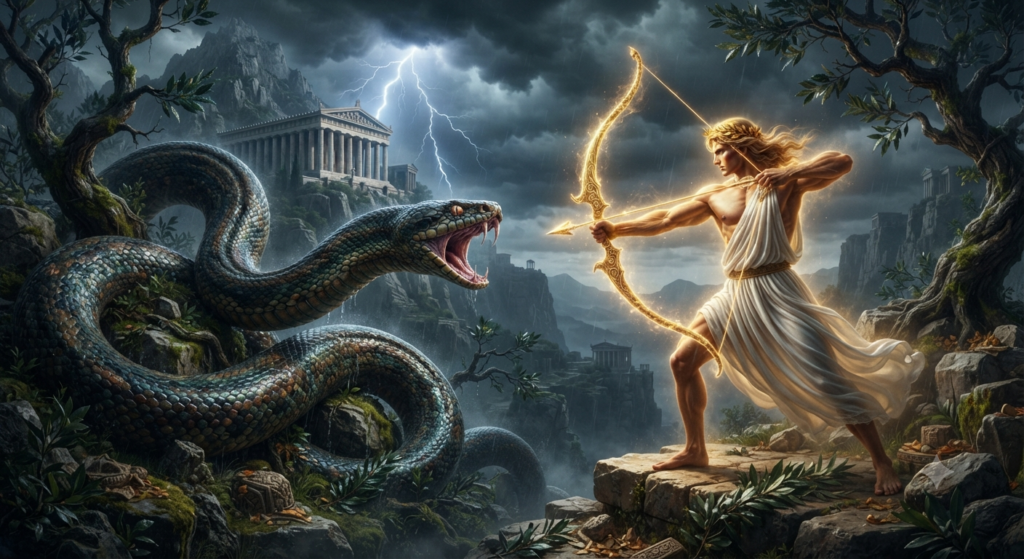
The Python of Delphi appears in Greek tradition as a monstrous serpent or dragon that guarded the sanctuary before Apollo claimed it. In the best-known version, Apollo arrives at Delphi and slays the creature with his arrows, an act that becomes one of the defining moments of his cult. The victory is remembered not simply as a heroic feat, but as a sacred conquest that establishes his right to speak through the oracle.
This triumph also gives Delphi a distinct religious character. Apollo’s victory over the Python symbolizes the triumph of order, clarity, and prophecy over an older, earth-bound power associated with the wild and the obscure. The sanctuary therefore becomes a place where divine speech passes through controlled ritual, but still retains traces of the older, more ancient holiness of the site.
Delphi as the center of Greek prophetic authority
Delphi occupied a singular place in the Greek imagination as the chief sanctuary of Apollo and the most respected oracle in the Hellenic world. Kings, city-states, colonists, and private petitioners all sought guidance there, and the sanctuary’s authority was expressed through the voice of the Pythia, the priestess who delivered Apollo’s answers. The myth of the Python helped justify that status by linking the site to a divine struggle whose outcome favored Apollo.
The oracle’s prestige rested not only on myth, but also on the way Greek communities treated Delphi as a pan-Hellenic religious center. Although many cities had local cults and seers, Delphi stood apart because its prophecies could shape political decisions, colonial foundations, and sacred law. The story of Apollo’s conquest of the Python gave a mythic foundation to that influence, presenting the sanctuary as a place won by the god himself.
Python in the early myths of the sanctuary
In early traditions, Python is not always described in the same way. Sometimes the creature is simply a serpent; at other times it is a giant dragon-like guardian of the oracle. The name itself is closely tied to Delphi’s older identity, and some ancient writers treat Python as native to the place rather than imported from elsewhere. This suggests a memory of a pre-Apollonian sacred landscape.
The creature’s role in myth is inseparable from the sanctuary’s antiquity. Python is often understood as a guardian of the earth’s powers, connected to the deep, prophetic knowledge that belonged to older divinities before Apollo’s arrival. In that sense, the serpent does not merely block a shrine; it represents a kind of primitive, chthonic authority that Apollo must confront and transform.
The Delphic oracle before Apollo’s arrival
Several ancient traditions imply that Delphi was sacred before Apollo became its master. The site was linked to earth goddesses and other early powers, and the oracle may once have belonged to Gaia, Themis, or another older divinity. This prehistory matters because it shows Delphi as a layered sanctuary, not a place created from nothing by Apollo.
The myth of Python preserves this memory in dramatic form. By defeating the serpent and inheriting the sanctuary, Apollo becomes the new guardian of a place that already possessed holiness. The story does not erase the older sacred order completely; instead, it incorporates it into Apollo’s cult, allowing the new god to rule where older powers had once spoken.
Slaying the serpent and claiming the shrine
The most familiar version of the myth tells how Apollo, still young, came to Delphi and killed Python with arrows. After the killing, he took control of the shrine and established his oracle there. In some accounts he did this to avenge his mother Leto, whom the serpent had pursued or threatened during her pregnancy; in others the motive is less personal and more territorial, centered on Apollo’s claim to sacred authority.
The slaying becomes a foundational act for the sanctuary. Apollo’s arrows are not only weapons but instruments of divine order, and the serpent’s death marks the transition from an older regime to a new one. Ancient authors often connect the event with ritual memory, including the Pythian Games, which are said to have commemorated Apollo’s victory over the Python and reinforced his cult at Delphi.
Gaia, Themis, and the older powers at Delphi
The older traditions of Delphi often involve Gaia, the Earth, and Themis, the divine order or law that governs cosmic and social balance. Some sources imply that the oracle originally belonged to Gaia before passing to Themis and then to Apollo. This sequence reflects a broader Greek pattern in which older earth-based powers are succeeded by Olympian gods while still retaining a place in the sacred memory of the site.
These figures matter because they show that Delphi was never imagined as purely Apollonian in origin. The sanctuary preserved traces of a deeper religious past, one tied to the earth, fertility, and ancestral wisdom. Apollo’s victory over Python therefore does not simply destroy the old powers; it reorganizes them within a new divine order, leaving Delphi as a place where old and new layers of worship coexist.
Versions of the myth in Homeric and later sources
Homer does not give a full, canonical version of the Python myth, but early Greek poetry already knows Delphi as an important sacred place of Apollo. Later authors provide fuller accounts. The Homeric Hymn to Apollo is especially important, describing Apollo’s arrival at Delphi and his establishment of the sanctuary after overcoming the serpent or dragon that guarded it. Apollodorus, in his Library, offers a more systematic mythological account, while Pausanias preserves local traditions and variations.
Ovid, writing in Latin, also recounts Apollo’s defeat of Python in the Metamorphoses, emphasizing the god’s youthful power and the fame he gains through the slaying. Across these sources, details differ: the serpent’s exact nature, the motive for the killing, and the identity of earlier divine owners are not always the same. What remains consistent is the basic mythic structure of Apollo claiming Delphi through the defeat of a primordial serpent.
How the Python myth shaped ritual at Delphi
The myth of Python was not just a story told about Delphi; it shaped how the sanctuary was remembered and celebrated. The Pythian Games, one of the major Panhellenic festivals, were associated with Apollo’s victory and were held in honor of the god at Delphi. Their very name points back to Python, keeping the serpent’s memory alive within the civic and religious life of the sanctuary.
Ritual also preserved the tension between Apollo’s bright order and the older, darker powers of the site. Ancient worship at Delphi included careful purification, sacrifice, and consultation, all of which reflected the seriousness of approaching a place once marked by primordial force. The myth helped frame these practices as appropriate responses to a sanctuary where divine speech had once been contested and then claimed by Apollo.
Serpent symbolism in Greek religious imagination
In Greek myth, serpents are rarely simple creatures. They can represent danger, guardianship, fertility, the earth, or hidden wisdom, depending on the context. Python belongs to this broader symbolic world, standing at the threshold between the living world and the deeper powers beneath it. Its association with Delphi makes it one of the most important serpents in Greek religious memory.
Apollo’s victory over the serpent also reveals an important pattern in Greek thought: gods and heroes often establish order by overcoming a creature tied to a more archaic sphere. Yet the serpent is not always evil in Greek myth, and that nuance matters. Python is not merely a monster to be eliminated; it is also a sign that Delphi once belonged to a different sacred logic, one rooted in the earth and in older forms of divine knowledge.
Why the Python of Delphi still matters today
The myth of the Python of Delphi remains important because it captures a central feature of Greek religion: sanctuaries were not static, but layered with memory, conflict, and change. Apollo’s victory over the serpent explains how Delphi became his oracle while preserving traces of a much older sacred past. It is a myth of replacement, but also of continuity, since the holiness of the site endures through the very act of conquest.
Modern readers still find the story compelling because it combines epic narrative with religious history. It speaks to the human tendency to explain authority through myth, and to the way cultures reimagine older sacred places through new divine rulers. At Delphi, the Python is the shadow beneath Apollo’s light: a reminder that even the most radiant oracle in Greek myth rose from an older, darker depth.
The myth of the Python of Delphi is ultimately a story about sacred succession. Apollo’s defeat of the serpent marks his claim to the most famous oracle in Greece, yet the older earth powers never disappear entirely from the sanctuary’s memory. Delphi endures in myth as a place where ancient holiness, divine struggle, and prophetic speech meet, and the Python remains central to understanding why the shrine of Apollo mattered so deeply in the Greek world.

Orin Vale has spent the better part of two decades tracing the threads that connect the world’s oldest stories — from the halls of Asgard to the banks of the Nile, from Olympus to the jungles of the Maya. What began as a childhood fascination with flood myths and trickster gods grew into years of independent study across comparative mythology and ancient religion, always chasing the same question: what did these stories mean to the people who first told them? Orin writes for readers who want more than trivia — the ones looking for the beliefs, fears, and truths that myths were built to carry.